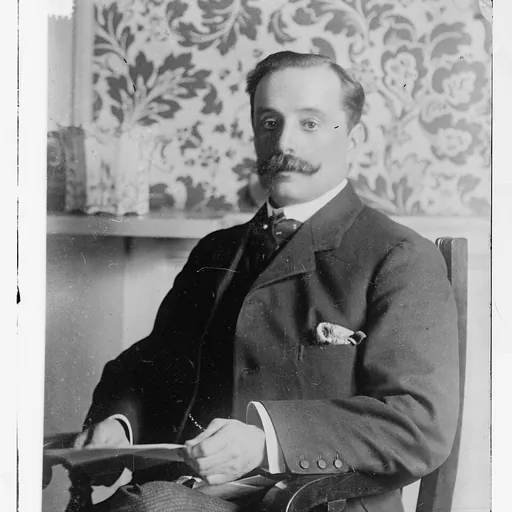
About Sir Charles Hobhouse, 4th Baronet
Lived 1862 – 1941 (aged 78). Sir Charles Hobhouse, 4th Baronet was a British politician.
Sir Charles Edward Henry Hobhouse, 4th Baronet, TD, PC, JP (30 June 1862 – 26 June 1941) was a British Liberal politician and officer in the Territorial Force. He was a member of the Liberal cabinet of H. H. Asquith between 1911 and 1915, and kept a diary, since published, of his time in the Cabinet.
Background and education He was the third child and only son of Sir Charles Parry Hobhouse, 3rd Baronet, and his wife Edith Lucy Turton, daughter of Sir Thomas Turton, 2nd Baronet, born at Dormansland, Surrey. He was educated at Eton College, and matriculated at Christ Church, Oxford in 1880. He then attended the Royal Military College, Sandhurst.
Military career Hobhouse was commissioned from Sandhurst as a lieutenant in the King's Royal Rifle Corps (KRRC) on 23 August 1884, However, he became a captain in the part-time 7th Battalion, KRRC, (the Royal 2nd Middlesex Militia) on 17 April 1897. When a new 3rd Volunteer Battalion of the Gloucestershire Regiment was formed in Bristol during the Second Boer War, he was commissioned as a major in the unit, succeeding to its command with the rank of lieutenant-colonel on 5 April 1903. He continued in that role when the battalion became the 6th Battalion, Gloucestershire Regiment in the Territorial Force in 1908. Hobhouse retired from the command on 5 April 1911, but on the death of the 6th Gloucesters' Honorary Colonel, Earl Roberts, shortly after the outbreak of World War I, he was appointed to succeed him on 24 December 1914. Hobhouse continued to be the 6th Gloucesters' Hon Colonel for the rest of his life, the battalion being converted into 44th Royal Tank Regiment in 1938.
Political career Hobhouse's first attempt to get elected was at North Buckinghamshire. He was Liberal Member of Parliament for Devizes between 1892 and 1895 and for Bristol East between 1900 and 1918. He was a Parliamentary Private Secretary at the Colonial Office from 1892 to 1895 and a Church Estates Commissioner from 1906 to 1907.
Hobhouse was appointed to his first ministerial post in 1907 when Sir Henry Campbell-Bannerman made him Under-Secretary of State for India. The Hobhouse Commission he headed recommended a cautious expansion of the panchayat raj system in Indian villages. The commission's report influenced later legislation for India. He was a member of Asquith's cabinet as Chancellor of the Duchy of Lancaster between 1911 and 1914 and as Postmaster-General between 1914 and May 1915 when Asquith's Liberal government was replaced by a coalition in which Hobhouse did not hold office.
Hobhouse, told by his doctors that he had only months to live, retired from active politics in October 1915 (the last published entry in his diary is 14 October, followed by a letter to Asquith the following day thanking him for his kindness in promoting his career). However on the operating table what had been thought to be a growth was found to be merely “a large stoppage” and he resumed limited political activity thereafter.
Apart from his career in national politics, Hobhouse was an Alderman on Wiltshire County Council from 1893 to 1924. He succeeded his father as fourth Baronet in 1916. At the Coupon election in 1918 he lost his seat, as did Asquith, and the leading former Liberal Cabinet ministers McKenna, Runciman, Simon, Samuel and McKinnon Wood. Hobhouse became the first former Cabinet minister to suffer the embarrassment of losing his deposit, deposits being a measure just introduced to discourage “freak” candidates.
In 1922 Hobhouse stood again in North Buckinghamshire but again came third, behind both Conservative and Labour.
Don’t just read it —
keep it.
Full-length biographies made to live with: read them, listen on the way to work, watch them tonight.
- E-book
- Audio
- Video
Instant download · yours to keep · every purchase keeps this site free
Important facts
People in Sir Charles Hobhouse, 4th Baronet's life
Named in this biography and alive at the same time

Related people
Same field, nearest in time



Contemporaries
People whose lives overlapped Sir Charles Hobhouse, 4th Baronet's


Frequently asked questions
Who was Sir Charles Hobhouse, 4th Baronet?
British politician (1862-1941)
When was Sir Charles Hobhouse, 4th Baronet born?
Sir Charles Hobhouse, 4th Baronet was born on 30 June 1862.
When did Sir Charles Hobhouse, 4th Baronet die?
Sir Charles Hobhouse, 4th Baronet died on 26 June 1941 in Monkton Farleigh.
What was Sir Charles Hobhouse, 4th Baronet's occupation?
Sir Charles Hobhouse, 4th Baronet was a politician.
What nationality was Sir Charles Hobhouse, 4th Baronet?
Sir Charles Hobhouse, 4th Baronet was British.
Sources & further reading
· Wikipedia: Sir Charles Hobhouse, 4th Baronet
Cite this page
APA: Biography.guide. (2026). Sir Charles Hobhouse, 4th Baronet. https://biography.guide/sir-charles-hobhouse-4th-baronet/
MLA: "Sir Charles Hobhouse, 4th Baronet." Biography.guide, https://biography.guide/sir-charles-hobhouse-4th-baronet/.
Chicago: "Sir Charles Hobhouse, 4th Baronet." Biography.guide. https://biography.guide/sir-charles-hobhouse-4th-baronet/.
Data last updated: 2026-09-30 · Spot an error? Report a correction.
Portrait: Wikimedia Commons · author & licence
Page generated 2026-10-04 14:22 UTC