
About Sir Archibald Campbell, 1st Baronet
Lived 1769 – 1843 (aged 74). Sir Archibald Campbell, 1st Baronet was a British military personnel.
Heraldic achievement of the Campbell Baronets of Nova Scotia, as displayed on the memorial of Major General Sir John Campbell, 2nd Baronet (1807–1855) in Winchester Cathedral.
Sir Archibald Campbell, 1st Baronet, (12 March 1769 – 6 October 1843) was a British army officer. From 1824 to 1826, Gen. Campbell commanded the British forces in the First Anglo-Burmese War, the longest and most expensive war in British Indian history, that gave the British control of Assam, Manipur, Cachar, Jaintia, Arakan and Tenasserim. He became known as the "Hero of Ava". From 1831 to 1837, he was the administrator of the colony of New Brunswick, Canada. The Canadian city of Campbellton in the province of New Brunswick was named in his honour.
Early life Archibald was born 12 March 1769, at Glen Lyon, Perthshire, and educated at Tonbridge School, Kent, England. He was the third son of Captain Archibald Campbell and his wife Margaret Small of Dirnanean, daughter of Captain James Small, factor of the forfeited estates of the Robertsons of Struan. Archibald was a descendant of the Robertsons through his maternal great-grandmother, Magdalen Robertson, Archibald's great-grandfather on his father's side, Duncan Campbell 2nd Laird of Duneaves, Perthshire, was a first cousin of Robert Campbell, 5th of Glenlyon. One of Archibald's maternal great-uncles was Major-General John Small who fought in the American Revolutionary War and later became Lieutenant Governor of Guernsey. Archibald grew up at Carie, formerly part of the Robertson estate on the south shore of Loch Rannoch within the parish of Logierait.
Military career
Early career Campbell entered the army aged 18, in 1787 as an ensign. The next year he and his regiment, the 77th Regiment of Foot, left for India, where he took part in the campaign against Tipu Sultan in 1790. In 1791 he was promoted to Lieutenant. He served in the Mysore campaign and the first siege of Seringapatam.
In 1795 his regiment was ordered to reduce the Dutch garrison (Fort Stormsburg) of Cochin on the coast of Malabar. In 1799 he took part of the reduction of the island of Ceylon.
Later in 1799 he purchased the rank of captain in the 67th but exchanged into the 88th so that he could continue with his foreign service. However, he was required by ill-health to return home in 1801. He was appointed major in the 6th battalion of reserve, stationed in Guernsey.
He moved in 1805 to the 1st battalion which was leaving for Portugal. He fought in the battles of Roliça, Vimeiro and Corunna. In 1809 he was promoted to lieutenant-colonel and assisted General Beresford in organising the Portuguese army. In that capacity he was made full colonel and then brigadier. He was present through most of the fighting in the Peninsula.
In 1813 Campbell was appointed to the rank of major-general in the Portuguese army. In 1816 he was given command of the Lisbon division. He returned to the service of Britain in 1820, after a revolution in Portugal. Campbell was appointed colonel of the 38th Regiment of Foot (in which post he was succeeded by Field Marshal Sir John Forster FitzGerald, GCB) and went to India with it. For his Peninsula service, Campbell was awarded the Army Gold Cross with one clasp for the battles of Albuera, Vitoria, the Pyrenees, the Nivelle, and the Nive.
First Anglo-Burmese War (1824–1826)
Battle of Yangon (May–December 1824) In India, General Campbell was directed to take command of an expedition against the Burmese in the First Anglo-Burmese War. In May 1824, he led a British naval force of over 10,000 men (5000 British soldiers and over 5000 Indian sepoys) to Yangon (Rangoon), and took the deserted city with little resistance on 11 May 1824. After fortifying the Shwedagon Pagoda compound, Campbell launched attacks on Burmese lines, and by July 1824, had successfully pushed the Burmese towards Kamayut, from the Shwedagon, then successfully repelled Burmese efforts to retake the city in September.
In December 1824, Campbell and his 10,000 men decisively defeated the 15,000 strong Burmese forces led by General Maha Bandula in the final battle of Yangon. Thousands of Burmese soldiers were cut down under British gunfire and exploding Congreve rocket fire. Only 7000 of the 15,000 survived.
March to Upper Burma and Victory (January–February 1826) With the Burmese army in disarray, Campbell marched north to Upper Burma, and took the ancient capital of Pagan (Bagan) in early February 1826. After Campbell's forces took the village of Yandabo, about from the capital Ava (Innwa), on 16 February, the Burmese finally agreed to full British demands "without discussion". As the chief commander of British forces, Campbell was the lead signatory of the Treaty of Yandabo on the British side. The Burmese agreed to cede to the British Assam, Manipur, Arakan and Tenasserim; stop all interference in Cachar and Jaintia; and pay an indemnity of one million pounds sterling. In 1839 he was made Commander-in-chief in Bombay but did not enjoy the post for long due to ill-health.
Lieutenant-governor Campbell returned to England in 1829 and was given the colonelcy of the 95th (Derbyshire) Regiment of Foot (1828–1834). In 1831 he was made Lieutenant Governor of New Brunswick, where he stayed for six years (1831–1837). Campbell was concerned for the safety of New Brunswick. For this reason he began the construction of a road, known as the "Royal Road", from Fredericton to Grand Falls, so as to improve the movement of troops into the northern part of the colony where the Americans had become a threat. The Canadian city of Campbellton in the province of New Brunswick was named in his honour.
In 1834 he transferred as Colonel to the 77th (East Middlesex) Regiment of Foot and in 1840 transferred again to be Colonel of the 62nd (Wiltshire) Regiment of Foot, holding the latter post until his death in 1843 at age 74.
Family Garth House, Fortingall. The home of Sir Archibald and Lady Helen (MacDonald) Campbell
Archibald Campbell married Helen MacDonald, a sister of John MacDonald of Garth, on 6 July 1801 at Marylebone, London. She was also the sister of Mrs William McGillivray, née Magdalen MacDonald.
One of his sons-in-law was his aide-de-camp, Lt. Col John James Snodgrass. Another son-in-law was General The Hon. Sir Augustus Almeric Spencer, G.C.B.,
Granddaughter Laura Augusta Mackenzie Douglas married Donald Mackenzie the son of Donald Mackenzie, stylised Lord Mackenzie, a Senator of the College of Justice, Edinburgh, Scotland. A second granddaughter, Helen Maria Mackenzie Douglas, married another of Mackenzie's sons, Andrew Mitchell Mackenzie. He is buried on one of the southern terraces, at its western end.
Sir Archibald's son, Sir John Campbell, 2nd Baronet succeeded to the baronetcy upon his death.
Knight level on 1815 Knight Grand Cross level on 1826
Don’t just read it —
keep it.
Full-length biographies made to live with: read them, listen on the way to work, watch them tonight.
- E-book
- Audio
- Video
Instant download · yours to keep · every purchase keeps this site free
Important facts
People in Sir Archibald Campbell, 1st Baronet's life
Named in this biography and alive at the same time
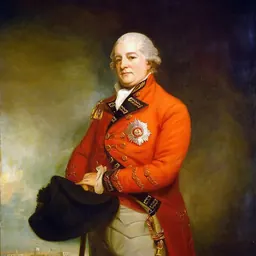

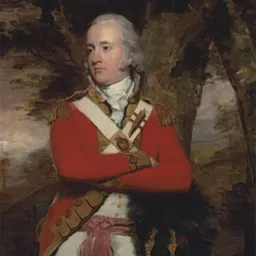


Related people
Same field, nearest in time
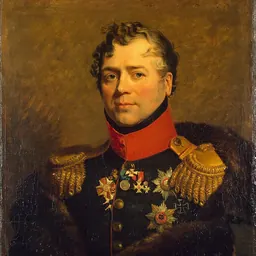

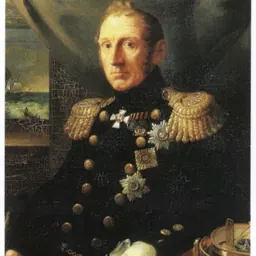

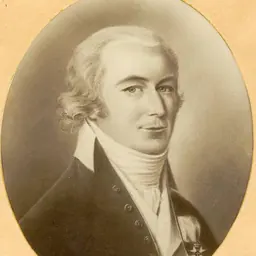
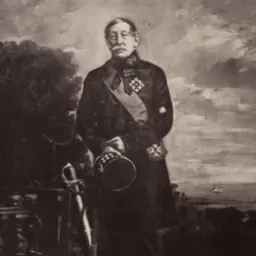
Contemporaries
People whose lives overlapped Sir Archibald Campbell, 1st Baronet's



Frequently asked questions
Who was Sir Archibald Campbell, 1st Baronet?
British Army general
When was Sir Archibald Campbell, 1st Baronet born?
Sir Archibald Campbell, 1st Baronet was born on 12 March 1769 in Glen Lyon.
When did Sir Archibald Campbell, 1st Baronet die?
Sir Archibald Campbell, 1st Baronet died on 6 October 1843 in Edinburgh.
What was Sir Archibald Campbell, 1st Baronet's occupation?
Sir Archibald Campbell, 1st Baronet was a military personnel.
What nationality was Sir Archibald Campbell, 1st Baronet?
Sir Archibald Campbell, 1st Baronet was British.
Sources & further reading
· Wikipedia: Sir Archibald Campbell, 1st Baronet
· DBpedia: Sir Archibald Campbell, 1st Baronet
Cite this page
APA: Biography.guide. (2026). Sir Archibald Campbell, 1st Baronet. https://biography.guide/sir-archibald-campbell-1st-baronet/
MLA: "Sir Archibald Campbell, 1st Baronet." Biography.guide, https://biography.guide/sir-archibald-campbell-1st-baronet/.
Chicago: "Sir Archibald Campbell, 1st Baronet." Biography.guide. https://biography.guide/sir-archibald-campbell-1st-baronet/.
Data last updated: 2026-09-25 · Spot an error? Report a correction.
Page generated 2026-09-27 05:11 UTC