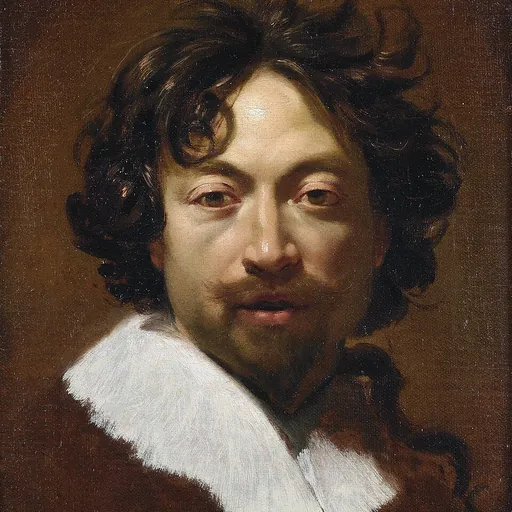
About Simon Vouet
Lived 1590 – 1649 (aged 59). Simon Vouet was a French painter, draftsperson, architectural drafter and visual artist.
Simon Vouet (; 9 January 1590 – 30 June 1649) was a French painter who studied and rose to prominence in Italy before being summoned by Louis XIII to serve as Premier peintre du Roi in France. He and his studio of artists created religious and mythological paintings, portraits, frescoes, tapestries, and massive decorative schemes for the king and for wealthy patrons, including Cardinal Richelieu. During this time, "Vouet was indisputably the leading artist in Paris," and was immensely influential in introducing the Italian Baroque style of painting to France. He was also, according to Pierre Rosenberg, "without doubt one of the outstanding seventeenth-century draughtsmen, equal to Annibale Carracci and Lanfranco."
A major international exhibition of Vouet's work is planned for 2027, co-organized by the Musée du Petit Palais in Paris and the Legion of Honor museum in San Francisco.
Career Simon Vouet was born on January 9, 1590, in Paris. His father Laurent was a painter in Paris and taught him the rudiments of art. Simon's brother Aubin Vouet was also a painter, as also was Simon's wife Virginia da Vezzo, their son Louis-René Vouet, their two sons-in-law, Michel Dorigny and François Tortebat, and their grandson Ludovico Dorigny.thumbnail Virginia da Vezzo, the Artist's Wife, as the Magdalen (c. 1627), LACMA
Simon began his career as a portrait painter. At age 14 he travelled to England to paint a commissioned portrait and in 1611 was part of the entourage of the Baron de Sancy, French ambassador to the Ottoman Empire, for the same purpose. From Constantinople he went to Venice in 1612 and was in Rome by 1614.
David with the Head of Goliath (1620–1622), Palazzo Bianco, GenoaHe remained in Italy until 1627, mostly in Rome where the Baroque style was becoming dominant. He received a pension from the King of France and his patrons included the Barberini family, Cassiano dal Pozzo, Paolo Giordano Orsini and Vincenzo Giustiniani.
Vouet's immense success in Rome led to his election as president of the Accademia di San Luca in 1624. His most prominent official commission of the Italian period was an altarpiece for St Peter's in Rome (1625–1626), destroyed at some time after 1725 (though fragments remain.)
Judith with the Head of Holofernes (c. 1624–1626) painted by Virginia da Vezzo, the first wife of Simon Vouet, at the Musée des Beaux-Arts de NantesIn response to a royal summons, Vouet returned to France in 1627, where he was made Premier peintre du Roi. Louis XIII commissioned portraits, tapestry cartoons and paintings from him for the Palais du Louvre, the Palais du Luxembourg and the Château de Saint-Germain-en-Laye. In 1632, he worked for Cardinal Richelieu at the Palais-Royal and the Château de Malmaison. In 1631 he decorated the château of the président de Fourcy, at Chessy, the hôtel Bullion, the château of Marshal d'Effiat at Chilly, the hôtel of the Duc d’Aumont, the Séguier chapel, and the gallery of the Château de Wideville.
Today, a number of Vouet's paintings are lost, and "only two major decorative schemes survive, those for the chateaux of Colombes and Chessy,"
Though never entirely forgotten by connoisseurs and collectors (such as William Suida), Vouet fell into a relative obscurity that was not remedied until William R. Crelly's monograph of 1962, and catalogue, which Brejon de Lavergnée says fulfilled "its aim of rehabilitating the artist."
The exhibition's organizer, Jacques Thuillier, "is surely justified in claiming the altarpiece of the Presentation of Jesus in the Temple as among the greatest masterpieces of seventeenth-century monumental painting," writes Brejon de Lavergnée, who further asserts that in the artist's works of the 1640s, such as Saint Francis of Paola Resuscitating a Child, "one can see Vouet concluding his career with pictures of an immense gravity informed by an intense spiritual energy. Images of the greatest force, these paintings constitute the apogee of French seventeenth-century painting."
Works Paintings Crelly's catalogue raisonné of 1962 lists more than 150 preserved paintings by Vouet. Since that publication, "a number of paintings, some of them of considerable importance, have turned up in various parts of the world and the list of his work continues to grow." A new catalogue raisonné, by Arnauld and Barbara Brejon de Lavergnée, is forthcoming. This is a partial list by present location, and then, as possible, by date.
Louvre, Paris Prince Marcantonio Doria d'Angri (1621) Saint William of Aquitaine (1622–1627) The Holy Family with St Elisabeth and the Infant St John the Baptist (1625–1650) Woman Wearing a White Veil (1630s) Allegory of Wealth (c. 1635–1640) Allegory of Charity (1630–1635) Gaucher de Châtillon (1632–1635) Allegory of Virtue (c. 1634) Heavenly Charity (c. 1640) Presentation of Jesus in the Temple (1641) Hesselin Madonna or Madonna of the Oak Cutting (c.1640–1645) Portrait of Louis XIII between two female figures symbolising France and Navarre (1643) Portrait of a Young Man Polymnia, Muse of Eloquence
Elsewhere in France Presumed portrait of Aubin Vouet, the artist's brother (c. 1620), Musée Réattu, Arles Anges portant les instruments de la Passion (1625), Musée des Beaux-Arts et d'Archéologie de Besançon Cupid and Psyche (1626–1629), Musée des Beaux-Arts de Lyon Self-portrait (1626–1627), Musée des Beaux-Arts de Lyon Suite of the loves of Rinaldo and Armida (1631), based on Tasso's epic poem Jerusalem Delivered, collection of Guyot de Villeneuve, Paris Repentant Magdalen (1633), Musée de Picardie, Amiens Ceres Trampling the Attributes of War (1635), Musée des Beaux-arts Thomas Henry, Cherbourg-Octeville Deposition of Christ (c.1635), Musée d'art moderne André Malraux, Le Havre Lot and his Daughters (1633), Musée des Beaux-Arts de Strasbourg, subject of a special exhibit in 2005–2006 Crucifixion (1636–1637), Musée des Beaux-Arts de Lyon The Four Cardinal Virtues—Allegory of Temperance, Allegory of Force, Allegory of Prudence, Allegory of Justice (1638), Salon de Mars, Versailles Death of Dido (c. 1641), Musée des Beaux-Arts de Dole Time Vanquished by Love, Venus and Hope (1640–1645), Musée des Arts Décoratifs, Bourges Allégorie de la Charité (1640–1645; possibly a studio work), Musée d'Art et d'Histoire de Draguignan Last Supper, Musée des Beaux-Arts de Lyon
Italy Mary Magdalene (1614–1615), Quirinal Palace, Rome Angel with Dice and Tunic and Angel with Spear of the Passion (1615–1625), Museo di Capodimonte, Naples Last Supper (1616–1620), Palazzo Comunale, Loreto Crucifixion (1621–6122), Chiesa del Gesù, Genoa Young Man with a ruff (1620), Luigi Koeliker Collezione, Milano David with the Head of Goliath (1620–1622), Palazzo Bianco, Genoa Nativity of the Virgin (c. 1629), San Francesco a Ripa, Rome Annunciation (c. 1621–1622), Uffizi, Florence Circumcision of Jesus (1622), Museo di Capodimonte, Naples Portrait of Artemisia Gentileschi with Painting Implements (c. 1623–1625), private collection Temptation of Saint Francis and Saint Francis Renouncing His Goods (1624–1625), San Lorenzo in Lucina, Rome Saint Agatha's Vision of Saint Peter in Prison (c. 1625), Palazzo Abatellis, Palermo
Elsewhere in Europe The Annunciation (n.d.), Pushkin Museum, Moscow Lovers (1614–1618), Pushkin Museum, Moscow Judith (1620–1622), Kunsthistorisches Museum, Vienna The Ill-Matched Couple (Vanitas) (c. 1621), National Museum, Warsaw Sophonisba Receiving the Poisoned Chalice (c. 1623), Gemäldegalerie Alte Meister, Dresden Time Vanquished by Love, Beauty and Hope (1627), Prado, Madrid Diana (1637), Cumberland Gallery, Hampton Court Palace, England Sleeping Venus (1630–1640), Museum of Fine Arts, Budapest Parnassus, or Apollo and the Muses (c. 1640) Museum of Fine Arts, Budapest The Rape of Europa (1640), Thyssen-Bornemisza Museum, Madrid Artemisia Building the Mausoleum (early 1640s), Nationalmuseum, Stockholm Judith, Alte Pinakothek, Munich Saint Jerome (c.1620), National Library of Wales, Wales
United States Saint Agnes (c. 1615), Blanton Museum of Art, Austin The Halberdier (c. 1615–1620), Dayton Art Institute Woman Playing a Guitar (c. 1618), Metropolitan Museum of Art, New York Portrait of a Gentleman (c. 1620), Blanton Museum of Art, Austin Saint Luke and Saint John (1622–1625), Philadelphia Museum of Art Saint Jerome and the Angel (c. 1622–1625), National Gallery of Art, Washington, D.C. Two Modelli for Altarpiece in St. Peter's (1625), LACMA, Los Angeles Saint Sebastian (c. 1625), Museum of Fine Arts, Houston The Holy Family with the Infant Saint John the Baptist (1626), Legion of Honor, San Francisco Saint Cecilia (c. 1626), Blanton Museum of Art, Austin Salome (1626–1627), Crocker Art Museum, Sacramento Angels with Attributes of the Passion: Angel Holding the Vessel and Towel for Washing the Hands of Pontius Pilate and Angel with the Superscription from the Cross (1627), Minneapolis Institute of Arts Virginia da Vezzo, the Artist's Wife, as the Magdalen (c. 1627), LACMA, Los Angeles Saint Mary Magdalen (c. 1630), Cleveland Museum of Art Diana and Endymion and Neptune and Amphitrite (1630s), (c. 1620–1684), Legion of Honor, San Francisco
Gallery: Images of Vouet and his family
Don’t just read it —
keep it.
Full-length biographies made to live with: read them, listen on the way to work, watch them tonight.
- E-book
- Audio
- Video
Instant download · yours to keep · every purchase keeps this site free
Important facts
more
Monsù Simon Vouet, Monsù Simon de Bue, Simone Boet, Simon Ovetti, Simone Vovet, Monsu Simon Ovett, Monsu Simon Guetta, Monsu Simon de Bue, Monsu Simon Guet, Monsu Simon Vouet, Monsu Vovet, Simon Voet, Monsu Ovet, Simone Wouet, Simon Voét, Monsu Vouet, D. Vouet, Voyett, Symon Vouët, monsu oveto, Vouetto, Simone Ovet, Simon Woet, Munsù Vet francese, Simon Wovest, monsù Vonetti, Le Vouet, francese SimonPeople in Simon Vouet's life
Named in this biography and alive at the same time

Related people
Same field, nearest in time

Contemporaries
People whose lives overlapped Simon Vouet's



Frequently asked questions
Who was Simon Vouet?
French painter (1590-1649)
When was Simon Vouet born?
Simon Vouet was born on 9 January 1590 in Paris.
When did Simon Vouet die?
Simon Vouet died on 30 June 1649 in Paris.
What was Simon Vouet's occupation?
Simon Vouet was a painter, draftsperson, architectural drafter and visual artist.
What nationality was Simon Vouet?
Simon Vouet was French.
Sources & further reading
Cite this page
APA: Biography.guide. (2026). Simon Vouet. https://biography.guide/simon-vouet/
MLA: "Simon Vouet." Biography.guide, https://biography.guide/simon-vouet/.
Chicago: "Simon Vouet." Biography.guide. https://biography.guide/simon-vouet/.
Data last updated: 2026-09-23 · Spot an error? Report a correction.
Portrait: Wikimedia Commons · author & licence
Page generated 2026-09-27 05:07 UTC