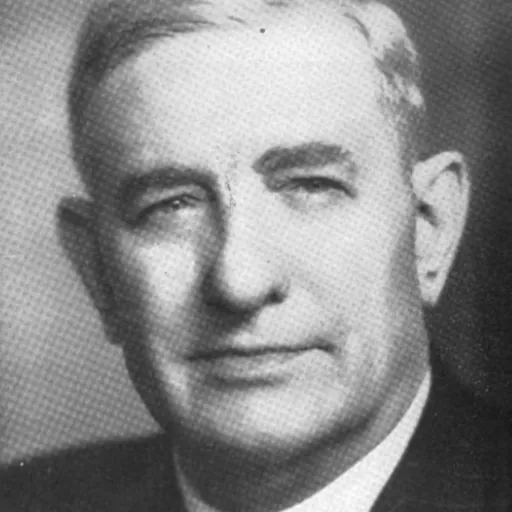
About Simeon S. Willis
Lived 1879 – 1965 (aged 85). Simeon S. Willis was an American lawyer and judge.
Simeon Slavens Willis (December 1, 1879 – April 1, 1965) was an American attorney who served as the 46th governor of Kentucky, United States, serving from 1943 to 1947. He was the only Republican elected governor of Kentucky from 1927 (The departure of Flem D. Sampson) to 1967 (The inauguration of Louie Nunn).
Willis's family came to Kentucky from Ohio about 1889. After briefly working in the education and journalism fields, Willis read law with private tutors and was admitted to the bar in 1901. He became interested in politics, but his early races for office were unsuccessful with the exception of his four-year stint as city solicitor for Ashland, Kentucky. Finally in 1927, newly elected governor Flem D. Sampson appointed Willis to the Kentucky Court of Appeals—then the court of last resort in the state. Willis went on to win a full four-year term on the court in 1928, and distinguished himself by revising Thornton on the Law of Oil and Gas, a six-volume law reference. He was defeated for re-election to his seat in 1932 and returned to his law practice.
After a decade out of politics, Willis was chosen without opposition as the Republican gubernatorial nominee in 1943. Infighting among the state's Democrats, combined with Willis's popular proposal to eliminate the state income tax, carried him to a narrow victory over J. Lyter Donaldson. Willis was opposed by Democratic majorities in both houses of the Kentucky General Assembly. The end of World War II in 1945 brought sizable budget surpluses to the state, and disagreements over how to spend the excess funds spilled over into special legislative sessions. Willis was not able to realize his campaign promise of eliminating the state income tax because the legislature expanded the budget far beyond what he proposed. But he did forge a record of modest accomplishments, including constructing five tuberculosis hospitals across the state and significantly increasing funding for education. Following his term as governor, he served on various state boards and commissions, but failed in his only attempt to return to elective office—a 1952 campaign against Bert T. Combs to return to the Court of Appeals. Willis died on April 1, 1965, and is interred at Frankfort Cemetery in the capital city of Frankfort.
Early life Simeon S. Willis was born on December 1, 1879, in Lawrence County, Ohio, which is located along the Ohio River on the southern border of the state. He was the youngest of nine children born to John H. and Abigail (Slavens) Willis. During the Civil War, his grandfather William Willis served as captain of Company C of the 5th West Virginia Infantry of the Union Army, and his father John H. Willis served as a corporal in that company. Later, John Willis moved to eastern Ohio, where he became a pioneer in the charcoal industry.
Willis was educated in the public schools of Lawrence County. Soon after, he joined Hager and Stewart, a prominent law firm in the area, where he worked for six years. He took a brief leave of politics and served as an appeals agent for the Selective Service System during World War I. Ida Willis became the first female executive director of the Kentucky Heritage Commission. In 1979, the Ida Lee Willis Memorial Foundation was created in her honor.
When Flem D. Sampson was elected governor in 1927, he appointed Willis to fill his seat on the Kentucky Court of Appeals. Willis's decade-long absence from politics worked to his advantage, as he had few ties to the state's established politicians and little in the way of a recent political track record that could be exploited by his opponent. He further proposed abolition of the state income tax, a proposal that was popular with voters, but was derided by the Democratic-leaning Louisville Courier-Journal as a "weird unreality".
Willis won the general election by a vote of 279,144 to 270,525. Further, factionalism in the Democratic party had hurt Donaldson. Though he enjoyed the support of sitting governor Keen Johnson, Donaldson garnered only lukewarm support from Johnson's predecessor, Senator A. B. "Happy" Chandler.
Governor John W. Bricker of Ohio, who did become the Republican vice-presidential nominee in 1944, had helped Willis in his gubernatorial race. Upon Willis' victory, Bricker wired a friend to express jubilation, which turned out to have been unfounded: "Election showed definite trend in all areas against New Deal. I was not surprised at the outcome particularly in Kentucky because the thinking of the people of the Middle West is in line with results down there. It looks very much like a Republican victory next year."
Willis faced the challenge of having Democratic majorities in both houses of the General Assembly and strong Democratic leadership in each. In the House, Democrats held a 56–44 majority, and Harry Lee Waterfield served as Speaker of the House. The state budget was $31 million when Willis took office; by the time he left office, it had expanded to $52 million.
Other accomplishments of Willis's administration included eliminating tolls on twelve of the state's thirteen major bridges, and expanding programs for dependent children and the elderly. In the 1947 gubernatorial election, the party fragmented over their choice of gubernatorial nominee, and Democrat Earle C. Clements was elected governor.
Later political career Following his term as governor, Willis returned to his private practice in Ashland. In 1952, he failed in his bid to return to the Court of Appeals, having lost to Bert T. Combs, who later was elected as governor. From 1956 to 1960, Willis served as a member of the Kentucky Public Service Commission.
In 1958, he received a citation for outstanding service to the state bar. In 1961, he was appointed to the review board authorized by the Veterans' Bonus Act. Also in 1961, he was appointed to the State Parole Board, a position he held until 1965.
Willis died on April 2, 1965, and is buried at the Frankfort Cemetery in the state capital. The Simeon Willis Memorial Bridge over the Ohio River in Ashland is named in his honor.
Don’t just read it —
keep it.
Full-length biographies made to live with: read them, listen on the way to work, watch them tonight.
- E-book
- Audio
- Video
Instant download · yours to keep · every purchase keeps this site free
Important facts
People in Simeon S. Willis's life
Named in this biography and alive at the same time





Related people
Same field, nearest in time

Contemporaries
People whose lives overlapped Simeon S. Willis's




Frequently asked questions
Who was Simeon S. Willis?
American lawyer and politician (1879-1965)
When was Simeon S. Willis born?
Simeon S. Willis was born on 1 December 1879 in Aid Township.
When did Simeon S. Willis die?
Simeon S. Willis died on 2 April 1965 in Frankfort.
What was Simeon S. Willis's occupation?
Simeon S. Willis was a lawyer and judge.
What nationality was Simeon S. Willis?
Simeon S. Willis was American.
Sources & further reading
Cite this page
APA: Biography.guide. (2026). Simeon S. Willis. https://biography.guide/simeon-s-willis/
MLA: "Simeon S. Willis." Biography.guide, https://biography.guide/simeon-s-willis/.
Chicago: "Simeon S. Willis." Biography.guide. https://biography.guide/simeon-s-willis/.
Data last updated: 2026-09-22 · Spot an error? Report a correction.
Portrait: Wikimedia Commons · author & licence
Page generated 2026-09-27 05:01 UTC