
About Siegfried Guggenheim
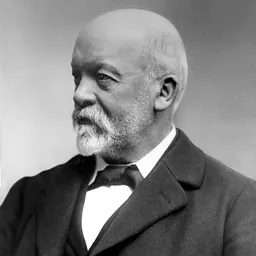
Lived 1873 – 1961 (aged 87). Siegfried Guggenheim was a German and American notary, lawyer, jurist, opinion journalist, art collector and philanthropist.
Siegfried Guggenheim (1873–1961) was a German lawyer, notary and art collector. He emigrated from Germany to the United States in 1938 due to fear of persecution due to his Jewish faith.
Biography Guggenheim was born to Jewish parents in 1873. His father was a merchant. In 1900, he became the jurist doctorate in Offenbach, working as a lawyer. In 1919, he became a notary public order. Guggenheim was heavily engaged in Offenbach's cultural and social life and was a member of many organizations. He enjoyed fine arts and Jewish culture. He was a patron to the artist Rudolf Koch. From Guggenheim's patronage emerged two great works: The Offender Haggadah tapestries, which can be found in the Klingspor Museum, and the so-called Offenbacher Haggadah, a tapestry by Fritz Kredel.
He also participated in the lively Jewish life. He was a member of the Central Association of German citizens of Jewish faith, and from 1933 to 1939 chairman of the Offenbach Jewish community. He initiated 1912 with Max Goldschmidt, the then chairman of the Jewish community, the construction of a synagogue in Offenbach.
With the seizure of power by the Nazis in 1933, his notary license was withdrawn. In November 1938, Guggenheim lost his license to practice law. He was deported to the Buchenwald concentration camp on November 9, 1938, making him a victim of Kristallnacht. After a few weeks he was released in December under the condition that he must leave Germany. Later that month, he emigrated with his wife, Eugenie (1878-1984) to Flushing, New York. Their German citizenship was officially withdrawn in 1941. The Guggenheim's correspondence with the Frankfurt journalist and social worker Martha Wertheimer during their stay in the United States survived the war.
In 1948, the city of Offenbach appointed Siegfried Guggenheim an honorary citizen and named a street after him. Siegfried Guggenheim died in 1961, while his wife outlived him, dying in 1984. Both he and his wife were cremated after their deaths and their urns were buried in Offenbach.
Don’t just read it —
keep it.
Full-length biographies made to live with: read them, listen on the way to work, watch them tonight.
- E-book
- Audio
- Video
Instant download · yours to keep · every purchase keeps this site free
Important facts
People in Siegfried Guggenheim's life
Named in this biography and alive at the same time



Related people
Same field, nearest in time




Contemporaries
People whose lives overlapped Siegfried Guggenheim's



Frequently asked questions
Who was Siegfried Guggenheim?
German notary (1873–1961)
When was Siegfried Guggenheim born?
Siegfried Guggenheim was born on 12 October 1873 in Worms.
When did Siegfried Guggenheim die?
Siegfried Guggenheim died on 30 January 1961 in Flushing.
What was Siegfried Guggenheim's occupation?
Siegfried Guggenheim was a notary, lawyer, jurist, opinion journalist, art collector and philanthropist.
What nationality was Siegfried Guggenheim?
Siegfried Guggenheim was German and American.
Sources & further reading
· Wikipedia: Siegfried Guggenheim
· DBpedia: Siegfried Guggenheim
Cite this page
APA: Biography.guide. (2026). Siegfried Guggenheim. https://biography.guide/siegfried-guggenheim/
MLA: "Siegfried Guggenheim." Biography.guide, https://biography.guide/siegfried-guggenheim/.
Chicago: "Siegfried Guggenheim." Biography.guide. https://biography.guide/siegfried-guggenheim/.
Data last updated: 2026-09-20 · Spot an error? Report a correction.
Page generated 2026-09-27 05:18 UTC