
About Sidney Harman
Lived 1918 – 2011 (aged 92). Sidney Harman was an American audio engineer, engineer and businessperson.
Early life and education Harman was born in Montreal, Quebec, Canada, a twin and the seventh of Nathaniel and Gertrude Diana (née Silverstein) Harman's eight children. Harman immigrated with his parents and siblings to New York City in 1923 and was raised there. Harman's father managed the regional office of a hearing aid company in Montreal before moving the family for a similar job in New York.
Harman was a graduate of Baruch College of the City University of New York in 1940, earning a BA in Business Administration and later earned a Ph.D. in social psychology from the Union Graduate College in Schenectady in 1973. His doctoral thesis was titled "Business and Education - New Experiments, New Hope".
Harman was a Jewish entrepreneur and philanthropist. Harman's abilities in engineering sound kept him from the front lines. He instead worked at a secret military base in Watertown, New York. Harman helped develop a classified “sonic deception” project meant to confuse the Nazis during the Battle of the Bulge in Belgium and in the Pacific. Recordings of various military activities were played on high-powered public address systems in the field.
In his 2003 autobiography, Harman explained “The object was to persuade sentries at enemy listening posts that a significant activity was under way, coming at them from the direction of the broadcast, while in fact the real action was from a different direction".
Consumer electronics Early audio career After graduating from college, Harman's first job was at the David Bogen Company as an engineer where he designed public-address systems. While working at Bogen, Harman met Bernard Kardon, first Bogen's design engineer and later executive vice-president.
During his 14-year tenure at Bogen, Harman moved from engineer to sales manager. He was later named general manager of the firm.
Precursors of high fidelity equipment In the late 1930s, Kardon had often helped recording engineers and professional musicians modify available public address amplifiers and speakers to better reproduce radio programs and recorded music.
Recognizing a nascent high-fidelity industry, Harman lobbied the Bogen company to develop improved audio systems for American consumers. Bogen wasn't interested so Harman left in 1953, taking Kardon with him.
Harman/Kardon Inc. Naming their new company Harman/Kardon Inc., each invested $5,000 in capital. Harman handled sales, merchandising, and advertising, while Kardon was Chief Engineer, Designer and Production Manager.
Harman Kardon Festival D-1000 receiver, In 1954 their first products were the 7 tube A-100 AM - FM tuner featuring automatic frequency control, priced at $70.50 and the Festival D-1000 receiver, the world's first integrated hi-fi receiver priced at $189.50 . Advertised as having "all the critical electronic elements of a deluxe high-fidelity system on one compact, controlled chassis", the unit included a wide bandwidth FM radio tuner, a pre-amplifier and 20-watt amplifier with automatic loudness control all in a complete chassis.
The partners had created an advanced audio receiver that could be used to play radio programs and records at home with high audio fidelity by simply attaching speakers. Listeners were amazed. “We knocked the hell out of them; they were trembling with Shostakovich's Fifth” Harman said. “Nobody had heard anything like that in his living room”, Harman recalled.
By 1956 Harmon/Kardon was worth $600,000 . Kardon retired in 1957.
Harman Kardon Festival TA-230 receiver, c. 1958In 1958 Harman introduced the Festival TA-230, the first high fidelity simulcast stereo receiver. Harman steadily grew his company into a consumer audio juggernaut in the home, professional, and automotive markets producing speakers, amplifiers, noise-reduction devices, video and navigation equipment, voice-activated telephones, climate controls and home theater systems.
Sold and repurchased Harman/Kardon Avoiding conflict of interest while serving as Under Secretary of Commerce during the Carter administration, Harman sold the company to the Beatrice Company for $100 million in 1977 . Beatrice spun the company off from its holdings and the company lost value.
Harman repurchased the company in 1980 after leaving government service, saying “There are two ways to get rich, one is to sell your company to Beatrice Foods. The other is to buy it back.” The newly formed HARMAN International developed audio equipment aimed at the high-end consumer and professional markets. After acquiring United Technologies' wire division for $5 million, Harman built it into a $100 million division that supplied speakers to the automotive OEM market. The company earned $1.17 billion in sales in 1995.
In 2002, Harman was awarded the Electronic Industries Alliance (EIA) Medal of Honor for "outstanding contributions to the advancement of the electronics industry". The EIA said Harman's "unwavering commitment to excellence, innovation, and human development, both in the electronics industry and the greater community" and his "commitment to progressive management at every level, his promotion of the arts as integral in business, and his remarkable vision in anticipating, interpreting, and giving life to the opportunities in digital technology" were the reasons for the award.
Retired from HARMAN International In 2007, the last full year before Harman's retirement, the company he had founded and reformed had net sales of $3,551,144,000 and earned a net income of $313,963,000 . The company was then focused on three business segments - Automotive, Consumer and Professional, offering products under company-owned brand names including AKG, Becker, Crown International, dbx, DigiTech, JBL, JBL Professional, Infinity Systems, Harman/Kardon, Lexicon, Mark Levinson Audio Systems, Soundcraft and Studer.
HARMAN International corporate customers in 2007 included Apple, Inc., BMW, Land Rover, DaimlerChrysler, General Motors, Hyundai/Kia Lexus, Mercedes-Benz, Mitsubishi, Porsche, PSA Peugeot Citroën, Rolls-Royce, Saab, and Toyota.
As of June 30, 2007 the company held 1,885 trademark registrations and 294 pending trademark applications around the world. The company also held 1,695 United States and foreign patents and 2,172 pending patent applications covering various audio, infotainment and software products.
Harman retired as chairman in 2008 and was elected Chairman Emeritus. He was also one of the first inductees into the Consumer Electronics Association's Hall of Fame.
US desegregation supporter Politically liberal, Harman became active in the US civil rights movement voluntarily teaching black children after public schools in Prince Edward County, Virginia were closed in an effort to avoid court-ordered desegregation. Harman shuttled between Long Island, N.Y. and Virginia at his own cost to teach black students who were being denied public education.
In 1972 Harman met Irving Bluestone, vice president of the United Automobile Workers union while testifying before a United States Senate subcommittee about factory worker anger and frustration. Harman said he felt the main problem was corporate America treating employees like replaceable pieces of machinery. Bluestone asked Harman "Are you for real?" when they were introduced. Bluestone decided to work with Harman to address worker dissension at the Bolivar plant.
Supported by the Ford Foundation, the Alfred P. Sloan Foundation and the National Commission on Productivity and Work Quality, the project was initially a success. Managers had to set a quota of one group visit per week to limit distractions due to so many corporate and labor union leaders wanting to visit the plant. he reacquired a number of businesses of Harman International he had sold to Beatrice. The company continued its growth plan with a string of acquisitions throughout the 1980s that pushed Harman International's sales from about $80 million in 1981 to more than $200 million by 1986, and then to more than $500 million by 1989.
Supporter of education Harman was a lifelong and ardent supporter of education across America.
Harman served for three years as president of Friends World College, a worldwide, experimental Quaker College.
Harman Professorship in International Science, Public Policy, and Human Development In March 1991 Harman founded and served as an active member of the Harman Professorship in International Science, Public Policy, and Human Development at the John F. Kennedy School of Government at Harvard University.
Each semester distinguished poets, playwrights, novelists, journalists and essayists are invited to participate in the program's workshops, classes and conferences. The Harman hosts guest readings and offers participants a weeklong residency. The program also sponsors creative writing competitions and literary internships for Baruch College students.
Academy for Polymathic Study Harman was recognized as a polymath. He was founder and first chairman of the Academy for Polymathic Study at USC. He also served as the inaugural Isaias W. Hellman Professor of Polymathy in the academy. The academy encourages critical and integrative thinking, the study of history's great polymaths, and intellectual investigation across the boundaries of traditional academic specialties. In 2012 the Harman Family Foundation's gave $10 million to endow the center now named the Sidney Harman Academy for Polymathic Study. Harman merged the news magazine with the website The Daily Beast, saying he hoped the merged media outlet would result in the “renewal and reinvention of media... it may well lead the revolution".
Philanthropy Harman's philanthropic activities were many and varied, including serving as a trustee of the Martin Luther King Center for Social Change, the Los Angeles Philharmonic Association and the National Symphony Orchestra. He was chairman of the executive committee of the Board of the Public Agenda Foundation; chairman of the executive committee of the Board of Business Executives for National Security; a member of the Council on Foreign Relations and the U.S. Council on Competitiveness; and a member of the Board of the Leadership Institute of the University of Southern California. Harman's family has served as a major contributor to Israeli and Zionist causes during much of Harman's lifetime. In 1980 Harman married his second wife Jane Harman (née Lakes),
A memorial celebration for Harman was held on May 25, 2011, at Sidney Harman Hall in Washington, D.C. President Bill Clinton, US Supreme Court Justice Stephen Breyer, journalist Andrea Mitchell and Yo-Yo Ma were among the attending dignitaries who shared anecdotes of Harman's life.
Clinton recalled visiting a Harman factory in California, and how Harman gave recently laid-off workers the opportunity to use space inside the factory to make items and sell them, keeping the profits. Clinton said "That tells you something about his values and his creativity... he was a young man at 92 because he never forgot what mattered".
Breyer spoke of Harman's love of Shakespeare and his ability to recite large portions of plays from memory. Breyer said Harman felt those "literary gems shed light on contemporary problems... but he did not live in the past" but used "the past to inform the future".
Andrea Mitchell said of Harman "There was no one better at making a toast and he never needed a note—or a teleprompter. He was always smarter, funnier, and better company than anyone else in the room".
Don’t just read it —
keep it.
Full-length biographies made to live with: read them, listen on the way to work, watch them tonight.
- E-book
- Audio
- Video
Instant download · yours to keep · every purchase keeps this site free
Important facts
Family & relationships
People in Sidney Harman's life
Named in this biography and alive at the same time





Related people
Same field, nearest in time



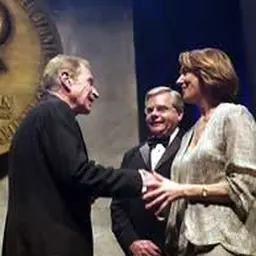
Contemporaries
People whose lives overlapped Sidney Harman's

Frequently asked questions
Who was Sidney Harman?
American businessman (1918–2011)
When was Sidney Harman born?
Sidney Harman was born on 4 August 1918 in Montreal.
When did Sidney Harman die?
Sidney Harman died on 12 April 2011 in Washington, D.C..
What was Sidney Harman's occupation?
Sidney Harman was an audio engineer, engineer and businessperson.
What nationality was Sidney Harman?
Sidney Harman was American.
Sources & further reading
Cite this page
APA: Biography.guide. (2026). Sidney Harman. https://biography.guide/sidney-harman/
MLA: "Sidney Harman." Biography.guide, https://biography.guide/sidney-harman/.
Chicago: "Sidney Harman." Biography.guide. https://biography.guide/sidney-harman/.
Data last updated: 2026-09-22 · Spot an error? Report a correction.
Page generated 2026-09-27 05:22 UTC