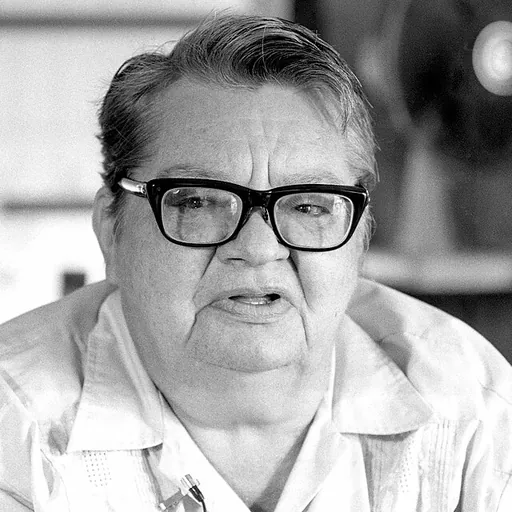
About Shirley Willer
Lived 1922 – 1999 (aged 77). Shirley Willer was an American lGBTQ rights activist.
Shirley Willer (September 26, 1922 – December 31, 1991) was an American feminist and activist. Born in Chicago, Illinois, Willer joined the Daughters of Bilitis (DOB) in the 1950s and became the president of the organization a few years after. Because of her energy and dedication, she helped to revolutionize the homophile movement in the 1960s and helped pave the way for future civil rights advancements for the gay community.
Family, career, and personal life Shirley Willer was born on September 26, 1922, in Chicago, Illinois. Willer's family consisted of her father, Arthur C. Willer, her mother, Theresa, and her younger sister, Doris. While her father was a native of Illinois, her mother was originally from Austria and received American citizenship in 1919. Her father worked as a salesman for the Prudential Life Insurance Company in Chicago for many years before he became a judge. Arthur, a heavy drinker, often beat his wife and so, in 1931, Willer's mother packed her and her younger sister into the family car and fled. To make ends meet, her mother worked split shifts as a nurse, leaving Willer to manage household activities.
Willer obtained a bachelor's degree in nursing at the University of Chicago. She later went back to school at the University of Iowa to obtain her master's degree in nursing. In 1941, at age 19, Willer discovered she was a lesbian during a nursing class lecture about mental hygiene. The lecture discussed common terms used to describe people who find individuals of the same sex attractive. The professor stated that lesbians are not attracted to men and oftentimes develop crushes on women. Willer reflected on the lecture and realized that she was a lesbian. Later in an interview, Willer stated that at this moment, she thought to herself "Oh, gee, I'm one of those things!" She had thought everyone was like that. She never understood why other girls got excited about going out on dates when she preferred the company of other women. After the lecture, Willer spoke with her professor about identifying as a lesbian. Her professor, appalled by her statement, sent her to a psychiatrist who Willer saw for six months. When Willer returned home that evening, she came out to her mother. Disgusted, her mother stated, "Where did I go wrong?" She developed romantic feelings towards her cousin. Her aunt did not approve and forbid Willer to see her daughter ever again.
For most of her life, Willer worked as a registered nurse at the Albert Merritt Billings Hospital in Chicago. She often worked 16-hour shifts due to nursing shortages due to World War II. During her time as a nurse, she filled many different positions, ranging from psychiatric nursing to working with Argonne National Laboratory. Argonne National Laboratory contributed to the Manhattan Project, which helped build America's atomic bomb. After living in Chicago, Willer visited California and lived in San Francisco. As a result of this, the DOB found it difficult to recruit members due to the risks of associating with homosexuals. Most lived discreetly, preferring to pass as heterosexual in public, and often even in private. Willer's openness about her relationship with Marion Glass was a dangerous move at the time. Yet the visibility of her love life endured both in and outside of the community. This openness encouraged other couples to follow her and Glass' example, increasing visibility for homosexual couples in the United States. Her work in the DOB increased acceptance of the gay community in general. She later noted a decrease in personal discrimination and police harassment as a result of the DOB's work within the New York chapter. The effect of Willer's work created a sharp distinction between older and younger generations, the former operating with discretion and the latter with open acceptance.
At Willer's encouragement, the DOB worked closely with the Mattachine Society, an LGBT civil rights organization founded in 1950 that initially focused largely on the rights of gay men. The DOB was originally created as a counterpart to this organization and to provide a space for lesbian women. Willer created general guidelines for interacting with the male section of the gay community, and despite some initial struggle, her guidelines ultimately benefited both groups. After the DOB and Mattachine Society disbanded, Willer's efforts to bring gay men and lesbians together helped to form the modern LGBT community.
During Willer's tenure as the president of the DOB, she attempted to convince the group to have a more aggressive political stance. But, despite Willer's efforts, the DOB stayed closer to its accommodationist roots. The DOB's reputation for emphasizing accommodation reduced potential membership as alternatives appeared. But the organization's failure prompted other movements to learn from its mistakes. Although decentralization played a part in the organization's downfall, it planted the seeds for the demonstration at Stonewall and the post-Stonewall gay liberation movement.
Some chapters of the DOB remained active even after The Ladder stopped production in 1972. The organization established a $4,000 need-based scholarship fund for members of the gay community. It also created a legal defense fund of $6,000, necessary for the multitude of legal penalties charged to homosexuals living in New York City at the time. Willer primarily drove the fundraiser efforts for these trusts.
Season 2, episode 2 of the podcast “Making Gay History” is about Willer.
Don’t just read it —
keep it.
Full-length biographies made to live with: read them, listen on the way to work, watch them tonight.
- E-book
- Audio
- Video
Instant download · yours to keep · every purchase keeps this site free
Important facts
Related people
Same field, nearest in time




Contemporaries
People whose lives overlapped Shirley Willer's



Frequently asked questions
Who was Shirley Willer?
American activist
When was Shirley Willer born?
Shirley Willer was born on 26 September 1922 in Chicago.
When did Shirley Willer die?
Shirley Willer died on 31 December 1999 in Key West.
What was Shirley Willer's occupation?
Shirley Willer was a lGBTQ rights activist.
What nationality was Shirley Willer?
Shirley Willer was American.
Sources & further reading
Cite this page
APA: Biography.guide. (2026). Shirley Willer. https://biography.guide/shirley-willer/
MLA: "Shirley Willer." Biography.guide, https://biography.guide/shirley-willer/.
Chicago: "Shirley Willer." Biography.guide. https://biography.guide/shirley-willer/.
Data last updated: 2026-09-24 · Spot an error? Report a correction.
Portrait: Wikimedia Commons · author & licence
Page generated 2026-09-27 05:09 UTC