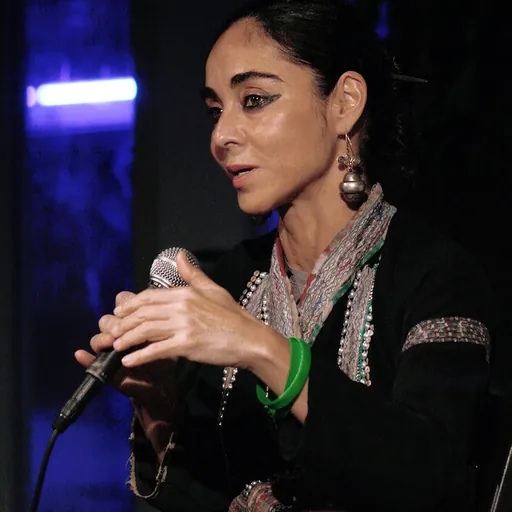
Shirin Neshat
Iranian artist, film director, and photographer (born 1957)
About Shirin Neshat
Born 1957. Shirin Neshat is an American and Iranian photographer, film director, screenwriter, video artist, filmmaker and video installation artist.
Early life and education Neshat is the fourth of five children of wealthy parents, brought up in the religious city of Qazvin in north-western Iran under a "very warm, supportive Muslim family environment", where she learned traditional religious values through her maternal grandparents. Neshat's father was a physician and her mother a homemaker. Neshat said that her father "fantasized about the west, romanticized the west, and slowly rejected all of his own values; both her parents did. What happened, I think, was that their identity slowly dissolved, they exchanged it for comfort. It served their class". In college she studied art under Harold Paris and Sylvia Lark. Neshat graduated from UC Berkeley in 1983, and soon moved to New York City. She quickly realized that making art wasn't her profession then. After meeting her future husband, who ran the Storefront for Art and Architecture, an alternative space in Manhattan, she dedicated ten years to working with him there.
During this time, Neshat made a few attempts at creating art, which was subsequently destroyed. She was intimidated by the New York art scene and believed her art was not substantial. She states, "Those ten years I made practically no art, and the art I did make I was dissatisfied with and eventually destroyed."
Since the Storefront ran like a cultural laboratory, Neshat was exposed to creators — artists, architects, and philosophers; she asserts Storefront eventually helped reignite her interest in art. In 1993 Neshat began earnestly to make art again, starting with photography. As a way of coping with the discrepancy between the culture that she was experiencing and that of the pre-revolution Iran in which she was raised, she began her first mature body of work, the Women of Allah series, portraits of women entirely overlaid by Persian calligraphy.
Her work refers to the social, cultural and religious codes of Muslim societies and the complexity of certain oppositions, such as man and woman. Neshat often emphasizes this theme by showing two or more coordinated films concurrently, creating stark visual contrasts through motifs such as light and dark, black and white, male and female. Neshat has also made more traditional narrative short films, such as Zarin.
The work of Neshat addresses the social, political and psychological dimensions of women's experience in contemporary Islamic societies. Although Neshat actively resists stereotypical representations of Islam, her artistic objectives are not explicitly polemical. Rather, her work recognizes the complex intellectual and religious forces shaping the identity of Muslim women throughout the world. Using Persian poetry and calligraphy, she examined concepts such as martyrdom, the space of exile, the issues of identity and femininity.
In 2001–02, Neshat collaborated with singer Sussan Deyhim and created Logic of the Birds, which was produced by curator and art historian RoseLee Goldberg. The full-length multimedia production premiered at the Lincoln Center Summer Festival in 2002 and toured to the Walker Art Institute in Minneapolis and Artangel in London. In this collaboration and her other projects that incorporate music, Neshat uses sound to help create an emotionally evocative and beautiful piece that will resonate with viewers of both Eastern and Western cultures. In an interview with Bomb magazine in 2000, Neshat revealed: "Music becomes the soul, the personal, the intuitive, and neutralizes the sociopolitical aspects of the work. This combination of image and music is meant to create an experience that moves the audience." In 2011, Neshat created her second live performance, OverRuled, for Performa 11.
When Neshat first came to use film, she was influenced by the work of Iranian director Abbas Kiarostami. Neshat's recognition became more international in 1999, when she won the International Award of the XLVIII Venice Biennale with Turbulent and Rapture,
In 2009, she won the Silver Lion for best director at the 66th Venice Film Festival for her directorial debut Women Without Men, based on Shahrnush Parsipur's novel of the same name. She said about the movie: "This has been a labour of love for six years. ... This film speaks to the world and to my country." The film examines the 1953 British-American backed coup, which supplanted Iran's democratically elected government with a monarchy.
In 2022, she joined protests about the Death of Mahsa Amini, by showing her work Woman Life Freedom, at Piccadilly Circus, and Pendry West Hollywood.
In 2026, Neshat signed with 800 other Hollywood professionals, the statement calling to condemn Iran for the atrocities it committed against Iranian civilians during the 2025-2026 Iranian protests against reparation and economic crisis.
Exhibitions Neshat's first solo exhibition was at Franklin Furnace in New York in 1993. A major retrospective of Neshat's work, organized by the Detroit Institute of Arts, opened 2013. In 2014, she had an exhibition titled "Afterwards", at the Mathaf: Arab Museum of Modern Art. In 2019, The Broad Museum in Los Angeles presented a 30-year retrospective of Neshat's work: Shirin Neshat: I Will Greet the Sun Again; the show traveled to the Modern Art Museum of Fort Worth in 2021. In 2022, Neshat participated in the group exhibition "Eyes on Iran" at Franklin D. Roosevelt Four Freedoms State Park, Roosevelt Island, New York; in response to the Mahsa Amini protests. Shirin Neshat: I Will Greet the Sun Again at The Broad in Los Angeles, 2019–2020, was her largest exhibition to date. In 2023, Neshat presented The Fury at Fotografiska Stockholm, followed by a presentation of the exhibition at Fotografiska Berlin in 2024.
Recognition Neshat was an artist in residence at the Wexner Center for the Arts in 2000 and at MASS MoCA in 2001. In 2004, she was awarded an honorary professorship at the Universität der Künste, Berlin. In 2006, she was awarded The Dorothy and Lillian Gish Prize, one of the richest prizes in the arts, given annually to "a man or woman who has made an outstanding contribution to the beauty of the world and mankind's enjoyment and understanding of life."
In 2010, Neshat was named Artist of the Decade by Huffington Post critic G. Roger Denson, for "the degree to which world events have more than met the artist in making her art chronically relevant to an increasingly global culture," for reflecting "the ideological war being waged between Islam and the secular world over matters of gender, religion, and democracy," and because "the impact of her work far transcends the realms of art in reflecting the most vital and far-reaching struggle to assert human rights."
Opera At the 2017 Salzburg Festival, Neshat directed Giuseppe Verdi's opera Aida, with Riccardo Muti as conductor and Anna Netrebko singing the main character. Asked by the festival organizers about the particular challenge for an Iranian woman to stage a play that deals with the threats of political obedience and religion to private life and love, Neshat said, "Sometimes the boundaries between Aida and myself are blurred."
Works Turbulent, 1998. Two channel video/audio installation. Rapture, 1999. Two channel video/audio installation. Soliloquy, 1999. Color video/audio installation with artist as the protagonist. Fervor, 2000. Two channel video/audio installation. Passage, 2001. Single channel video/audio installation. Logic of the Birds, 2002. Multi-media performance. Tooba, 2002. Two channel video/audio installation based on Shahrnush Parsipur's novel Women Without Men. The Last Word, 2003. Single channel video/audio installation. Mahdokht, 2004. Three channel video/audio installation. Zarin, 2005. Single channel video/audio installation. Munis, 2008. Color video/audio installation based on Shahrnush Parsipur's novel Women Without Men. Faezeh, 2008. Color video/audio installation based on Shahrnush Parsipur's novel Women Without Men. Possessed, 2009. Black & white video/audio installation. Women Without Men, 2009. Feature film based on Shahrnush Parsipur's novel Women Without Men. OverRuled, 2011. Performance. Illusions & Mirrors, 2013. Short film commissioned by Dior and featuring Natalie Portman. Looking for Oum Kulthum, 2017.Feature film co-directed by Shoja Azari. Land of Dreams, 2021. Feature film co-directed with Shoja Azari, written by Jean-Claude Carrière. The Fury, 2022. Monochrome two channel video installation.
Awards First International Prize at the Venice Biennale (1999) Grand Prix at the Kwangju Biennale (2000) ZeroOne Award from the Universität der Künste Berlin (2003) Rockefeller Foundation Media Arts Fellowship, New York (2008) Cultural Achievement Award, Asia Society, New York (2008) Honorary Fellowship of the Royal Photographic Society, Bristol (2020)
Don’t just read it —
keep it.
Full-length biographies made to live with: read them, listen on the way to work, watch them tonight.
- E-book
- Audio
- Video
Instant download · yours to keep · every purchase keeps this site free
Important facts
Family & relationships
People in Shirin Neshat's life
Named in this biography and alive at the same time



Related people
Same field, nearest in time

Contemporaries
People whose lives overlapped Shirin Neshat's


Frequently asked questions
Who is Shirin Neshat?
Iranian artist, film director, and photographer (born 1957)
When was Shirin Neshat born?
Shirin Neshat was born on 26 March 1957 in Qazvin.
What is Shirin Neshat's occupation?
Shirin Neshat is a photographer, film director, screenwriter, video artist, filmmaker and video installation artist.
What nationality is Shirin Neshat?
Shirin Neshat is American and Iranian.
Sources & further reading
Cite this page
APA: Biography.guide. (2026). Shirin Neshat. https://biography.guide/shirin-neshat/
MLA: "Shirin Neshat." Biography.guide, https://biography.guide/shirin-neshat/.
Chicago: "Shirin Neshat." Biography.guide. https://biography.guide/shirin-neshat/.
Data last updated: 2026-09-22 · Spot an error? Report a correction.
Portrait: Wikimedia Commons · author & licence
Page generated 2026-09-27 05:02 UTC