
About Shin Sawbu
Lived 1394 – 1471 (aged 76–77). Shin Sawbu was a monarch.
Shin Sawbu (, ; , ; 1394–1471) was queen regnant of Hanthawaddy from 1454 to 1471. Queen Shin Sawbu is also known as Binnya Thau (, ) or Old Queen in Mon. Queen Shin Sawbu and Queen Jamadevi of Haripunjaya are the two most famous among the small number of queens who ruled in mainland Southeast Asia.
Early life Shin Sawbu was the only daughter of the Mon King Razadarit who had two sons as well. She was born on 11 February 1394 (Wednesday, 12th waxing of Tabaung of 755 ME) to the junior queen Thuddhamaya . At birth she was given the name ( in Sanskrit and Pali). At age 20, she was married to Binnya Bwe (Smin Chesao), Razadarit's nephew and had a son, Binnya Waru and two daughters, Netaka Taw and Netaka Thin. Her husband died when she was just 25.
Residence at Ava In 1421, Sawbu's father King Razadarit died. The king's eldest son Binnya Dhammaraza ascended the throne but his younger brothers Binnya Ran and Binnya Kyan rebelled. By the invitation of Binnya Kyan, King Thihathu of Ava came down with an army in November 1423 (Natdaw 785 ME). Binnya Dhammaraza pacified his brothers by making Binnya Ran the crown prince as well as giving the governorship of the Irrawaddy delta, and Binnya Kyan the governorship of Martaban. Crown Prince Binnya Ran in a gesture of peace, presented his sister Shin Sawbu to Thihathu, who, in turn presented a princess of Ava to marry Binnya Ran. It was December 1423.
When Shin Sawbu went to Ava, she was 29 years old, a widow and a mother with a son and two daughters. During the time she resided at Ava, she did not have any additional children. King Thihathu was very fond of her but he died during a military expedition in the north in 1425. Shin Sawbu remained in Ava for four more years. During her residence at Ava, Shin Sawbu became the patron of two Mon monks, Dhammanyana and Pitakahara, who resided at the Ariyadhaza monastery at Sagaing near Ava. In 1429, at the age of 35, the queen escaped with the help of her Mon monk preceptors and returned to Pegu accompanied by them.
Reign at Pegu
All members of Pegu's male line to the throne having been exhausted, Shin Sawbu ascended the throne as queen in early 1454. Two of her brothers, Binnya Dhammayaza and Banya Ran I, and one of her sons, Binnya Waru, had already ruled as kings of Pegu.
In 1457, shortly after ascending the throne, the Buddhist world celebrated the two thousandth anniversary of the Buddha's Paranirvana which in Southeast Asia is dated to the year 543 BCE.
After ruling Pegu for around seven years, in 1460 she decided to abdicate and move from Pegu to Dagon where she could lead a life of religious devotion next to the Shwedagon pagoda.
Shin Sawbu chose a monk to succeed her on the throne of Pegu. The monk Pitakahara, who had helped her escape from Ava, left the sangha, was given the titles Punnaraja and Dhammazedi, and became her son-in-law and a suitable heir to the throne by marrying her younger daughter Mipakathin.
The actual handing over of power from Shin Sawbu to Dhammazedi, who became king under the title Ramadhipati in the year 1457, is commemorated in an inscription written in the Mon language.
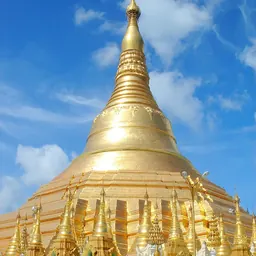
In Dagon, the queen devoted her time and attention to the Shwedagon pagoda, enlarging the platform around the pagoda, paving it with stones and placing stone posts and lamps around the outside of the pagoda. She extended the glebe lands supporting the pagoda to Danok.
She also had her own weight in gold (25 viss) beaten out into gold leaf and covered the Shwedagon pagoda with this gold leaf. The inhabitants of Dagon donated 5,000 viss of bronze to the pagoda.
Stone inscriptions Three inscriptions in stone have been found from Shin Sawbu's reign.
The first inscription, known as Kyaikmaraw I commemorates a land dedication. On 25 September 1455, the queen dedicated land to the Kyaikmaraw pagoda that she had built. The inscription records that jewels, precious objects, and the revenues of a place named "Tko' Mbon" were given to the Moh Smin [Royal Promontory] pagoda at Myatheindan near Martaban. The second part of the inscription provides benedictions for those coming to pay their respects to the pagoda and makes many references to Buddhist scripture. The third part of the inscription outlines the torments of hell. The inscription is rich in linguistic, religious, and historical information with Burmese linguistic influences and the word "caw" or "chao" meaning "lord" from a Tai language used supposedly because "this title had been given to the Wareru dynasty by the Thai king."
Mon folk traditions At the end of the nineteenth century, some Mons are said to have regarded the British Queen Victoria as the reincarnation of Shin Sawbu. Dhammazedi. To whom the fateful bowl fell, left the sacred order, received her daughter in marriage, and assumed the government. The other monk, in his disappointment, aroused suspicion and was executed in Paunglin, north of Dagon. The lords also resented the choice at first but became reconciled owing to Dhammazedi's high character; when some of them continued murmuring that he was not of royal race, Shinsawbu had a beam taken out of the and carved into a Buddha image, and showed it to them saying 'Ye say he is of common blood, he cannot be your King. See here this common wood – yesterday it was trodden in the dust of your feet, but to-day, is it not the Lord and do we not bow before it?'."
Singer provides an alternative story with the governor of Pathein, Binnya Ein, married to Shin Sawbu's elder daughter Mipakahtau, rebelling because he was not appointed king ahead of Dhammazedi. This rebellion ends when he is poisoned.
The Mon history Nidana Ramadhipati Katha provides an alternative story of how Baña Thau ended up living in Ava claiming that she was already ruling at Pegu as queen when she was abducted and brought to Ava and made chief queen.
Dispute over duration of reign Funeral procession of Queen Shin Sawbu. An illustration from Rachathirat, a Thai version of Razadarit Ayedawbon, 1946 printed edition. Noted that the artist depicted this funeral in Thai royal tradition. Some hold that Shin Sawbu ruled for seven years, Guillon holds that Sawbu and Dhammazedi ruled jointly, with Dhammazedi ruling over Pegu and Shinsawbu ruling over Dagon. Dagon had long been the traditional appanage of Mon queens.
Palace and burial locations Furnival claimed that "the ramparts of Shin Sawbu's residence at Dagon" were the colonial era "bunkers of the golf course near the Prome Road," but others claim these ruins are, in fact, a wall built in 1841.
The stupa that contained her remains is said to be at a monastery in Sanchaung Township of modern-day Yangon near the Shwedagon Pagoda on the grounds of a monastery once named the Shin Sawbu Tomb Monastery, which is located west of Pyay Road (Prome Road) on Shin Saw Pu Road (Windsor Road).
Historiography Various Burmese chronicles do not agree on the key dates of the queen's life.
Event Slapat Rajawan (1766) Mon Yazawin (Shwe Naw) Maha Yazawin (1724) Hmannan Yazawin (1832) Birth 1406 Nov/Dec 1395 19 February 1396 11 February 1394 Marriage to Smin Sithu not reportedgroup=note|772 ME (1410/11) when she was in her 15th year (aged 14). group=note|The Maha Yazawin is inconsistent. Reign 1463/64–1470/71 1445/46–1470/71 1453/54–1470/71 (summary section) 1452/53–1470/71 1453/54–1470/71 (summary section) Death 1470/71 1470/71 1470/71 75 75 77
Commemorations
Shin Saw Pu Road, a road in Yangon
Don’t just read it —
keep it.
Full-length biographies made to live with: read them, listen on the way to work, watch them tonight.
- E-book
- Audio
- Video
Instant download · yours to keep · every purchase keeps this site free
Important facts
Family & relationships
People in Shin Sawbu's life
Named in this biography and alive at the same time

Related people
Same field, nearest in time




Contemporaries
People whose lives overlapped Shin Sawbu's




Frequently asked questions
Who was Shin Sawbu?
Queen Regnant of Kingdom of Hanthawaddy
When was Shin Sawbu born?
Shin Sawbu was born on 11 February 1394 in Bago.
When did Shin Sawbu die?
Shin Sawbu died in 1471 in Dagon Township.
What was Shin Sawbu's occupation?
Shin Sawbu was a monarch.
What nationality was Shin Sawbu?
Shin Sawbu's recorded nationality: Sukhothai Kingdom.
Sources & further reading
Cite this page
APA: Biography.guide. (2026). Shin Sawbu. https://biography.guide/shin-sawbu/
MLA: "Shin Sawbu." Biography.guide, https://biography.guide/shin-sawbu/.
Chicago: "Shin Sawbu." Biography.guide. https://biography.guide/shin-sawbu/.
Data last updated: 2026-09-20 · Spot an error? Report a correction.
Page generated 2026-09-27 05:23 UTC