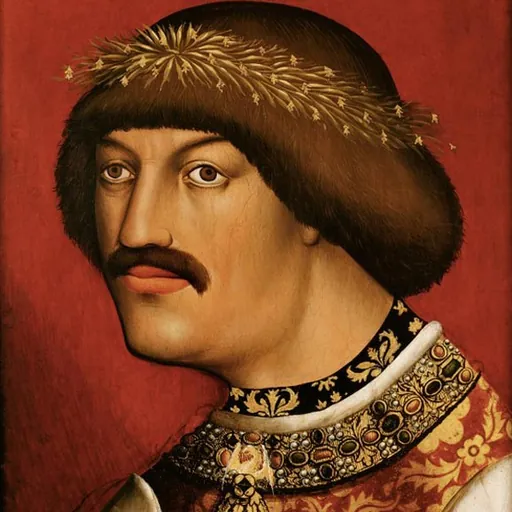
About Albert II of Germany
Lived 1397 – 1439 (aged 42). Albert II of Germany was a German monarch.
Albert II (, 10 August 1397 – 27 October 1439) was King of the Romans and a member of the House of Habsburg. By inheritance he became Albert V, Duke of Austria. Through his wife Elizabeth of Luxembourg (jure uxoris), he also became King of Hungary, King of Croatia, King of Bohemia, and inherited a claim to the Duchy of Luxembourg.
He played a significant role in the Hussite Wars, assisting his father-in-law Sigismund and suffering defeats like the Battle of Domažlice in 1431. Crowned King of Hungary in 1438, he struggled to control Bohemia and fought against Polish-Bohemian forces. He later became King of the Romans but died in 1439 while defending Hungary from the Ottomans. His reign saw anti-Hussite and anti-Jewish persecutions, continuing medieval crusades against perceived heretics. Austrian Jews faced increased taxation and expulsions, culminating in the 1420 Vienna pogrom, partly driven by accusations of aiding the Hussites.
Biography
Albert was born in Vienna as the son of Albert IV, Duke of Austria, and Joanna Sophia of Bavaria.
He succeeded to the Duchy of Austria at the age of seven on his father's death in 1404. His uncle Duke William of Inner Austria, then head of the rivaling Leopoldinian line, served as regent for his nephew, followed by his brothers Leopold IV and Ernest the Iron in 1406. The quarrels between the brothers and their continued attempts to gain control over the Albertinian territories led to civil war-like conditions. Nevertheless, Albert, having received a good education, undertook the government of Austria proper on the occasion of Leopold's death in 1411 and succeeded, with the aid of his advisers, in ridding the duchy of the evils which had arisen during his minority.
In 1422 Albert married Elisabeth of Luxemburg, the daughter and heiress of the King Sigismund of Hungary (later also Holy Roman Emperor and King of Bohemia), and his second wife, the Slovenian noblewoman Barbara of Celje. Besides Hungary, Albert's marriage brought him claims to numerous Slavic kingdoms and principalities and other realms of Central and Eastern Europe as well.
Albert assisted his father-in-law Sigismund in his campaigns against the Hussites, involving the Austrian duchy in the Hussite Wars. In return Sigismund designated him as his successor and granted him the title of Margrave of Moravia in 1423. The Austrian lands were devastated several times and Albert also participated in the 1431 Battle of Domažlice where the Imperial troops suffered an embarrassing defeat. While his lands were harmed it was a show of loyalty to the church as the church was trying to consolidate its influence and power. Albert was never crowned as Holy Roman Emperor.
Afterwards engaged in defending Hungary against the attacks of the Turks, he died on 27 October 1439 at Neszmély and was buried at Székesfehérvár. Albert was an energetic and warlike prince, whose short reign as a triple king gave great promise of usefulness for the Holy Roman Empire. This economic transformation was accompanied by a deterioration of relations between Jewish and Christian populations, with an increase of violent persecutions (Pogrom) by the latter towards the former. Summoned by Pope Urban II with the aim of conquering the Holy Land, crusaders interpreted the papal call to use violence against non Christians as a command to attack and destroy Jewish communities in France These German-Austrian massacres were arguably a great influence on Albert V and his Jewish persecutions and expulsions.
Though the Jews in the Austrian duchy had been subject to local persecutions during the 13th and 14th century, their position remained relatively safe. Jewish communities prospered in several towns like Krems or the area around the Judenplatz at Vienna. During the confusion after the death of Duke Albert IV in 1404 their situation worsened sharply, culminating in the blaze of the Vienna synagogue on 5 November 1406, followed by riots and lootings.
With the ordering of campaign preparations against the Hussites by King Sigismund in the beginning of the 15th century, taxes were used to fund a crusade army. Albert V of Austria followed suit, keeping his good standing with the Catholic Church while he was in power. When Albert V came of age in 1411 and interfered in the Hussite Wars, he repeatedly established new taxes on the Jewish community to finance his campaigns, to destroy "devilry" and "imprudence".
In English he is sometimes known as Albert the Grave or Albert the Magnanimous; this is possibly due to a confusion with the 16th-century ruler Albert V, Duke of Bavaria, who is called the Magnanimous in German.
Family
His children with Elizabeth of Luxembourg were: Anne of Austria (1432–1462), who married William III, Duke of Saxony. William became (1457–69) Duke of Luxembourg, in right of his wife King Albert II and His Wife Elizabeth of Luxembourg in Prayer, on the Altar the Crowns of Bohemia and Hungary, as well as the Imperial Crown of the Holy Roman Empire (1820) by Karl RussElisabeth (c. 1436–1439 to 1505), who married Casimir IV of Poland, and whose son Vladislaus II of Bohemia later became king of Bohemia and Hungary George (born and died at Vienna on 16 February 1435) Ladislas V Posthumus of Bohemia, King of Hungary and Bohemia
Male-line family tree
Ancestry
Don’t just read it —
keep it.
Full-length biographies made to live with: read them, listen on the way to work, watch them tonight.
- E-book
- Audio
- Video
Instant download · yours to keep · every purchase keeps this site free
Important facts
Family & relationships
People in Albert II of Germany's life
Named in this biography and alive at the same time

Related people
Same field, nearest in time


Contemporaries
People whose lives overlapped Albert II of Germany's



Frequently asked questions
Who was Albert II of Germany?
King of Germany, Hungary and Bohemia
When was Albert II of Germany born?
Albert II of Germany was born on 16 August 1397 in Vienna.
When did Albert II of Germany die?
Albert II of Germany died on 27 October 1439 in Neszmély.
What was Albert II of Germany's occupation?
Albert II of Germany was a monarch.
What nationality was Albert II of Germany?
Albert II of Germany was German.
Sources & further reading
· Wikipedia: Albert II of Germany
· DBpedia: Albert II of Germany
Cite this page
APA: Biography.guide. (2026). Albert II of Germany. https://biography.guide/albert-ii-of-germany/
MLA: "Albert II of Germany." Biography.guide, https://biography.guide/albert-ii-of-germany/.
Chicago: "Albert II of Germany." Biography.guide. https://biography.guide/albert-ii-of-germany/.
Data last updated: 2026-09-23 · Spot an error? Report a correction.
Portrait: Wikimedia Commons · author & licence
Page generated 2026-09-27 05:05 UTC