
About Shidzue Katō
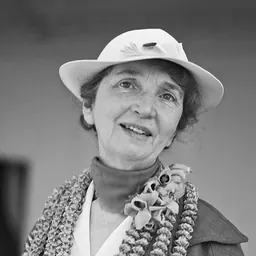
Lived 1897 – 2001 (aged 104). Shidzue Katō was a Japanese politician and feminist.
, also published as Shidzue Ishimoto, was a 20th-century Japanese feminist and one of the first women elected to the Diet of Japan, best known as a pioneer in the birth control movement. She is known in the U.S. as the "Margaret Sanger of Japan". Hirota travelled frequently to the West for work, and because of this Katō and her family grew up familiar with Western things At age 17, Katō was married to Baron Keikichi Ishimoto (石本恵吉), a Christian humanist interested in social reforms. In the United States, Baron Ishimoto began to veer from Christian humanism toward a more radical Communist position. In 1946, Shidzue Katō was elected to the Diet of Japan, the national legislature of Japan. Her campaign platform was based on family planning and improving the economic prospects of women. Although Katō was initially hopeful of women's growing political role, she was soon marginalized in the mostly male Diet. Despite this, she looked for other ways to achieve her political reforms. In 1946 she was instrumental in organizing the first "women only" rally in Tokyo. This rally protested for greater economic resources for women.
Honors Even after Katō retired from politics, she continued her political activism. She continued to lecture on feminist issues, as well as continued to chair the Family Planning Federation of Japan.
In 1988, Katō received the United Nations Population Award.
In 1996, The Katō Shidzue Award was established by Dr. Attiya Inayatullah to commemorate her work. The Katō Shizue Award "targets women's groups, women's organizations and/or individual women who are active in the movement toward improvement of sexual and reproductive health/rights of women as well as empowerment of women (i.e., social, economic, political and legal empowerment) in developing countries and/or in Japan."
Death and legacy Katō died on December 22, 2001, at the age of 104. In an obituary at the Web site of the International Planned Parenthood Federation, the writer noted that her efforts "have continued to bear fruits for Japanese society, bringing down the number of abortions, infant mortality, and maternal death rates, while increasing contraceptive usage to 80 percent. Japan's family planning model has been so successful that it attracts attention from other countries as a working model."
Works Facing Two Ways: The Story of My Life, published by Farrar and Rinehard (New York, NY), 1935. An edited version for children called East Way, West Way: A Modern Japanese Girlhood, illustrated by Fuji Nakamizo, was published by Farrar and Rinehard (New York, NY), in 1936. Straight Road, 1956. Katō Shizue Hyakusai, c. 1997.
Don’t just read it —
keep it.
Full-length biographies made to live with: read them, listen on the way to work, watch them tonight.
- E-book
- Audio
- Video
Instant download · yours to keep · every purchase keeps this site free
Important facts
People in Shidzue Katō's life
Named in this biography and alive at the same time


Related people
Same field, nearest in time






Contemporaries
People whose lives overlapped Shidzue Katō's


Frequently asked questions
Who was Shidzue Katō?
Japanese politician (1897-2001)
When was Shidzue Katō born?
Shidzue Katō was born on 2 March 1897 in Tokyo.
When did Shidzue Katō die?
Shidzue Katō died on 22 December 2001 in Japan, Tokyo.
What was Shidzue Katō's occupation?
Shidzue Katō was a politician and feminist.
What nationality was Shidzue Katō?
Shidzue Katō was Japanese.
Sources & further reading
Cite this page
APA: Biography.guide. (2026). Shidzue Katō. https://biography.guide/shidzue-kato/
MLA: "Shidzue Katō." Biography.guide, https://biography.guide/shidzue-kato/.
Chicago: "Shidzue Katō." Biography.guide. https://biography.guide/shidzue-kato/.
Data last updated: 2026-09-20 · Spot an error? Report a correction.
Page generated 2026-09-27 05:30 UTC