About Shi Jianru
Lived 1879 – 1900. Shi Jianru was a Chinese revolutionary.
Shi Jianru (Simplified Chinese: 史坚如, Traditional Chinese: 史堅如, June 24, 1879 – November 9, 1900), originally named Shi Jiuwei (史久緯), styled Jingru (經如), later changed to Jianru, was a Christian from Panyu, Guangdong, China (Qing Dynasty). He was a martyr against the late Qing dynasty, also a descendant of the Ming dynasty general Shi Kefa. In October 1900, he made an unsuccessful attempt to bomb the highest-ranking official of Guangdong, for which he was arrested and executed by Qing authorities.
Life Shi was born into a wealthy bureaucratic family, with ancestors from Shanyin, Zhejiang. He had one brother and one sister. Despite being frail in his youth, he was intelligent and fond of learning, enjoying reading books. In 1898, he enrolled in the Christian Gezhi Academy, where he received a Western-style education. In 1899, he joined the Revive China Society through the introduction of a Professor from Gezhi Academy and met Sun Yat-sen in Yokohama, Japan. Upon returning to China, he started to organize revolutionary activities in the Hunan region and planned an uprising.
In 1900, the Boxer Rebellion erupted in northern China which led to the invasion of the Eight-Nation Alliance. Revolutionary forces, under the leadership of Sun Yat-sen, seized the opportunity presented by the chaos to launch uprisings. Zheng Shiliang initiated the Huizhou Uprising, while Shi Jianru raised funds in Guangzhou by mortgaging his own land to support the revolution. However, due to a lack of funds, the revolutionary forces in Guangzhou, led by Shi, were weak, prompting him to devise a big plan to gain influence. He considered assassinating the local Governor-General, De Shou, to support the Huizhou Uprising. Initially, he purchased 25 boxes of explosives, but they were seized by authorities. Later, he acquired 200 pounds of explosives. Under the name of his friend Song Shaodong, Shi rented a mansion behind De Shou's residence and dug a tunnel there to store the explosives.
On November 8, 1900, De Shou issued the order for Shi's execution. The next day, November 9, Shi was escorted to the execution ground near Tianzi Wharf in Guangzhou, where he was beheaded at the young age of 21. As a warning to the public, his head was displayed at the site of the explosion. De Shou reported the incident to the imperial court and later received approval for his actions.
The execution ground of Guangzhou (then Canton) where Shi Jianru was beheaded in Nov 1900 (not photographed during Shi's execution). In the ground stood an executioner holding his sword with foreign visitors around as this is also a hot spot for touring. Local authorities carried out capital punishment here every year in the Qing era.
Afterwards After Shi's execution, the authorities discarded his body in a desolate hill east of the city, where executed prisoners were laid to rest together. Witnessing this, the compassionate abbot of a nearby temple secretly buried Shi's remains in a crypt beneath the Buddha altar within the temple.
The inscription written by Sun Yat-sen and his companions for the statue of Shi Jianru (Chinese).
Following the fall of the Qing dynasty, Shi's story was revisited. In late 1911, voices emerged advocating for the casting of a bronze statue in his honor. On April 28, 1912, Sun Yat-sen convened a memorial ceremony for Shi Jianru in Guangzhou, attended by around six to seven thousand people from all walks of life. Sun praised him as a “model of righteousness and heroism ".
In early 1913, the still-living abbot of the temple informed Hu Hanmin, then governor of Guangzhou and a close friend of Shi Jianru, about the burial. The monks donated the temple's land, which Hu Hanmin turned into a shrine for Shi, managed by his relatives. Shi's remains were reinterred in a golden pagoda on the site. Upon learning of this, Sun Yat-sen immediately wrote an inscription for Shi Jianru's memorial. In 1917, the Yunnan-Guangdong Army produced a bronze statue of Shi Jianru.
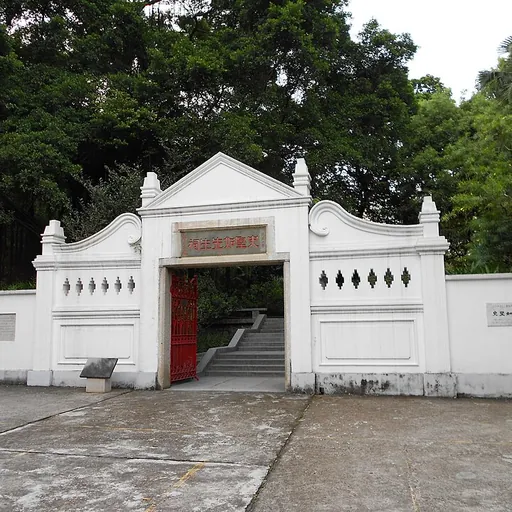
The shrine of Shi Jianru’s tomb is located within the Huanghuagang Martyrs’ Cemetery in Guangzhou, with the plaque above the entrance inscribed by Hu Hanmin.
In 1924, the Kuomintang erected a white marble statue of Shi at Lingnan School, his alma mater, which was unveiled on May 20 and later moved to his shrine. In December of the same year, Hu Hanmin erected a monument in the First Park (now Guangzhou People's Park) in honor of Shi. In 1928, Shi Jianru's nominal son, Shi Xuji, entrusted the shrine to the government.
In 1978, the Guangzhou Cultural Relics Department relocated Shi's golden pagoda to the Huanghuagang Martyrs’ Cemetery and established a shrine for him there, along with his stone statue and Hu Hanmin's inscribed plaque.
The epitaph written in English by Sun Yat-sen and others for the statue of Shi Jianru. It contains inaccuracies in his birth and death dates.
In Sun Yat-sen University (formerly Lingnan University), there is a memorial pavilion called “Xingting,” donated and built by Xing Society students in 1928, to commemorate Shi Jianru, Qu Lizhou, and Xu Yaozhang, three faculty members.
Family members Older Brother: Shi Guyu (史古愚?-1914), a revolutionary, also known as Zhang Xiaoran. He sold family property to participate in Sun Yat-sen’s revolution. Younger Sister: Shi Jingran (史憬然, 1881-1902), was a progressive young woman who majored in Chinese medicine and was active in revolution activities like his older brother. She was also a member of the Xingzhonghui, in which she was the only female. She died due to illness caused by cold raw food in 1902. Nominal Son: Shi Xuji (史勖濟), born in 1904, was the son of Shi Guyu. He became the nominal son of Shi Jianru in his father's wish. He once taught at the 25th Middle School of Guangzhou.
Don’t just read it —
keep it.
Full-length biographies made to live with: read them, listen on the way to work, watch them tonight.
- E-book
- Audio
- Video
Instant download · yours to keep · every purchase keeps this site free
Important facts
People in Shi Jianru's life
Named in this biography and alive at the same time

Related people
Same field, nearest in time



Contemporaries
People whose lives overlapped Shi Jianru's


Frequently asked questions
Who was Shi Jianru?
Chinese revolutionary
When was Shi Jianru born?
Shi Jianru was born in 1879 in Guangzhou.
When did Shi Jianru die?
Shi Jianru died in 1900.
What was Shi Jianru's occupation?
Shi Jianru was a revolutionary.
What nationality was Shi Jianru?
Shi Jianru was Chinese.
Sources & further reading
Cite this page
APA: Biography.guide. (2026). Shi Jianru. https://biography.guide/shi-jianru/
MLA: "Shi Jianru." Biography.guide, https://biography.guide/shi-jianru/.
Chicago: "Shi Jianru." Biography.guide. https://biography.guide/shi-jianru/.
Data last updated: 2026-09-21 · Spot an error? Report a correction.
Portrait: Wikimedia Commons · author & licence
Page generated 2026-09-27 05:00 UTC