
About Shen Dao
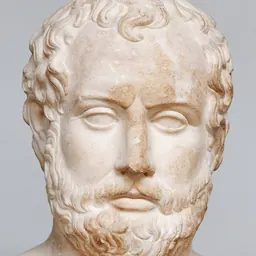
Lived 350 BC – 275 BC (aged 74–75). Shen Dao was a philosopher and writer.
Shen Dao , or , was an early-mid Warring states period Chinese philosopher and writer. Noteworthy as a predecessor influencing both Han Fei and Daoism, his remaining fragments are the most substantial of any Jixia Academy scholar. Often argued to influence the Guanzi, in connection with the flourishing academy, he may have been well known; with references in the Zhuangzi, Xunzi, Han Feizi, Lushi Chunqiu, Huangdi Sijing (unnamed), and later Huainanzi, retaining some individual significance into the early Han dynasty.
As introduced by Feng Youlan, Shen Dao was early remembered modernly for his influence on the Han Feizi with regards the concept of shi (, circumstantial advantage or authority), most notably Chapter 40's "Objection to Positional Power” (Nan shi 難勢). Though defended by the Han Feizi, it sees Shen Dao as having a more naturalistic conception of power compared with "riding the wind", as also depicted in the Zhuangzi. The Han Feizi advocates "power founded by men".
Sima Qian discusses him amongst the Jixia academy scholars, taking him as rooted in Huang-Lao (Daoism). Later classified by the Confucian archivists as Legalist together with others from the Han Feizi, he shares some comparable early administrative ideas with them, and was likely the most broadly well known of them earlier in the Warring States period, but was less likely familiar with Shang Yang as a statesman.
Xun Kuang criticized Shen Buhai as more focused on power, and Shen Dao as "obsessed by fa." Most of Shen Dao's work would appear to have concerned fa, a concept including administrative methods and standards as including laws, advocating that reward and punishment be based in fa rather than the ruler's judgements, like the more legalistic Shang Yang. Advocating their distribution through both laws and impartial administrative mechanisms, he was otherwise more focused on administration more comparable with administrator Shen Buhai, but still bases the appointment of tasks and officials in the ruler's discretion.
Making some discussion of law, in his time, Shen Dao argued the value of laws that are not good (不善) as still having value over no laws. Bad laws are taken as still contributing to a more equitable distribution of goods and properties, and therefore preventing resentment, especially against the ruler. That "Even if a law is not good, it is still better than having no law" becomes perhaps his most famous statement, included in the Qunshu Zhiyao. But Shen Dao did prefer good laws, advocating that punishment and reward be proportionate rather than extreme.
Textual transmission The Shiji states that the Shenzi was twelve essays. The Han dynasty's Treatise on Literature in the Book of Han listed the Shenzi as rendered in forty-two chapters, which is considered the most complete form of the text.
The Shenzi was available until the fall of the Tang dynasty, though not commonly in its original edition; the Book of Sui, Old & New Book of Tang listed ten volume editions. The older 42 essay edition was lost between the Tang to Song Dynasties.
From the late 1500's onwards, a number of one chapter Shenzi texts were produced deriving from the older fragments and encyclopedia. Despite the recovery of additional manuscripts, the most thorough remaining source on Shen Dao is the Tang's Qunshu zhiyao political encyclopedia.
Xun Kuang considered Shen's style grandiose.
Shanghai manuscripts In 2007, the Shanghai Museum published a collection of texts written on bamboo slips from the state of Chu dating to the Warring States period, including six bamboo slips with sayings of Shenzi. They are titled "Shenzi Speaks of Reverence and Frugality" (Shenzi Yue Gong Jian 慎子曰恭儉), based on a title on the third fragment. These are the only known examples of the text of Shenzi that are contemporaneous with its composition.
Shenzi Speaks refers to Master Shen, and discusses concepts like positional power and administrative methods as to connect them to Shenzi. But they also include Confucian concepts, and it is not positive they belong to the exact same tradition. A more conservative estimation would place them as later syncretists still in the heyday of his fame, but would also magnify the scope of his authority, still opening with reference to Shenzi himself.
Translation A critical reconstruction of the lost Shenzi was made by Paul Thompson, and published in 1979 as The Shen Tzu Fragments. A complete modern Chinese vernacular (baihua) translation and commentary was published in Guiyang by the Guizhou Renmin Chubanshe in 1996, titled Shenzi, Yinwenzi, Gongsun longzi quanyi (慎子、尹文子、公孫龍子全譯), translated by Gao Liushui (高流水) and Lin Hengsen (林恒森).
With a subsequent prior translation by Emerson (2013), Eirik Lang Harris has since published a complete translation, including broader fragments discussing him, in 2016. Thompson was more concerned with whether the fragments were legitimate and credibly attributable to Shen Dao. In this regard, Harris still considered Thomspon the most thorough examination of Shen Dao's primary fragments, and credibly attributable to Shen Dao.
Western dating Though not his focus, Herrlee G. Creel (1974) considered Shen Dao a younger contemporary of Shen Buhai. A general round dating of circa 350-275 bce used in the west derives from that theorized by the famed early modern scholar Ch'ien Mu. Translator Thomphson (1979) placed him a decade earlier, 360-285 bce. Translator Harris' (2016) still used Thompson's dating.
Although Harris does not engage in a dating argument, he relates political naturalism, and an interest in the natural world, as comparable to figures spanning Laozi to Shen Dao's Jixia successor Xun Kuang. Sinologist Hansen viewed Shen Dao's morally neutral naturalism as a development of the type earlier seen in Mencius (371–c.289 BCE), but there is also room for comparison with the earlier Mohists.
Usually referred to as "Shenzi" ( 'Master Shen') for his writings, very little is known of Shen Dao's life, as his historical records are brief. David R. Knechtges (2014) placed Shen Dao, an itinerant philosopher from the state of Zhao, about 350 BC, traveling to the city of Linzi (modern Zibo in Shandong) in 300 BC to become a member of the Jixia Academy, probably leaving Linzi after its capture by the state of Yan in 285 BC before his death a decade later in 275.
Harris only recalls the brief references of the Xunzi and Sima Qian's Shiji. The Shiji places him as a native of the Zhao state alongside his Jixia Academy successor Xun Kuang (of the Xunzi), but comments little on him or his Jixia compatriots except to assign him as having studied Huang-Lao (Yellow Emperor and Laozi) and Dao-de (The Way and it's virtue)). Depicted as debating others of the Jixia academy, he is not known to have held any political or bureaucratic appointment.
Earlier dating Chinese sources can commonly be seen date Shen Dao to 395-315 BCE, several decades earlier than in the west. Arguably, Shen Dao is less technically complex than Shen Buhai, let alone Xunzi in the later Warring States period. Philosophically, he retains antiquated fatalistic ideas, with view of men as selfish that aligns more with early Warring States thinkers like Shen Buhai and Shang Yang than Xunzi's view of men as "bad" or "evil". His view of Heaven as lacking concern for man aligns with Laozi, but not Confucius, Mencius, or the Mohists.
With discovery of the Mawangdui silk texts, and Shen Dao content contained in the Huangdi Sijing, Chinese scholars again advocated the traditional idea of an early "Daoistic" Huang-Lao current influencing later thinkers, different from Daoism as later understood. Tang Lan (1975) related Shen Buhai with a theorized emergence of a 400bc Huang-Lao school; the similarly 'Daoistic' Shen Dao, then, is slightly younger contemporary of Shen Buhai.
If Tang's theory is taken to depend on early dating for the Huang-Lao boshu, the west argues a later dating for most of it. I's text (Dao Yuan) Dao the Origin resembles the Tao te Ching, but has received little dating commentary. German Sinologists Dieter Kuhn and Helga Stahl place it in the third century BCE without comment.
Following discovery of the Guodian Chu slips, Alan Chan of the Stanford Encyclopedia of Laozi (2025) argues that "bodies of sayings attributed to Laozi were committed to writing probably from the second half of the fifth century B.C.E." (450) Shen Dao has ideas that can be compared with Laozi, but is not an advanced development of Laozi.
Proto-Daoism Making use of the term "Dao" without cosmological or metaphysical reference, the Shenzi serves as noteworthy precursor to both Daoism and Han Fei. Posthumously, he is also sometimes classified as Taoist.
Sinologist Hansen (of the Stanford Encyclopedia of Daoism) believed that Shen Dao might have preceded completion of the Tao Te Ching (Laozi), serving as a relevant background for its development. But Hansen did not emphasize it. Rather, even if it was finished, Shen Dao still represents a low level of Daoist development compared to either Laozi or the Zhuangzi. So, Shen Dao is still a good theoretical reference for what some Daoist-leaning thinkers might have looked like before completion of those texts.
Nonetheless, Hansen took Shen Dao as a beginning of Daoist theory, or mature Daoism. Hansen viewed Shen Dao's morally neutral naturalism as a development of the type of thinking seen in Mencius and early Mohists. Later Mohists moved away from an emphasis on heaven or nature. Though still naturalist, Shen Dao begins the move toward emphasizing a concept of Dao or Way as a course of action, with the Zhuangzi ultimately abandoning heaven as authoritative in favor of the Great Dao.
Shen Dao and Laozi Less metaphysical in practice, and more concerned with the practical human world than the "inner workings of heaven and earth", translator Harris took Shen Dao's 'naturalism' as developing in the direction of the Tao te Ching and Huang-Lao typified texts. Not focusing on the idea of Dao in a cosmic sense in his fragments, Shen Dao nonetheless espouses a "Way (Dao) of Heaven."
Whichever came first, Shen Dao and Laozi are at least comparable, including concepts of rule by a wu wei semi-inactive ruler, as illustrated by translator Emerson. Xun Kuang also later "stresses the indifference of Heaven and Earth to human concerns."
Zhuangism Although the Han Feizi would generally be considered authoritarian, figures like Shen Dao were not necessarily more authoritarian for their time. He advocates that the realm be literally modeled (fa) off the natural world, relying on laws and administrative machinery (fa) to impartially determine rewards and punishments, rather than the ruler deciding them himself.
Compared with the "mature Daoism" of the Zhuangzi, Hansen and Harris considered Shen Dao more fatalist. But, as summarized by the Zhuangzi, it is a fatalism more in the sense of believing that things cannot necessarily be changed before their time. Not that the way things are is necessarily "right."
The Zhuangzi uses the term "the Great Clod" as a term for the "sum total of reality", but appears to quote Shen Dao when it says: "A clod of earth does not err with regard to the Tao." Taking his "fundamental" principle as the "equality of all things", as opposed to the egoist Yang Zhu, the Zhuangzi characterizes Shen Dao as impartial and lacking selfishness, his great way embracing all things, so that Wang Fuzhi speculated its chapter on "Seeing Things as Equal" was actually written by Shen Dao.
Relying on circumstances (Shi) The people of Qi have a saying – "A man may have wisdom and discernment, but that is not like embracing the favourable opportunity. A man may have instruments of husbandry, but that is not like waiting for the farming seasons." Mencius Shi is a not historically simply a Legalist or Totalitarian idea: before Han Fei, Mencius also discusses Shi. Arguably, it includes ideas that can traced back to philosophical founders like Confucius and Mozi. In particular, Léon Vandermeersch takes the idea of preeminence or sovereignty, as found in the Han Feizi's Chapter 40 discussion of Shi and Shen Dao (Shenzi), as already present in Mohism, and indeed as one of the most characteristic Chinese conceptions of sovereignty, developing an idea of power as established by man.
In contrast to Han Fei and the Later Mohists, Sinologist Hansen views the earlier Shen Dao as having only just begun to move away from an emphasis on heaven, or nature, towards a concept of Dao the Way. As opposed to Han Fei, Shen Dao's fragments still approve of Ways relying on nature, including illustrations of relying on water, which translator Harris takes as "reminding us" that the natural world has recognizable "qualities and patterns", whose actions can be predicted once understood.
Although Han Fei discusses Shen Dao in relation to power, Shen Dao's earlier conception of shi was not a naked concept of power. In contrast to Han Fei's "power founded by men", Shen Dao's power was still one based in "relying on circumstances", such as the powers of nature, which corresponds with the Zhuangzi's discussion of him. Both discussions of him use the same kind of imagery of being "tossed" or "driven" by the wind.
First quoted in Chapter 36, Chapter 40's discussion of Shen Dao also quotes a halberd-and-shield parable from the Zhuangzi.
Morality Benjamin I. Schwartz characterized Shen Dao's convictions as Daoisticly indifferent. Likening him to the 'inert passive clod' described in the last chapters of the Zhuangzi, Schwartz takes him as seeing the impersonal structures of political authority and human society as expressions of the spontaneous Dao in human civilization. Shen Dao rejects individual judgment, moral agents, sages, and, like other figures of the fa school, the "subjective intentionality of noble men." By contrast, Han Fei does not completely disregard the role of great men.
Schwarz speculated that Shen Dao's philosophy similarly involves a ruler free from the turbulence of emotion or moral responsibility. However, though not favored by translator Harris, Shen Dao has still modernly been argued to be at least "not fully untethered from a moral grounding", with the concept of Dao itself typically implying a morally grounded Way, even if Shen Dao's fragments do not fill in all the blanks. Shen Dao does not argue that a ruler should always take actions which benefit the state order or people. But he does argue that goods like an orderly state will benefit the people, if the ruler desires such things.
Yuri Pines (Stanford Encyclopedia) does not consider the Han Feizi's discussion of Shen Dao (chapter 40) itself amoral; catering to average rulers, Han Fei's discussion does not cater to "moral paragons", but it does not cater to "monstrous tyrants" either. Quoting from the Guanzi:
Book of Lord Shang Shen Dao might have influenced chapter 24 of the Book of Lord Shang, though there is not enough evidence to demonstrate its discussion of shi came from him, or at least directly from him. Making use of the later term shu methods (sometimes translated technique), it is also a notable later chapter that can be related with later developments of the tradition of Shen Buhai, though it is "less obvious" whether it actually reflects either's influence, as shu technique is a later term than Shen Buhai.
Although not all of the chapter would be reflective of Shen Dao, it will be discussed here for background. Like a number of other chapters of the Book of Lord Shang, it emphasizes directing the people to agriculture and warfare. But it notably lacks discussion of reward and punishment, and is notably "concerned exclusively with the maintenance of officials", as more the domain of Shen Buhai.
The chapter is more metaphorical than other chapters. It doesn't use shi in exactly the same way as Shen Dao, since it uses it in reference to the shi power of both the rulers and officials, whereas Shen Dao's fragments are only concerned with the shi of the ruler.
Relation with Confucianism Although the Zhuangzi takes Shen Dao as rejecting sages and lacking in "standards of conduct", he was otherwise content to leave questions of li (rites) to custom. Mencius advocated that Emperor Shun would run away with his father if he had committed murder, rather than see him arrested. Like Mencius, Shen Dao still upheld filial piety even if the parents are bad, but instead suggests that parents can be reproached if it might save them from disaster. Not considering Confucian values like filial piety sufficient for governing the state, Shen Dao advocates the ruler encourage faith in rules by acting according to rules, and not abandon the throne to help murderous family members escape.
Taking his opponents as "beclouded" by particular aspects of the Way, Xun Kuang criticizes Shen Dao in particular as obsessed with the emulation of models (fa) rather than the employment of worthy men, and that he does not necessarily decide on one model as correct. Shen Dao was more concerned that there be laws than with their particulars. Xun Kuang is of the opinion that his laws (or models) lack 'proper foundations', and will not be successful in ordering the state. But Xun Kuang doesn't oppose him just for advocating fa models or laws. Xun Kuang also discusses fa. Rather than law itself, Xun Kuang opposes litigation and paradoxes, as found in the school of names.
Statecraft
Where there is a scale, people cannot deceive others about weight; where there is a ruler, people cannot deceive others about length; and where there is Fa, people cannot deceive others about one's words and deeds. Shen Dao
A.C. Graham characterized Shen Dao as a theoretician of centralized power. He espouses an impersonal administration in much the same sense as Shen Buhai, and in contrast with Shang Yang emphasizes the use of talent and the promotion of ministers, saying that order and chaos are "not the product of one man's efforts." He also argued for Wu wei, or the non action of the ruler, along the same lines as Shen Buhai, saying
However he challenges the Confucian and Mohist esteem and appointment of worthies as a basis of order, pointing out that talented ministers existed in every age. Taking it upon himself to attempt a new, analytical solution, Shen advocated fairness as a new virtue. Scholar Sugamoto Hirotsugu attributes the concept of Fen, or social resources, later used by the Guanzi and Xunzi, to Shen, given a "dimensional" difference through Fa (measurement, standards, law, protocol, administrative method), social relationships ("yin") and division. Shen Dao eschews appointment by interview in favour of a mechanical distribution ("the basis of fairness") with the invariable Fa apportioning every person according to their achievement.
The greatest function of Fa ("the principle of objective judgement") is the prevention of selfish deeds and argument. However, doubting its long-term viability Shen did not exclude moral values and accepted (qualified) Confucian Li's supplementation of Fa and social relationships, though he frames Li in terms of (impersonal) rules.
For this reason he is said to "laugh at men of worth" and "reject sages", his order relying not on them but on the Fa.
Linking Fa to the notion of impartial objectivity associated with universal interest, and reframing the language of the old ritual order to fit a universal, imperial and highly bureaucratized state, Shen cautions the ruler against relying on his own personal judgment, contrasting personal opinions with the merit of the objective standard, or fa, as preventing personal judgements or opinions from being exercised. Personal opinions destroy Fa, and Shen Dao's ruler therefore "does not show favoritism toward a single person."
Creel believed that Shen had the same sort of administrative idea denoted by Shen Buhai's Xing-Ming, he notes that he does not use the term.
Doctrine of position (shi) Shen Dao, as the Han Feizi's figure for shi, may be a later figure than Shang Yang and Shen Buhai. However, used in many areas of Chinese thought, shi (situational advantage) probably originated in the military field. Diplomats and kings wishing to free themselves from the aristocrats relied on concepts of situational advantage and opportunity, as well as secrecy, which is part Shen Buhai's doctrine, long before the ascendancy of sovereignty or law. Sun Tzu would go on to incorporate Taoist philosophy of inaction and impartiality, as well as punishment and rewards as systematic measures of organization, recalling Han Fei's concepts of power (shi) and tactics (shu).
On the shi of The Art of War, relatable to Shen Dao's, Henry Kissinger says: "Chinese statesmanship exhibits a tendency to view the entire strategic landscape as part of a single whole... Strategy and statecraft become means of 'combative coexistence' with opponents. The goal is to maneuver them into weakness while building up one's own shi, or strategic position." Kissinger considers the "maneuvering" approach an ideal, but one that ran in contrast to the conflicts of the Qin dynasty.
The older works of Jacques Gernet and A.C. Graham in particular took the Legalists as understanding that the power of the state resides in social and political institutions, innovative in their aim to subject the state to them. Like Shen Buhai, Shen Dao largely focused on statecraft (Fa), and Confucian Xun Kuang discusses him in this capacity, never referencing Shen Dao in relation to power. Shen Dao was early remembered for his theories on shi (lit. "situational advantage", but also "power" or "charisma") because Han Fei references him in this capacity.
Shen Dao Searching out the causes of disorder, Shen Dao observed splits in the ruler's authority. Shen Dao's theory on power echoes Shen Buhai, referenced by Xun Kuang as its originator, who says "He who (can become) singular decision-maker can become the sovereign of All under Heaven". Shen Dao's theory may otherwise have been borrowed from the Book of Lord Shang.
For Shen Dao, "Power" (Shih) refers to the ability to compel compliance requiring no support from its subjects, though it does not preclude this. Shen Dao says: "When All under Heaven lacks the single esteemed [person], then there is no way to carry out the principles [of orderly government, li ].... Hence the Son of Heaven is established for the sake of All under Heaven... All under Heaven is not established for the sake of the Son of Heaven..."
Talent cannot be displayed without power. Shen Dao says: "The flying dragon rides on the clouds and the rising serpent wanders in the mists. But when the clouds disperse and the mists clear up, the dragon and the serpent become the same as the earthworm and the large winged black ant because they have lost what they ride." "The ruler of a state is enthroned for the sake of the state; the state is not established for the sake of the prince. Officials are installed for the sake of their offices; offices are not established for the sake of officials... Virtue is unreliable because people have different capacities. Both morality together with intellectual capability are insufficient to rule, while position of authority is enough to attain influence and subdue the worthy, making virtue "not worth going after."
Decline Commentary in the Han Feizi suggests that the Book of Lord Shang went into circulation in the late Warring States period with the ascent of Qin, entering into broader discussion. As an earlier more referenced writer from the flourishing Jixia academy, Shen Dao was arguably earlier more broadly well known than Shang Yang or Shen Buhai. Even in the late Warring States period, the Lushi Chunqiu, possibly influenced by the Han Feizi, still draws on at least "bits and pieces" of Shen Dao, holding a dim view of Shang Yang.
Though his ideas on power alone were influential enough for discussion in the Han Feizi, Herrlee G. Creel doubted that his following was ever as organized as that of Shang Yang or Shen Buhai, let alone the movements of the Confucians or Mohist, and ultimately lost discussion. Shang Yang and Shen Buhai continued to be debated in the later Discourses on Salt and Iron, seeing policy influence into the later Han dynasty.
Shen Dao is dismissive of the role of great men or sages. Though Shen Dao or Laozi are not generally considered anarchist, it would more accurately describe parts of the Zhuangzi that discusses them. Such 'anarchist' currents "tended to cede the ground of political discourse" to Confucianism. While still referenced in early Han dynasty texts like the Huainanzi, the Huainanzi was a work of scholarship surrounding Liu An, representative of the declining Han nobles.
Don’t just read it —
keep it.
Full-length biographies made to live with: read them, listen on the way to work, watch them tonight.
- E-book
- Audio
- Video
Instant download · yours to keep · every purchase keeps this site free
Important facts
People in Shen Dao's life
Named in this biography and alive at the same time


Related people
Same field, nearest in time




Contemporaries
People whose lives overlapped Shen Dao's


Frequently asked questions
Who was Shen Dao?
Chinese legalist theoretician (c.350–c.275 BC)
When was Shen Dao born?
Shen Dao was born in 350 BC.
When did Shen Dao die?
Shen Dao died in 275 BC.
What was Shen Dao's occupation?
Shen Dao was a philosopher and writer.
Sources & further reading
Cite this page
APA: Biography.guide. (2026). Shen Dao. https://biography.guide/shen-dao/
MLA: "Shen Dao." Biography.guide, https://biography.guide/shen-dao/.
Chicago: "Shen Dao." Biography.guide. https://biography.guide/shen-dao/.
Data last updated: 2026-09-20 · Spot an error? Report a correction.
Page generated 2026-09-27 05:33 UTC