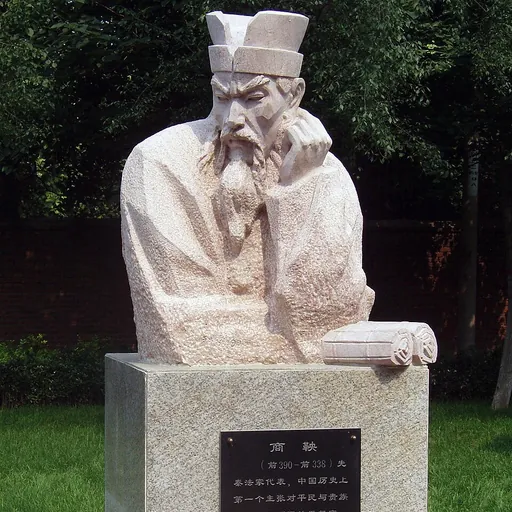
About Shang Yang
Lived 390 BC – 338 BC (aged 51–52). Shang Yang was a politician and philosopher.
Shang Yang (; – 338 BC), also known as Wei Yang and originally surnamed Gongsun , was a chancellor and reformer of the State of Qin. Ultimately becoming arguably the "most famous and influential statesman" from the (early) Warring States period, he was more evidently known to Xun Kuang as a renowned military leader whose reforms strengthened Qin. Possibly going into broad circulation late in the period, writings associated with Shang Yang went on to influence the Han Feizi.
Born in the Zhou vassal state of Wey, he migrated to Wei, ultimately finding office in Qin in 359 BCE. Becoming Qin's chief minister for twenty years, he launched two series of reforms, laying the administrative, political and economic foundations that would eventually enable Qin to conquer the other six rival states, unifying China under centralized rule for the first time under the Qin dynasty. Scholars consider it likely that both he and his followers contributed to The Book of Lord of Shang.
Biography According to the Shiji, Shang Yang was born as the son of a concubine, to become the chief adviser in Qin. His numerous reforms transformed the peripheral Qin state into a militarily powerful and strongly centralized kingdom. Changes to the state's legal system (which were said to have been built upon Li Kui's Canon of Laws) propelled the Qin to prosperity. Enhancing the administration through an emphasis on meritocracy, his policies weakened the power of the feudal lords.
In 341 BC, Qin attacked the state of Wei. Gongsun personally led the Qin army to defeat Wei, and eventually Wei ceded the land west of the Yellow River to Qin. For his role in the war, Gongsun received 15 cities in Shang as his personal fief, becoming known as the lord of Shang (Shang Jun) or Shang Yang. According to the Records of the Grand Historian, with his personal connections while serving in the court of Wei, Shang Yang invited Gongzi Ang, the Wei general, to negotiate a peace treaty. As soon as Ang arrived, he was taken prisoner, and the Qin army attacked, successfully defeating their opponents. Mark Edward Lewis considered reorganization of the military as potentially responsible for the orderly plan of roads and fields throughout north China. This might be far fetched, but Gongsun was as much a military reformer as a legal one.
The Shang Yang school of thought was favoured by Emperor Wu of Han, and John Keay mentions that Tang figure Du You was drawn to Shang Yang.
Reforms He is credited by Han Fei, often considered to be the greatest representative of Chinese Legalism , with the creation of two theories;
"fixing the standards" "equality before the law"
Believing in the rule of law and considering loyalty to the state above that of the family, Yang introduced two sets of changes to the State of Qin. The first, in 356 BC, were- Li Kui's Book of Law was implemented, with the important addition of a rule providing punishment equal to that of the perpetrator for those aware of a crime but failing to inform the government. He codified reforms into enforceable laws. The laws were stringent and multitudinous reformed by Yang and the punishments were strict. Assigning land to soldiers based upon their military successes and stripping nobility unwilling to fight of their land rights. The army was separated into twenty military ranks, based upon battlefield achievements. The reform of military made Qin citizens willing to join the army and helped the Qin dynasty build the military power necessary to unify China. As manpower was short in Qin, Yang encouraged the cultivation of unsettled lands and wastelands and immigration, favouring agriculture over luxury commerce (though also paying more recognition to especially successful merchants).
Yang introduced his second set of changes in 350 BC, which included a new standardized system of land allocation and reforms to taxation.
The vast majority of Yang's reforms were taken from policies instituted elsewhere, such as from Wu Qi of the State of Chu; however, Yang's reforms were more thorough and extreme than those of other states, and monopolized policy in the hands of the ruler. Under his tenure, Qin quickly caught up with and surpassed the reforms of other states.
Domestic policies Yang introduced land reforms, privatized land, rewarded farmers who exceeded harvest quotas, enslaved farmers who failed to meet quotas, and used enslaved subjects as (state-owned) rewards for those who met government policies.
As manpower was short in Qin relative to the other states at the time, Yang enacted policies to increase its manpower. As Qin peasants were recruited into the military, he encouraged active migration of peasants from other states into Qin as a replacement workforce; this policy simultaneously increased the manpower of Qin and weakened the manpower of Qin's rivals. Yang made laws forcing citizens to marry at a young age and passed tax laws to encourage raising multiple children. He also enacted policies to free convicts who worked in opening wastelands for agriculture.
Yang partly abolished primogeniture (depending on the performance of the son) and created a double tax on households that had more than one son living in the household, to break up large clans into nuclear families.
Yang moved the capital from the city of Yueyang to Xianyang, in order to reduce the influence of nobles on the administration. Xianyang remained Qin's capital until its fall in 207 BC.
Death Yang was deeply despised by the Qin nobility According to Zhan Guo Ce, Yang went into hiding; at one point Yang was refused a room at an inn because one of his own laws prevented admission of a guest without proper identification.
Yang was executed by : dismemberment by being fastened to five chariots, cattle or horses and being torn to pieces); his whole family was also executed. Despite his death, King Huiwen kept the reforms enacted by Yang.
A number of alternate versions of Yang's death have survived. According to Sima Qian in his Records of the Grand Historian, Yang first escaped to Wei. However, he was hated there for his earlier betrayal of Gongzi Ang and was expelled. Yang then fled to his fiefdom, where he raised a rebel army but was killed in battle. After the battle, King Hui of Qin had Yang's corpse torn apart by chariots as a warning to others.
Early modern assessments A. F. P. Hulsewé considered Shang Yang the "founder of the school of law", and considers his unification of punishments one of his most important contributions; that is, giving the penalty of death to any grade of person disobeying the king's orders. Shang Yang even expected the king, though the source of law (authorizing it), to follow it. This treatment is in contrast to ideas more typical of archaic society, more closely represented in the Rites of Zhou as giving different punishments to different strata of society.
Hulsewe points out that Sima Tan considered equal treatment the "school of law's" most salient point: "They do not distinguish between close and far relatives, nor do they discriminate between noble and humble, but in a uniform manner they decide on them in law." The Han dynasty adopted essentially the same denominations of crimes, and conception of equality, as Shang Yang set down for Qin, without collective punishment of the three sets of relatives.
Early references Shang Yang's deeds are presented in the late pre-imperial Qin state's encyclopedic Lushi Chunqiu, though its opinion of him had already declined. Though ultimately becoming famous (and infamous) more broadly, the Han Feizi, traditionally placed near the end of the Warring States period, is the first preserved reference for writings associated with Shang Yang, with the Book of Lord of Shang possibly going into broad circulation late in the period alongside the Guanzi.
The Xunzi mentions Shang Yang among renowned military leaders of the recent past. The Xunzi does not directly mention Shang Yang as strengthening Qin, but Yuri Pines believed that it "clearly attributes" Qin's strengthening over (the past) "four generations" to him. A.C. Graham did not see Xun Kuang (or the Xunzi) as being otherwise apparently very familiar with Shang Yang, and it seems unlikely that the Zhuangzi's authors were very familiar with him either.
However, there is at least one possible earlier example to note, in the Analects, but only if Chapter 14 of the Analects is taken to be later than Confucius. Brooks & Taeko do not directly argue whether Chapter 14 references The Book of Lord Shang. They argue that Chapter 14 dates to circa 310 BCE. To note, some ideas in the Book of Lord Shang may as so generalizable to early Warring States period mobilization that they may not have to come from it.
Don’t just read it —
keep it.
Full-length biographies made to live with: read them, listen on the way to work, watch them tonight.
- E-book
- Audio
- Video
Instant download · yours to keep · every purchase keeps this site free
Important facts
People in Shang Yang's life
Named in this biography and alive at the same time
Related people
Same field, nearest in time




Contemporaries
People whose lives overlapped Shang Yang's


Frequently asked questions
Who was Shang Yang?
Qin State statesman, chancellor and reformer (c. 390–338 BC)
When was Shang Yang born?
Shang Yang was born in 390 BC in Puyang.
When did Shang Yang die?
Shang Yang died in 338 BC in Xianyang.
What was Shang Yang's occupation?
Shang Yang was a politician and philosopher.
What nationality was Shang Yang?
Shang Yang's recorded nationality: Wey, Qin.
Sources & further reading
Cite this page
APA: Biography.guide. (2026). Shang Yang. https://biography.guide/shang-yang/
MLA: "Shang Yang." Biography.guide, https://biography.guide/shang-yang/.
Chicago: "Shang Yang." Biography.guide. https://biography.guide/shang-yang/.
Data last updated: 2026-09-20 · Spot an error? Report a correction.
Portrait: Wikimedia Commons · author & licence
Page generated 2026-09-27 04:57 UTC