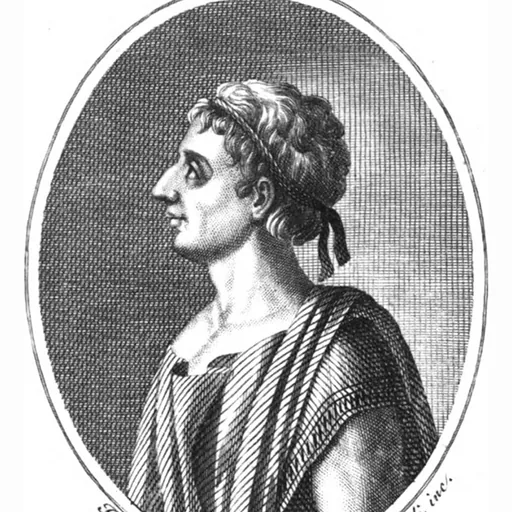
About Dionysius I of Syracuse
Lived 430 BC – 367 BC (aged 62–63). Dionysius I of Syracuse was a politician.
Dionysius I or Dionysius the Elder ( 432 – 367 BC) was a Greek tyrant of Syracuse, Sicily. He conquered several cities on Sicily and southern Italy, opposed Carthage's influence on Sicily and made Syracuse the most powerful of the western Greek colonies. He was regarded by the ancients as the worst kind of despot: cruel, suspicious, and vindictive.
Early life Dionysius was the son of Hermocrates, a prominent Syracusan general . Dionysius began his working life as a clerk in public office in Syracuse. Having consolidated his position, Dionysius imposed the mercenaries on all parts of the polis community, signaling that democracy had ended in Syracuse. His rule was "unconstitutional and illegitimate and could not fail to provoke rebellions among the partisans of democratic government". Dionysius' position at home was threatened as early as 403 by those philosophically opposed to tyranny. Sparta, which had in the past deposed tyrants from Corinth to Athens, did not damn Dionysius and his autocracy. In fact, according to the historian Diodorus Siculus, relations between the two were very positive:
When the Lacedaemonians [Spartans] had settled the affairs of Greece to their own taste, they dispatched Aristus, one of their distinguished men, to Syracuse, ostensibly pretending that they would overthrow the government, but in truth with intent to increase the power of the tyranny; for they hoped that by helping to establish the rule of Dionysius they would obtain his ready service because of their benefactions to him.
Dionysius even received the privilege of conscripting mercenaries from lands under Spartan authority. The demise of such a prominent democratic polis and the subsequent actions of Dionysius represented a recurring norm in fourth-century Greek states, thanks to the prevalence of mercenaries. The mercenary and the tyrant went hand in hand; for example, Polybius noted that "the security of despots rests entirely on the loyalty and power of mercenaries". Aristotle wrote that some form of "guard" (i.e., a personal army) is needed for absolute kingship, and for an elected tyrant an optimum number of professional soldiers should be employed. Too few would undermine the tyrant's power, while too many would threaten the polis itself. The philosopher also notes that the people of Syracuse were warned not to let Dionysius conscript too many "guards" during his regime. his attempts to drive the Carthaginians entirely out of Sicily failed; at his death they were still masters of at least a third of it.
He carried out an expedition against the Italiote League in 387 BC After him, the Adriatic became a sea of Syracuse. In the Corinthian War, he joined the side of the Spartans and assisted them with mercenaries and ships (which contributed in blocking the Athenians' supplies from the Black Sea forcing them to peace). He joined the Illyrians in an attempt to plunder the temple of Delphi. under Agesilaus, however, and with aid from Thessaly, Macedonia, and the Molossians themselves, the Spartans expelled the Illyrians.
Colonization of the Adriatic Sea (388 - 383 BC)
Around 387-385 BC, Dionysius undertook an intensive program of colonization of the Adriatic for a number of reasons: to dominate the naval routes to the rich grain markets of the Po Delta, to conquer Epirus and to gain access to the riches of the temples of Delphi. To do this, Dionysius made a pact with the Illyrians and the Senones.
in Italy Ankón (now Ancona, a colony populated in 387 BC by political exiles), and Adrìa (in 385 BC, now Adria); in Dalmatia Issa (now Vis) and in Albania Lissos (in 385 BC, now Lezhë). According to others, he was given an overdose of a sleeping potion by his physicians at the instigation of his son, Dionysius the Younger, who succeeded him as ruler of Syracuse. Modern historian Jeff Champion states that there is no evidence to prove the claim he was conspired against.
His life was written by Philistus, but the work is lost. Plutarch relates a version of this story in his On the Fortune of Alexander.
He also posed as an author and patron of literature; his poems, severely criticized by Philoxenus, were hissed at the Olympic games, but having gained a prize for a tragedy on the Ransom of Hector at the Lenaea at Athens, he was so elated that he engaged in a debauch which, according to some sources, proved fatal.
Historical significance and legacy
He was one of the first Greek rulers to be given divine honors during his lifetime, and he made innovations in military technique, such as siege engines, which became a standard feature of warfare under Alexander the Great and later generals.
It has been theorized that Brennus was working in concert with Dionysius, who sought to control all of Sicily. Rome had strong allegiances with Messana, a small city state in north east Sicily, which Dionysius wanted to control. Rome's army being pinned down by Brennus' efforts would have assisted Dionysius's campaign.
Don’t just read it —
keep it.
Full-length biographies made to live with: read them, listen on the way to work, watch them tonight.
- E-book
- Audio
- Video
Instant download · yours to keep · every purchase keeps this site free
Important facts
People in Dionysius I of Syracuse's life
Named in this biography and alive at the same time

Related people
Same field, nearest in time
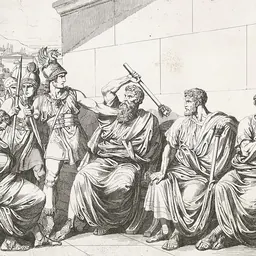
Contemporaries
People whose lives overlapped Dionysius I of Syracuse's
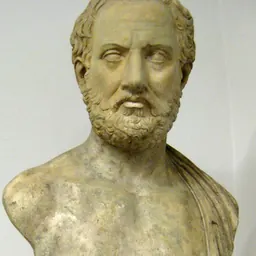
Frequently asked questions
Who was Dionysius I of Syracuse?
Greek tyrant of Syracuse (c. 432 – 367 BC)
When was Dionysius I of Syracuse born?
Dionysius I of Syracuse was born in 430 BC in Syracuse.
When did Dionysius I of Syracuse die?
Dionysius I of Syracuse died in 367 BC.
What was Dionysius I of Syracuse's occupation?
Dionysius I of Syracuse was a politician.
Sources & further reading
· Wikipedia: Dionysius I of Syracuse
· DBpedia: Dionysius I of Syracuse
Cite this page
APA: Biography.guide. (2026). Dionysius I of Syracuse. https://biography.guide/dionysius-i-of-syracuse/
MLA: "Dionysius I of Syracuse." Biography.guide, https://biography.guide/dionysius-i-of-syracuse/.
Chicago: "Dionysius I of Syracuse." Biography.guide. https://biography.guide/dionysius-i-of-syracuse/.
Data last updated: 2026-09-21 · Spot an error? Report a correction.
Portrait: Wikimedia Commons · author & licence
Page generated 2026-09-27 05:01 UTC