
About Shaun Greenhalgh
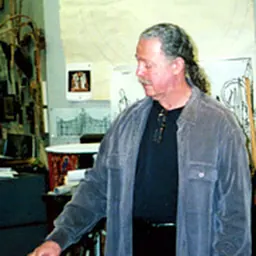
Born 1961. Shaun Greenhalgh is a British sculptor, painter and art forger.
Shaun Greenhalgh (born 19 September 1961) is a British artist and former art forger. Over seventeen years, between 1989 and 2006, he produced a large number of forgeries. With the assistance of his brother and elderly parents, who fronted the sales side of the operation, he successfully sold his fakes internationally to museums, auction houses, and private buyers, accruing nearly £1 million.
The family have been described by Scotland Yard as "possibly the most diverse forgery team in the world, ever". However, when they attempted to sell three Assyrian reliefs using the same provenance as they had previously, suspicions were finally raised.
The Victoria and Albert Museum in London held an exhibition of Greenhalgh's works from 23 January to 7 February 2010.
The Metropolitan Police's Art and Antiques Unit built a replica model of the shed where the works were created. Many of Greenhalgh's fakes, including the Amarna Princess, a version of the Roman Risley Park Lanx, and works supposedly by Barbara Hepworth and Thomas Moran, were displayed.
Family roles Greenhalgh's family was involved in "the garden shed gang". They established an elaborate cottage industry at his parents' house in The Crescent, Bromley Cross, South Turton, which is about north of Bolton town centre.
Other members of the family were invoked to help establish the legitimacy of the fake items. These included Olive's father who owned an art gallery, a great-grandfather who it seemed had had the foresight to buy well at auctions, A self-taught artist, undoubtedly influenced by his job as an antiques dealer, he worked up his forgeries from sketches, photographs, art books and catalogues. He attempted a wide range of crafts, from painting in pastels and watercolours, to sketches, and sculpture, both modern and ancient, busts and statues, to bas-relief and metalwork. He invested in a large range of different materials – silver, stone, marble, rare stone, replica metal, and glass. While this sounds as though materials were openly displayed, it was perhaps not quite that obvious. Angela Thomas, a curator from the Bolton Museum, actually visited the family at home prior to the purchase of the Amarna Princess and reported nothing untoward. made the telephone calls "because he was shy and did not like to use the telephone." For example, George Sr. told the Bolton Museum that he was "thinking about using [the Amarna Princess statue] as a garden ornament".
The Amarna Princess
In 1999, the Greenhalghs began their most ambitious project. Using the leeway this vague description allowed, Greenhalgh manufactured what became known as the Amarna Princess, a 20-inch statue, apparently made of a translucent alabaster. It later emerged within a Panorama documentary that he had bought the tools to produce the work from hardware store B&Q.
Done in the Egyptian "Amarna period" style of 1350 BC, the statue represents one of the daughters of the Pharaoh Akhenaten and Queen Nefertiti. At the time, as Greenhalgh had researched, only two other similar statuettes were known to exist in the world. claiming the Amarna Princess was from his grandfather's "forgotten collection", bought at the Silverton Park auction. This would have made the average value of each piece more than £83,000, although money received varied between £100 (for the Eadred Reliquary) and £440,000 (for the Amarna Princess). The Greenhalghs did not manage to offload most of their works. Many which they did sell, such as the Eadred Reliquary, purportedly were undersold, garnering only minimal amounts. Others, such as the Lowry painting The Meeting House, only gained in value from their repeated resale, which would not have benefited the Greenhalghs.
As time went on, more ambitious, expensive pieces of work were produced, some of which did sell, like the Risley Park Lanx. However, these were subject to more scrutiny and indeed it was one of these, the Assyrian reliefs, which led to their exposure and arrests, which suggests that the longevity of their scam was concentrated on the passing-off of lower level items.
Balanced against this must be the success of sales to private individuals. They are unlikely to have had the same level of expertise at their disposal as institutions, and are probably less willing to advertise their losses once the forgeries were detected. Certainly they have not had the same exposure as the debacle surrounding the Bolton Museum, for example. Two individual buyers, "wealthy Americans" have been identified, but only after they donated their purchase to the British Museum.
In addition, the bank records of the Greenhalghs only went back six years, so in the final analysis the exact amount of monies involved over the seventeen-year scam has not been determined. What is known is that "two Halifax accounts... one containing £55,173 and the other £303,646" were frozen, pending a confiscation hearing in January 2008, and Shaun Greenhalgh was convicted for "conspiracy to conceal and transfer £410,392."
Bonhams consulted with the British Museum about various suspicious aspects, and the museum then spotted several improbable anomalies. The horses' reins were "not consistent"
Court case, convictions and sentencing At their trial at Bolton Crown Court in 2007, the three defendants pleaded guilty to creating the forgeries and laundering the money they received. On 16 November, Shaun Greenhalgh was sentenced to 4 years and eight months, while his mother received a 12-month suspended sentence. The parents were using wheelchairs at their appearance for sentencing. George Greenhalgh's sentence was delayed for medical reports in 2007,
Detective Sergeant Vernon Rapley, from the Metropolitan Police Arts and Antiquities Unit said shortly after the Greenhalgh's were sentenced: "Looking at them now I'm not sure the items would fool anyone, it was the credibility of the provenances that went with them." The subject of an academic thesis. 1993–1994. Thomas Moran sketch and watercolour acquired by Bolton Museum. "The former was a gift given by the Greenhalghs; the latter was purchased for £10,000." 1994. The Faun. A ceramic sculpture by Paul Gauguin. Authenticated by the Wildenstein Institute, sold at Sothebys auction in 1994 for £20,700 to private London dealers, Howie & Pillar. Bought by the Art Institute of Chicago in 1997 for $125,000. On display until October 2007. 1995. Anglo-Saxon ring. Tried to sell it through Phillips Auctioneers; determined by British Museum to be a fake. 1995. 24 sketches by Thomas Moran sold in New York. Police believe up to 40, worth up to £10,000, were created by Greenhalgh, six or seven of which are unaccounted for. He claimed each one only took him thirty minutes to forge, and that a former mayor of Bolton had given them to an ancestor of his who worked for the mayor as a cleaner. An ancient Celtic fibula (or brooch) Henry Moore. A carved stone head by Henry Moore, which Greenhalgh Snr tried to convince the Tate Modern, London to buy, claiming to have got it via his grandmother.
La Bella Principessa claim
In November 2015 as part of the publicity for the upcoming A Forger's Tale, an article in The Sunday Times put forward Greenhalgh's claim that he was the creator of La Bella Principessa attributed to Leonardo da Vinci.
A December 2015 article in The New York Times also promoted Greenhalgh's claimed authorship of the work, which it said he had made in the late 1970s, around the age of 20, using vellum recycled from a 16th-century land deed and the face of a supermarket check-out girl named "Alison" who worked in Bolton.
Greenhalgh repeated his claim to be the creator in a May 2017 interview with Simon Parkin in The Guardian, observing that he had studied the work again when it was exhibited at the Villa Reale di Monza in 2015. The Postscript chapter in Greenhalgh's 2017 autobiography provided further details about his claim, identifying the sitter as "Bossy Sally from the Co-Op" (p. 356).
Art historian Martin Kemp said he found the claim hilarious and ridiculous.
Television programmes On 4 January 2009, BBC Two broadcast a dramatisation of the Greenhalgh story called The Antiques Rogue Show, a play on the title of the BBC series Antiques Roadshow, already used by headline writers. In a letter from prison to the Bolton News, Shaun Greenhalgh complained about the depiction of himself and his family, calling the drama "character assassination".
Shaun Greenhalgh appeared in the 2012 BBC documentary The Dark Ages: An Age of Light and is listed as "Craftsman" in the credits.
In October 2019, he appeared in Handmade in Bolton on BBC2, a short documentary series fronted by Janina Ramirez, directed and narrated by Waldemar Januszczak, in which he remade four objects from the past using traditional materials and methods.
Autobiography His autobiography A Forger's Tale: Confessions of the Bolton Forger was originally published in a limited edition in 2015 by ZCZ Editions. The first full edition was published on 1 June 2017 with an Introduction by Waldemar Januszczak. It won The Observers Best Art Book of the Year, 2018.
Don’t just read it —
keep it.
Full-length biographies made to live with: read them, listen on the way to work, watch them tonight.
- E-book
- Audio
- Video
Instant download · yours to keep · every purchase keeps this site free
Important facts
People in Shaun Greenhalgh's life
Named in this biography and alive at the same time




Related people
Same field, nearest in time


Contemporaries
People whose lives overlapped Shaun Greenhalgh's

Frequently asked questions
Who is Shaun Greenhalgh?
Forger, fraudster (born 1961)
When was Shaun Greenhalgh born?
Shaun Greenhalgh was born on 19 September 1961 in Bromley Cross.
What is Shaun Greenhalgh's occupation?
Shaun Greenhalgh is a sculptor, painter and art forger.
What nationality is Shaun Greenhalgh?
Shaun Greenhalgh is British.
Sources & further reading
Cite this page
APA: Biography.guide. (2026). Shaun Greenhalgh. https://biography.guide/shaun-greenhalgh/
MLA: "Shaun Greenhalgh." Biography.guide, https://biography.guide/shaun-greenhalgh/.
Chicago: "Shaun Greenhalgh." Biography.guide. https://biography.guide/shaun-greenhalgh/.
Data last updated: 2026-09-20 · Spot an error? Report a correction.
Page generated 2026-09-27 05:15 UTC