
Shahu I
Chhatrapati of India from 1708 to 1749
About Shahu I
Lived 1682 – 1749 (aged 66–67).
Shahu I (18 May 1682 – 15 December 1749) was the fifth Chhatrapati of Maratha Empire from 1708 to 1749, the longest reign among the Maratha rulers. He was also the last subahdar of the Bijapur Subah, before being annexed by the Maratha Empire. During Shahu's reign, driven largely by the strategic vision and military leadership of his Peshwas, the Maratha Empire expanded across much of the Indian subcontinent and emerged as the leading power in South Asia.
Shahu, his father Sambhaji I and his grandfather Shivaji Maharaj, all belonged to the Bhonsle dynasty. He, along with his mother Yesubai Bhonsle, was under the capture of Aurangzeb during the Deccan Wars. For nearly 18 years, Shahu was under captive but was treated with royal courtesy and he was often interfered in Mughal politics. By 1707, Shahu was released by Aurangzeb's son Bahadur Shah I, in order to strengthen Mughals' relations with Marathas. Shahu held military and administrative posts during his captive days in the Mughal Empire before being the governor of the Bijapur Subah. Shahu succeeded his cousin Shivaji II by 1708 at the age of 26, shortly after Aurangzeb's death and his release. Then, Shahu launched military compaigns on the regions of Khed, Adilabad, Konkan, Bengal, Bihar and western Indian subcontinent. He also have successfully ceded them to the Maratha territory, with an exception of Bengal whose half territory was only incorporated to the empire. One of his most successful and famous campaigns were during at the Afsharid invasion of India in which the Afsharid Empire, under the rule of Nader Shah, occupied Delhi and the remaining western territories of an insignificant Mughal Empire. Marathas, under the rule of Shahu, helped the Mughals against the Persian Afsharid dynasty. By 1740, the combined forces of the Marathas and Mughals and other smaller regional powers defeated the Persians in the subcontinent and thereby, forcing Nader Shah's huge army to retreat from Lahore and western Indian subcontinent (Afghanistan, Khyber Pakhtunkhwa, Pakistan and Punjab) and ceded all their territories in India to the Marathas. Thus, Marathas eventually captured Delhi and became the sole dominant power in South Asia, replacing Mughals which have been the dominant power in the region for over three centuries, and made them his puppets.
Shahu also introduced Mughal and western-styled form of administration into the Maratha Empire. He divided his empire into subahs (provinces), a system which was introduced by Akbar in the Mughal Empire. During Shahu's reign, the central authority of the empire became much stronger and the empire was highly centralized, with the Chhatrapati being the head of the state. Shahu was a great patron of many Indian languages, such as Marathi, Hindustani, Persian, Sanskrit, Prakrit and Tamil. He also made Hindustani as the dominant language in the empire's court, alongside his dynastic language, Marathi. He also issued coins in Persian, Prakrit, Sanskrit and French languages. The empire, under Shahu, started making trade contacts and strong relations with powers outside South Asia such as Britain, France, Iran and others. Because of all these reforms, he is called as Maharaj e-Hind or Padishah e-Hind in Persian and Hindustani languages, making him the only Maratha emperor to carry these titles.
Shahu died in 1749 at the age of 67, due to sudden heart attack and was succeeded by his son, Rajaram II. Some historians often claims that the decline of the Maratha Empire took place after his death but these citations are often dismissed as the empire still continued to be an effective power in Asia during the reign of Rajaram II. However, Shahu's death was significant blow to the empire. After his death, the power was passed into the hands of the Peshwa and the Chhatrapati was reduced into a nominal power. The central authority grew weaker and the Maratha Empire was decentralized into several houses of powers such as Holkars in Indore and Delhi, Scindias in Gwalior and Sind and Gaekwads in Baroda and Bhopal, in which all of them was ruled by the Peshwa and the Ashta Pradhan.
Early life
In 1689, at the age of seven, Shahu was taken prisoner along with his mother by the Mughals after the Battle of Raigarh. Aurangzeb was fighting the decentralised Marathas and hoped to use the crown heir Shahu as a pawn in his battle. Therefore, he treated Shahu and his mother well. Even in Mughal captivity, Shahu's mother, Queen Yesubai, continued to rule her private territories as a Deshmukh. Aurangzeb regarded Shahu, whose real name was Shivaji as 'Sav or Sadhu Shivaji' in contrast to his grandfather Shivaji I, resulting in his popular title 'Raja Shahu' meaning Honest or Saint King.
Shahu was married to two daughters of high ranking Maratha Sardars in the Mughal service. Aurangzeb gifted Shahu the Bhavani sword of Shivaji, the sword of Afzal Khan, and another gold-hilted sword. Aurangzeb also granted him Sanads to lands and revenue rights around the Parganas of Akkalkot, Supa, Baramati, and Nevase for his maintenance. After Aurangzeb's death in 1707, one of his sons, Prince Azam Shah, released Shahu in the hope of starting an internecine conflict among the Marathas, and also to have Shahu on his side for his own succession battle for the Mughal throne. At that time, his aunt Tarabai, who governed the Maratha realm in the name of her son (also named Shivaji), denounced Shahu as an impostor substituted by the Mughals for the son of Sambhaji. Shahu then waged a civil war against Tarabai to gain the Chhatrapati's throne in 1708 and emerged victorious.
Ancestry
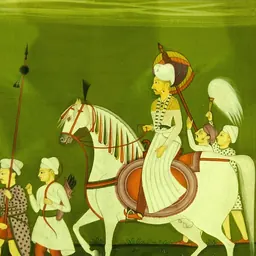
Accession Early reign Painting of Shahu I with his imperial guards, c. 18th century Following the death of Aurangzeb, Shahu grew impatient about returning to his homeland. He was advised by princess Zinat-un-Nissa (Aurangzeb's daughter) and Zulfiqar Khan to not wait for formal sanads of appointment from Azam Shah, but to quit the Mughal camp at once and proceed to his home country. He readily acted upon this advice and left the Mughal camp at Doraha on 8 May 1707. The rulers of Bharatpur, Jaipur, Jodhpur and Udaipur received Shahu on his way to Pune with warm hospitality. Shahu visited the sacred city of Ujjain and paid his obeisance to Shri Mahakaleshwar. At Burhanpur, Jotyaji Kaskar was left behind by Shahu to receive the sanads from the Mughals. Shahu then arrived at Bijagad, about thirty miles south of Narmada, and was joined by its ruler Rawal Mohansinh, who had long rebelled against Aurangzeb and cooperated with the Marathas. Mohansinh was the first to espouse the cause of Shahu and help him with troops and funds. From Bijagad, Shahu proceeded to Sultanpur, where he was joined by several Maratha chiefs such as Amritrao Kadambande, Rawal Sujansinh of Lamkani, the Bokils, the Purandares and other Brahmin families.
Kolhapur succession
Early conflicts After reaching Maharashtra, Senasahibsubha Parsoji Bhonsle, commander of 15,000 troops, pledged himself to Shahu. Parsoji’s example was quickly followed by Sardar Nimaji Shinde, Sarlashkar Haibatrao Nimbalkar, Rustamrao Jadhavrao (Shahu’s father-in-law), Sekhoji Thorat and Chimnaji Damodar who were all operating in Baglana, Khandesh and Nashik region. The forces of Tarabai assembled near Kudas Khed for a confrontation.
On 3 August 1707, Jotyaji Kesarkar received the formal sanads for Raja Shahu at Burhanpur from the new Mughal emperor, Bahadur Shah, who had got the throne by killing his half-brother and rival, emperor Azam Shah in the Battle of Jajau. While Bahadur Shah granted Marathas sardeshmukhi of the Deccan, he failed to grant them chauth and thus to satisfy them fully. He also did not recognise Shahu as the rightful Maratha Chhatrapati. He thus let Tara Bai and Shahu fight for supremacy over the Maratha Kingdom. The Battle of Khed would be a major development in the ensuing civil war.
Battle of Khed
leftOn his march from Pune to the field of Khed Kudus, Shahu faced resistance from the town of Parad(village in Jalna district), which had a small fortress from which a feeble cannonade was directed upon his forces by the Patil Sayaji Lokhande. The fortress was stormed and levelled to the ground, and the besieged were put to the sword. The Patil Sayaji's widow placed her son Ranoji in Shahu's palanquin. Shahu, who regarded this as his first victory, named the boy Fatesinh and adopted him as his own son.
Upon the death of Athani's Maratha lord Himmat Bahadur Vithoji Chavan, his son Udaji Chavan succeeded to his fief and his title of Himmat Bahadur. During the Maratha-Mughal Wars, Udaji's father had been a close friend of Ramchandra Amatya, and Udaji had joined the faction of Tarabai (and thereby of her son Sambhaji). From his castle at Battis Shirale, Udaji frequently mounted raids in Shahu's territories, terming the exactions as the "Chavan Chauth". In the 1730s, after the death of Senapati Trymbakrao Dabhade and Bajirao's distant campaigns, Udaji Chavan obtained sanction from Tarabai's son Sambhaji to lead a force across the Warana river against Shahu. He pitched his camp at Shirol and began to plunder the countryside. Shahu, who was hunting in the neighborhood, sent for Udaji Chavan, promising him a safe conduct. After receiving bitter chiding by Shahu for his actions, Udaji Chavan decided to having him assassinated. A few days later, four assassins entered Shahu's tent, who was seated alone. Shahu was so indifferent to the danger posed by the assassins that the assassins lost heart and threw down their guns at his feet, pleading for mercy. Shahu enquired about their employer and they admitted that they had been sent by Udaji Chavan. Shahu gave each of the assassins a gold bracelet, and made them pick up their arms and take them back to Udaji along with a certificate from himself that stated they were good and faithful servants while deciding to mount up the conflict against Sambhaji. Shambhusimha Jadhav and Pratinidhi launched a rapid assault on Sambhaji's camp at Warana riverbanks and wiped out most of the Kolhapur army. All of Sambhaji’s military chest and stores were captured by the Pratinidhi. Tarabai, Rajasbai, Sambhaji’s wife Jijabai, Bhagwantrao Ramchandra, and Vyankatrao Joshi were taken as prisoners to Chhatrapati Shahu who chivalrously sent Sambhaji’s mother and wife to Panhala. The dispirited Tarabai chose to reside with Shahu in the palace prepared for her at Satara, concluding her role in the civil war. Shahu's forces took Vishalgad next, compelling Sambhaji to agree to a conclusive treaty. The Battle of Palkhed was fought on 28 February 1728 at the village of Palkhed, near Nashik, Maharashtra, India, between the Maratha Empire and the Nizam-ul-Mulk, Asaf Jah I of Hyderabad, wherein the Marathas defeated the Nizam. After the Battle of Bundelkhand, the Marathas became major players in the Ganga-Yamuna Doab. During Shahu's lifetime, Marathas conquered Bundelkhand, Bundi, Malwa, Gujarat, Gwalior, Kota, and the Ganga-Yamuna Doab.
Shahu advanced the interests of the ryots and brought barren tracts under cultivation, encouraged the plantation of trees, and relieved the suffering of the poor classes by abolishing irksome taxes.
His Shirke queens, Sakwarbai and Sagunabai, owned their own residences called 'Dareemi Mahal' and 'Dhakta Mahal', respectively. They had their own 'Chitnis/Chitnavis' ministers to look after their establishments. They derived their income from the 'watans', certain privileges and trade revenue being carried on in ports of Colaba district called 'Khadi of Kundalika'. They had also received 'Sanads' from the Chhatrapati to carry on the trade in different precious commodities such as fish, salt, rice, spices, and cocoa-nuts to and from their tax-free ports of Roha and Ashtami. Disturbances, attacks, and onslaughts by Abyssinians, Europeans were frequent. The queens were often requested to check the nefarious activities of many upstarts with military support. Accounts reveal that the queens were well informed of the events taking place on the Western Indian coast, and that they maintained close contact with influential Maratha Sardars and other figures like Brahmendra Swami to maintain their hold over the political situation of Konkan sphere.
Shahu adopted Parvati Kolhatkar when she was 3 years old. She was the daughter of a Konkanastha Brahmin mamledar of Pen, Raigad. He trained her in warfare and administration. He later had her married to Sadashivrao Bhau when she was 15 years old. Even though her father was alive, he performed her kanyadan. He also adopted two sons, Ranoji Lokhande who was renamed Fatehsinh I, and Rajaram II of Satara (who succeeded him as Ramaraja Chhatrapati). Rajaram II had been brought to him by Shahu's paternal aunt, Tarabai, who initially claimed that the young man was her grandson and thus a descendant of Shivaji, but later disowned him as an imposter when he would not be a pawn for her politics. Ultimately, she admitted to his legitimacy in the presence of other Maratha Sardars. Due to the controversy of this event, after Shahu's death, Tarabai vengefully arrested Ramaraja Chhatrapati to take over Satara court. Thus, the executive powers were indirectly legitimised with the Pune-based Peshwa Balaji Bajirao.
Shahu had adopted Ranoji Lokhande, later known as Fatehsinh I Raje Sahib Bhonsle, the son of Meherban Sayaji Lokhande, the Patil of Parad Budruk(village in Jalna District now). Sayaji Patil had died in Chhatrapati Shahu's sack of Parad during the Maratha civil war, and his mother handed him over to Shahu who was seated on his palanquin. Fatehsinh thus became the first Raja of Akkalkot around the year 1708. Upon his adoption, Fatehsinh received the town of Akkalkot and surrounding areas. The descendants of Fatehsinh later went on to establish the Lokhande Bhonsle dynasty in Akkalkot state of Maharashtra.
Legacy, death and succession Chhatrapati Shahu I issuing orders to Peshwa Balaji BajiraoSatara (Sapta Tara) was the name of the citadel, while the capital city below the fort was actually named Shahunagar. Shahu shifted his throne from the citadel to the city's Rangmahal Palace in 1721. He supplied the new city with good drinking water brought in pipes from the Mahadara and Yavteshvar hills. There was also a mint established in the city.
Shahu was fond of sports such as hunting wild game and shooting birds, and used to have a daily ride outside Satara into the jungles for this purpose, thereby getting both fresh air and exercise. During the monsoon season this was accompanied by fishing. Shahu patronised singers, instrument-players, bards, and actors. He kept well-trained hounds and was particular about their pedigree. He was equally fond of well bred horses and birds, and knew their qualities and features. Rarities of various kinds such as candles, scents, knives, swords, tobacco, gunpowder used to be ordered by him through his admiral Kanhoji Angre from European traders. He also purchased elephant tusks. He was equally fond of good gardens, and ordered the planting of rare fruit and flower trees imported from different places. His adopted son Rajaram II of Satara, claimed by Tarabai to be her grandson, succeeded the Satara throne. However, actual power was held first by Tarabai, and then by Peshwa Balaji Baji Rao.
Don’t just read it —
keep it.
Full-length biographies made to live with: read them, listen on the way to work, watch them tonight.
- E-book
- Audio
- Video
Instant download · yours to keep · every purchase keeps this site free
Important facts
Family & relationships
People in Shahu I's life
Named in this biography and alive at the same time




Contemporaries
People whose lives overlapped Shahu I's



Frequently asked questions
Who was Shahu I?
Chhatrapati of India from 1708 to 1749
When was Shahu I born?
Shahu I was born on 18 May 1682.
When did Shahu I die?
Shahu I died in 1749 in Satara.
Sources & further reading
Cite this page
APA: Biography.guide. (2026). Shahu I. https://biography.guide/shahu-i/
MLA: "Shahu I." Biography.guide, https://biography.guide/shahu-i/.
Chicago: "Shahu I." Biography.guide. https://biography.guide/shahu-i/.
Data last updated: 2026-09-20 · Spot an error? Report a correction.
Page generated 2026-09-27 05:21 UTC