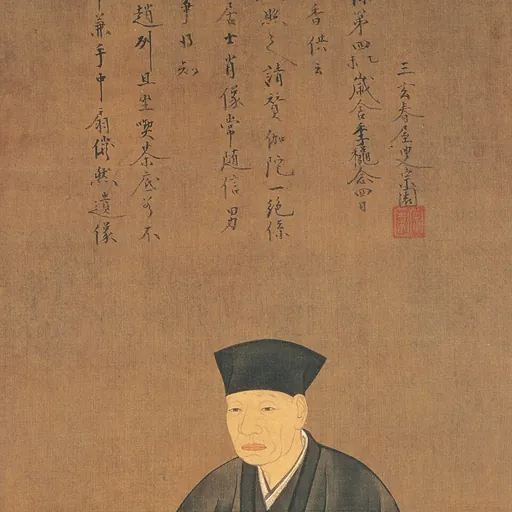
About Sen no Rikyū
Lived 1522 – 1591 (aged 68–69). Sen no Rikyū was a Japanese buddhist monk and tea master.
, also known simply as Rikyū,
Three iemoto or sōke ('head houses') of tea ceremony are directly descended from Rikyū: the Omotesenke, Urasenke, and Mushakōjisenke, all of which are dedicated to passing forward the teachings of their mutual family founder, Rikyū. They are collectively referred to as .
Early life Rikyū was born in Sakai, now in Osaka Prefecture. His father was a warehouse owner named , who later in life also used the family name Sen, and his mother was . His childhood name was .
As a young man, Rikyū studied tea under the townsman of Sakai named Kitamuki Dōchin (1504–62), and at nineteen, through Dōchin's introduction, he began to study tea under Takeno Jō'ō, who is also associated with the development of the wabi aesthetic in tea ceremony. He is believed to have received the Buddhist name from the Rinzai Zen priest Dairin Sōtō (1480–1568) of Nanshū-ji in Sakai. He married a woman known as Hōshin Myōju (d. 1577) around when he was 21. and, following Nobunaga's death in 1582, he was a tea master for Toyotomi Hideyoshi. His relationship with Hideyoshi quickly deepened, and he entered Hideyoshi's circle of confidants, effectively becoming the most influential figure in the world of . In 1585, as he needed extra credentials to enter the Imperial Palace in order to help at a tea gathering that would be given by Hideyoshi for Emperor Ōgimachi, the emperor bestowed upon him the Buddhist lay name and title . Another major event of Hideyoshi's that Rikyū played a central role in was the Grand Kitano Tea Ceremony, held by Hideyoshi at the shrine of Kitano Tenmangū in 1587.
Suigetsu (Intoxicated by the Moon) paper hanging scroll for a tea ceremony by Sen no Rikyū, c. 1575
It was during his later years that Rikyū began to use very tiny, rustic chashitsu (tea ceremony rooms) referred as ('grass hermitage'), such as the two-tatami mat tea room named Tai-an, which can be seen today at Myōki-an temple in Yamazaki, a suburb of Kyoto, and which is credited to his design. This tea room has been designated as a National Treasure. He also developed many tea utensils, including bamboo flower containers, tea scoops, and lid rests, and used everyday objects in tea ceremony in novel ways.
Raku ware chawan (tea bowls) were originated through his collaboration with a tile-maker named Raku Chōjirō. Rikyū preferred simple, rustic, locally-made items to the expensive, Chinese-made items that were fashionable at the time. Though not the inventor of the philosophy of wabi-sabi, which finds beauty in the very simple, Rikyū is among those most responsible for popularizing it, developing it, and incorporating it into tea ceremony. He developed a new form of tea ceremony using simple instruments and settings. This, along with his other beliefs and teachings, came to be known as (the grass-thatched hermitage style of ), or, more generally. This line of that his descendants and followers carried on was recognized as the .
A writer and poet, the tea master referred to the ware and its relationship with the tea ceremony, saying, "Though you wipe your hands and brush off the dust and dirt from the vessels, what is the use of all this fuss if the heart is still impure?"
Two of his primary disciples were Nanbō Sōkei (; dates unknown), a somewhat legendary Zen priest; and Yamanoue Sōji (1544–90), a townsman of Sakai. Another was Furuta Oribe (1544-1615), who became a celebrated tea master after Rikyū's death. Nanbō is credited as the original author of the Southern Record, a record of Rikyū's teachings. There is, however, debate over whether Nanbō even existed, and some scholars argue that his writings were actually by the samurai litterateur Tachibana Jitsuzan (1655-1708), who claimed to have found and transcribed these texts. Yamanoue's chronicle, the , gives commentary about Rikyū's teachings and the state of at the time of its writing.
Rikyū had a number of children, including a son, Sen no Dōan, and a daughter, Okame. This daughter married Sen Shōan, the son of Rikyū's second wife in a previous marriage. Due to complex circumstances, Sen Shōan, rather than Rikyū's legitimate heir, Dōan, was recognized as the second-generation figure in the Sen family tradition of tea ceremony.
Rikyū also wrote poetry and practiced ikebana.
One of his favourite gardens was said to be at Chishaku-in in Kyoto.
Death Although Rikyū had been one of Hideyoshi's closest confidants, because of crucial differences of opinion and because he was too independent, Hideyoshi ordered him to commit ritual suicide. One year earlier, after the Siege of Odawara (1590), his famous disciple Yamanoue Sōji was tortured and decapitated on Hideyoshi's orders. While Hideyoshi's reason may never be known for certain, it is known that Rikyū committed seppuku at his residence within Hideyoshi's Jurakudai palace in Kyoto in 1591 on the 28th day of the 2nd month (of the traditional Japanese lunar calendar; or April 21 when calculated according to the modern Gregorian calendar), at the age of seventy. The memorial gatha of Sanmon, "Kinmo palace", in Daitoku-ji.
According to Okakura Kakuzō in The Book of Tea, Rikyū's last act was to hold an exquisite tea ceremony. After serving all his guests, he presented each piece of the tea-equipage for their inspection, along with an exquisite kakemono, which Okakura described as "a wonderful writing by an ancient monk dealing with the evanescence of all things". Rikyū presented each of his guests with a piece of the equipment as a souvenir, with the exception of the bowl, which he shattered, as he uttered the words: "Never again shall this cup, polluted by the lips of misfortune, be used by man." As the guests departed, one remained to serve as witness to Rikyū's death. Rikyū's last words, which he wrote down as a death poem, were in verse, addressed to the dagger with which he took his own life:
When Hideyoshi was building his lavish residence at Fushimi the following year, he remarked that he wished its construction and decoration to be pleasing to Rikyū. Hideyoshi was known for his temper, and is said to have expressed regret at his treatment of Rikyū.
Rikyū's grave is located at Jukō-in sub-temple in the Daitoku-ji compound in Kyoto; his posthumous Buddhist name is Fushin'an Rikyū Sōeki Koji.
Memorials for Rikyū are observed annually by many schools of Japanese tea. The Omotesenke school's annual memorial takes place at the family's headquarters each year on March 27, and the Urasenke school's takes place at its own family's headquarters each year on March 28. The three Sen families (Omotesenke, Urasenke, Mushakōjisenke) take turns holding a memorial service on the 28th of every month, at their mutual family temple, the subsidiary temple Jukōin at Daitoku-ji temple.
Rikyū's Seven High-Status Disciples The ('Seven Foremost Disciples', 'Seven Luminaries') is a set of seven high-ranking daimyō or generals who were also direct disciples of Sen no Rikyū: Maeda Toshinaga, Gamō Ujisato, Hosokawa Tadaoki, Furuta Oribe, Makimura Toshisada, Dom Justo Takayama, and Shibayama Munetsuna. The seven-member set was first mentioned by Rikyū's grandson Sen no Sōtan. In a 1663 list given by Sōtan's son (and fourth-generation head of the Sen Sōsa lineage of tea masters), Maeda Toshinaga is replaced by Seta Masatada.
Don’t just read it —
keep it.
Full-length biographies made to live with: read them, listen on the way to work, watch them tonight.
- E-book
- Audio
- Video
Instant download · yours to keep · every purchase keeps this site free
Important facts
more
RikyūPeople in Sen no Rikyū's life
Named in this biography and alive at the same time






Related people
Same field, nearest in time
Contemporaries
People whose lives overlapped Sen no Rikyū's

Frequently asked questions
Who was Sen no Rikyū?
Japanese tea master
When was Sen no Rikyū born?
Sen no Rikyū was born in 1522 in Sakai.
When did Sen no Rikyū die?
Sen no Rikyū died on 21 April 1591 in Kyoto.
What was Sen no Rikyū's occupation?
Sen no Rikyū was a buddhist monk and tea master.
What nationality was Sen no Rikyū?
Sen no Rikyū was Japanese.
Sources & further reading
Cite this page
APA: Biography.guide. (2026). Sen no Rikyū. https://biography.guide/sen-no-rikyu/
MLA: "Sen no Rikyū." Biography.guide, https://biography.guide/sen-no-rikyu/.
Chicago: "Sen no Rikyū." Biography.guide. https://biography.guide/sen-no-rikyu/.
Data last updated: 2026-09-23 · Spot an error? Report a correction.
Portrait: Wikimedia Commons · author & licence
Page generated 2026-09-27 05:05 UTC