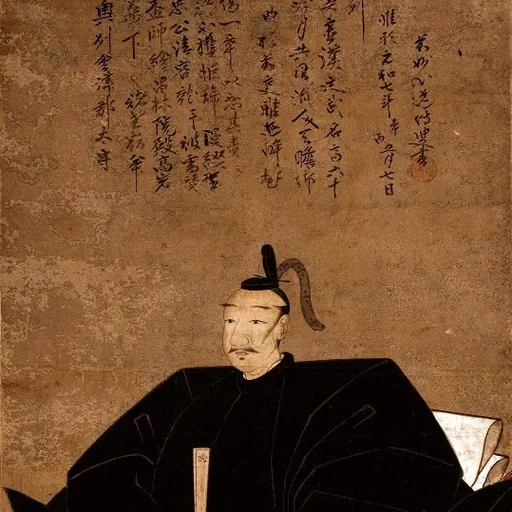
About Gamō Ujisato
Lived 1556 – 1595 (aged 38–39). Gamō Ujisato was a Japanese samurai.
was a Japanese daimyō of the Sengoku and Azuchi–Momoyama periods. He was heir and son of Gamō Katahide, lord of Hino Castle in Ōmi Province, and next managed Ise Province as lord of Matsusaka Castle and finally 920,000 koku in Aizu as lord of Tsurugajo Castle.
Ujisato was favoured by Oda Nobunaga and participated in almost all of his major battles, including those against the Azai and Asakura clans, the Sieges of Nagashima, the Tenshō Iga War and the Battle of Nagashino. After Nobunaga's death, he served Toyotomi Hideyoshi, and took part in all of Hideyoshi's subsequent campaigns: Kyushu Campaign, the Siege of Odawara (1590), the pacification of Ōshū (Mutsu and Dewa Provinces) (1590).
He joined Christianity and was even baptised and given the baptismal name Leon.
He was a disciple of Sen no Rikyū and a first-class tea master, one of The Seven Disciples of Rikyū.
The Gamō clan was a senior vassal of the Rokkaku clan, a daimyo in Ōmi Province. However, when Nobunaga Oda entered Kyoto, the Gamō clan left the Rokkaku clan and became vassals of the Oda clan. Nobunaga recognised Ujisato's qualities at their first meeting and liked his intelligent manner, saying that the sharp look in his eyes showed that he was no ordinary man, and Nobunaga had Ujisato serve close to him.
In May 1569, Ujisato reached the manhood (Genpuku) at the age of 14 and used the name .
When Shibata Katsuie took charge of the Hokuriku campaign in 1575, the Gamō clan and other Ōmi-shū were separated from Katsuie and the Gamō clan served as hatamoto under Nobunaga's direct command, based at Hino Castle. Nobunaga moved his headquarters to Azuchi in 1576, but like other former Ōmi-shu, the Gamō clan did not move to Azuchi Castle, but remained in their own territory at Hino Castle. Ujisato moved from place to place to fight while learning about governance under his father, and he increasingly acted independently of his father from around 1581. As a result of his exploits in the Battle of Shizugatake in 1583 and Komaki Nagakute in 1584, he was transferred to Matsugashima Castle in Ise Province in 1584 with 120,000 koku. He then built a new castle, Matsusaka Castle, in Yoiho no Mori in 1588. Aizu was surrounded by major forces such as Date Masamune and Mogami Yoshiaki, who were not to be underestimated, and Ōshū was also an important place to monitor Uesugi Kagekatsu in Echigo and to check Tokugawa Ieyasu in Kanto. Therefore, Hideyoshi, who highly valued Ujisato's abilities, appointed Ujisato as the commander-in-chief of the Toyotomi regime's forces to occupy Ōshū. He was therefore given 420,000 koku to provide him with sufficient troops, later increased to 730,000 koku and eventually given a grand estate of 920,000 koku.
He had a diverse ability, well known not only as a military commander of great leadership and valour, but also as a man of culture with a deep knowledge of the tea ceremony and Noh. In the tea ceremony, he is regarded as the first of The Seven Disciples of Rikyū, and is also said to have laid the foundations for the prosperity of the tea ceremony. After Sen no Rikyū was forced to commit seppuku by Hideyoshi, he took in his second wife's stepson, Sen Shōan, and was instrumental in his pardon. Later, through the intercession of Ujisato and Ieyasu, Shōan was pardoned and returned to the forefront of the tea ceremony in Kyoto, where his grandson founded the Sansenke (the three Sen families). It is also documented that in 1593 he appeared in a Noh performance at the Imperial Palace organized by Hideyoshi and was well received.
Anecdotes Many of his remaining anecdotes relate to his subordinates. Ujisato held a meeting once a month with all his vassals and allowed them to speak freely regardless of their age or position. It is said that at a time when he was still too low in kokudaka value to offer sufficient bounties, he invited his war-winning vassals to his home and treated them like guests of honour, with dinners he had cooked himself and sake. Then, while the vassals were bathing, they were approached and looked outside, where they saw Ujisato, covered in soot and boiling water with firewood. The vassals were said to have been so moved that they fought for loyalty. When Ujisato hired retainers, he always told them, "Our hatamoto always have a warrior wearing a silver catfish-taled helmet at the front, so do your best not to lose to him". When the newcomers went to the battlefield, it was Ujisato himself who was wearing the catfish-tailed helmet. Ujisato suddenly entrusted one of his troops to a vassal who was laughed at as a coward, over the objections of his other vassals, and contrary to most expectations, he made a major mark. He believed that any person could be useful if he gave them responsibility. It is said that Ujisato once warned his subordinate who had left his post, but when he saw him on his way back, he was gone again, so he immediately cut him down. There is also a theory about this subordinate that he was entrusted with the important catfish-tailed helmet, but he neglected it, so he was cut down. When Ujisato transferred to Aizu, he made Hideyoshi approve of his decision to take in problematic but skilled ronin, such as those who had been issued circulars to avoid being taken in by other daimyo because of their lord's anger. These misfits recognised Ujisato as their lord and played an active role, but after his death, they left the Gamō clan one after another. There is a theory that he was assassinated with poison by Hideyoshi or Ishida Mitsunari due to his death at the young age of 40 and rumours that Hideyoshi had been cautious about him. However, this story is less credible because it appeared in highly adapted historical documents written in later times and because Hideyoshi had a number of highly respected doctors examine him. From treatment records of the time, it is now assumed that one of the internal cancers would have been the cause of his death.
Family Father: Gamō Katahide Mother: Okiri no Kata Wife: Fuyuhime (1561–1641) Children: Takehime married Nanbu Toshinao by Fuyuhime Sekihime married Maeda Toshimasa by Fuyuhime Gamō Ujitoshi by Fuyuhime Gamō Hideyuki by Fuyuhime
Representative relics Helmets or (owned by the Iwate Prefectural Museum). It is said that when Ujisato's daughter, Otake-no-Kata, married Nanbu Toshinao, she brought a helmet worn by Ujisato as a gift. In the battle, Ujisato is said to have worn a . However, the remaining helmet is a swallow-tailed, despite being called catfish-tailed helmet. This is because the helmet is recorded as a catfish-tailed helmet in the ledger of the Nanbu family, which has handed down the helmet. The catfish-tailed helmet worn by Ujisato has not survived, and it is unclear whether the shape of the helmet that Ujisato actually wore was a catfish-tail or swallow-tail.
Swords Aizu Shintōgo sword Sword made by Shintōgo Kunimitsu owned by Gamō Ujisato. The name, "Aizu", refers to the Aizu area which he controlled.
Don’t just read it —
keep it.
Full-length biographies made to live with: read them, listen on the way to work, watch them tonight.
- E-book
- Audio
- Video
Instant download · yours to keep · every purchase keeps this site free
Important facts
People in Gamō Ujisato's life
Named in this biography and alive at the same time

Related people
Same field, nearest in time

Contemporaries
People whose lives overlapped Gamō Ujisato's



Frequently asked questions
Who was Gamō Ujisato?
daimyo
When was Gamō Ujisato born?
Gamō Ujisato was born in 1556 in Hino.
When did Gamō Ujisato die?
Gamō Ujisato died on 17 March 1595 in Fushimi-ku.
What was Gamō Ujisato's occupation?
Gamō Ujisato was a samurai.
What nationality was Gamō Ujisato?
Gamō Ujisato was Japanese.
Sources & further reading
Cite this page
APA: Biography.guide. (2026). Gamō Ujisato. https://biography.guide/gamo-ujisato/
MLA: "Gamō Ujisato." Biography.guide, https://biography.guide/gamo-ujisato/.
Chicago: "Gamō Ujisato." Biography.guide. https://biography.guide/gamo-ujisato/.
Data last updated: 2026-09-20 · Spot an error? Report a correction.
Portrait: Wikimedia Commons · author & licence
Page generated 2026-09-27 04:58 UTC