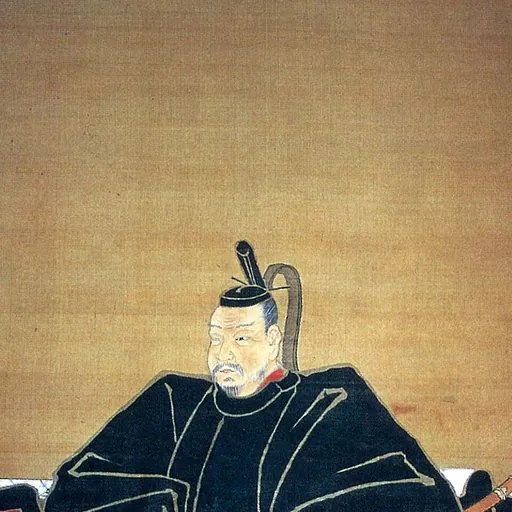
Date Masamune
Daimyo of the Sengoku period to early-Edo period; 1st lord of Sendai
About Date Masamune
Lived 1567 – 1636 (aged 68). Date Masamune was a Japanese samurai and military personnel.
was a Japanese samurai and daimyō during the Azuchi–Momoyama period through the early Edo period. Heir to a long line of powerful feudal lords in the Tōhoku region, he went on to found the modern-day city of Sendai. An outstanding tactician, he was made all the more iconic for his missing eye, as Masamune was often called dokuganryū (独眼竜), or the "One-Eyed Dragon of Ōshū". As a legendary warrior and leader, Masamune is a character in a number of Japanese period dramas.
Early life and rise Date Masamune was born as Bontenmaru (梵天丸) later Tojirō (藤次郎), as the eldest son of Date Terumune, likely born in Yonezawa Castle (in modern Yamagata Prefecture). Various theories behind the eye's condition exist. Some sources say he plucked out the eye himself when a senior member of the clan pointed out that an enemy could grab it in a fight. Others say that he had his trusted retainer Katakura Kojūrō gouge out the eye for him, making him the "One-Eyed Dragon" of Ōshu.
The Date clan had built alliances with neighboring clans through marriages over previous generations, but local disputes remained commonplace. Shortly after Masamune's succession in 1584, a Date retainer named Ōuchi Sadatsuna defected to the Ashina clan of the Aizu region. Masamune declared war on Ōuchi and the Ashina for this betrayal, and started a campaign to hunt down Sadatsuna. Formerly amicable alliances were cast aside as he began to attack and conquer the lands of Sadatsuna's allies in pursuit, even those of his kin in Mutsu and Dewa Province.
In the winter of 1585, one of these allies, Nihonmatsu Yoshitsugu felt defeat was approaching and chose to surrender to the Date instead. Masamune agreed to accept the surrender, but on the heavy condition that the Nihonmatsu give up most of their territory to the Date. This resulted in Yoshitsugu kidnapping Masamune's father Terumune during their meeting in Miyamori Castle, where Terumune was staying during the time. The incident ended with Terumune and Yoshitsugu killed as the fleeing Nihonmatsu party clashed with the pursuing Date troops near the Abukuma River.
Due to the death of Date Terumune by the hands of Nihonmatsu Yoshitsugu, Masamune swore vengeance. In January 1586, Masamune had his revenge by launching an attack against the Nihonmatsu at the Battle of Hitotoribashi. The following year, Date Masamune once again attacked Nihonmatsu at Battle of Koriyama in 1588, the son of Hatakeyama Yoshitsugu set the castle on fire and fled to Aizu. Various records of the event exist, although they present different accounts of its circumstances. That same year, he effectively won a series of battles against the Soma and Ashina clans.
In 1589, the Date clan fought many battles with their neighbours afterwards, including the Siege of Kurokawa and Battle of Suriagehara against Ashina clan. After defeating the Ashina clan, Masamune made Kurokawa Castle in Aizu domain his base of operations. Later, Masamune fought in the Siege of Sukagawa and defeated Nikaidō clan. In the end 1589, Masamune sealed the Date clan's hegemony over southern Mutsu Province.
Service under Hideyoshi In 1590, Toyotomi Hideyoshi seized Odawara Castle and compelled the Tōhoku-region daimyō to participate in the campaign. Although Masamune refused Hideyoshi's demands at first, he had no real choice in the matter since Hideyoshi was the virtual ruler of Japan. Masamune still delayed, infuriating Hideyoshi. Expecting to be executed, Masamune, wearing his finest clothes and showing no fear, faced his angry overlord. Not wanting further trouble, Hideyoshi spared his life, saying that "He could be of some use."
Being a major power in northern Japan, Masamune was naturally viewed with suspicion, as any potential rival would be viewed. Toyotomi Hideyoshi reduced the size of his land holdings after his tardiness in coming to the Siege of Odawara against Hōjō Ujimasa.
In 1591, Masamune forfeited the ancestral land of the Date Clan (present day Date City, Kawamata, Koori, and Kunimi) to Hideyoshi, causing widespread riots. He never regained the territory.
After he fought against Kunohe Rebellion, he was given Iwatesawa and the surrounding lands as his home domain. Masamune moved there, rebuilt the Iwatesawa Castle, renamed it Iwadeyama, and encouraged the growth of a town at its base. In 1636, Masamune died of a combination of esophageal cancer and peritonitis at the age of 68 years. He was returned to Sendai in the same daimyō procession as when he was alive. The shogunate gave approval for his eldest legitimate son, Date Tadamune, to inherit the Date clan territory.
Patron of culture and Christianity
Masamune expanded trade in the northeastern Tōhoku region. Although initially faced with attacks by hostile clans, he managed to overcome them after a few defeats and eventually ruled one of the largest fiefdoms of the later Tokugawa shogunate. He built many palaces and worked on many projects to beautify the region. He is also known to have encouraged foreigners to come to his land. Even though he funded and promoted an envoy to establish relations with the Pope in Rome, he was likely motivated at least in part by a desire for foreign technology, similar to that of other lords, such as Oda Nobunaga. Further, once Tokugawa Ieyasu outlawed Christianity, Masamune reversed his position, and though disliking it, let Ieyasu persecute Christians in his domain. For 270 years, Tōhoku remained a place of tourism, trade, and prosperity. Matsushima, for instance, a series of tiny islands, was praised for its beauty and serenity by the wandering haiku poet Matsuo Bashō.
He showed sympathy for Christian missionaries and traders in Japan. In addition to allowing them to come and preach in his province, he also released the prisoner and missionary Padre Sotelo from the hands of Tokugawa Ieyasu. Date Masamune allowed Sotelo as well as other missionaries to practice their religion and win converts in Tōhoku.
Masamune notably funded and backed one of Japan's few journeys of far-flung diplomacy and exploration in this period. He ordered the building of the exploration ship San Juan Bautista, using foreign (European) ship-building techniques. He sent one of his retainers, Hasekura Tsunenaga, Sotelo, and an embassy numbering 180 on a successful voyage to establish relations with the Pope in Rome. This expedition visited such places as the Philippines, Mexico, Spain and Rome. Previously, Japanese lords had never funded this sort of venture, so it was probably the first successful voyage. At least five members of the expedition stayed in Coria (Seville) of Spain to avoid the persecution of Christians in Japan. 600 of their descendants, with the surname Japón (Japan), are now living in Spain.
When the Tokugawa government banned Christianity, Masamune had to obey the law. However, some sources suggest that Masamune's eldest daughter, Irohahime, was a Christian.
Family
Father: Date Terumune Mother: Yoshihime (1548–1623), daughter of Mogami Yoshimori the daimyō of Dewa Province Wife: Megohime, daughter of Tamura Kiyoaki owner of Miharu Castle in Miharu Domain, Mutsu Province Sibling: Date Kojirō Masamichi Concubines: Īsaka no Tsubone (1569–1634) Shinzō no Kata (d. 1612) Shōkō'in (1583–1656) Oyama no Kata (1587–1668) Shōgo'in (d. 1644) Okachi no Kata (d. 1669) Hosshō'in (1604–1664) Prostitute: Kōnomae (1577–1641) Children: Date Hidemune (1591–1658), by Shinzō no Kata Irohahime (1594–1661), by Megohime, never remarried after the forced divorce with Matsudaira Tadateru Date Tadamune (1600–1658), by Megohime, the second lord of Sendai Domain (1600–1634), by Shinzō no Kata, adopted by to succeed the Iizaka clan but died childless Date Muneyasu (1602–1639), by Shōkō'in, first head of the Iwadeyama-Date branch family Date Munetsuna (1603–1618), by Megohime, first head of the Iwagasaki Date branch family but died childless Date Munenobu (1603–1627), by Oyama no Kata, was adopted to become the second head of the Iwagasaki Date branch family but also died childless and it became extinct Date Munetaka (1607–1626), by Oyama no Kata, was adopted and became the first head of the Murata Tade family (a Date line offshoot), but caught smallpox and died childless Mūhime (1608–1683), by Oyama no Kata, married Ishikawa Munetaka Takematsumaru (1609–1615), by Megohime Date Munezane (1613–1665), by Shōgo'in, adopted into the Watari family (different from the Watari-Date family) Minehime (1616–1635), by Okachi no Kata, married Date Munezane (1611–1639) of the Watari-Date family Date Munekatsu (1621–1679), by Okachi no Kata Sengikuhime (1626–1655), by Hosso'in, married Kyōgoku Takakuni Tsuta (1598–1671), by Kōnomae, adopted by Oniniwa Tsunamoto, married Harada Munesuke Watari Munemoto (1600–1669), by Kōnomae, initially adopted by Oniniwa Tsunamoto, then adopted by Watari Shigemune
Others Aunt: Onamihime (1541–1602), daughter of Date Harumune, sister of Date Terumune, and owner of Sukagawa Castle in Mutsu. Wet nurse (foster mother): Katakura Kita (1538–1610), half-sister of Katakura Kagetsuna and Oniniwa Tsunamoto, also mentor of Kagetsuna and Masamune.
"Three Great Men" of Date clan Katakura Kagetsuna (片倉 景綱, 1557 – December 4, 1615) was a samurai of the Katakura clan, also known by his court title, Bichū no Kami (備中守), or more commonly, as Katakura Kojūrō. Date Shigezane (伊達 成実, 1568 – July 17, 1646). A senior retainer of the Date clan of Sendai, he was a cousin of Date Masamune and founder of the Watari-Date clan. Oniniwa Tsunamoto (鬼庭 綱元) (1549 – July 13, 1640). Deeply trusted by Masamune, he was made a senior retainer at the young age of 35.
Retainers Oniniwa Yoshinao Rusu Masakage Shiroishi Munezane Kokubu Morishige Yashiro Kageyori Tamura Kiyoaki Ōuchi Sadatsuna Hasekura Tsunenaga Katakura Shigenaga Inawashiro Morikuni
Date clan's prominent castles
Yonezawa Castle: original base of power for the Date clan from 1548 and possibly Masamune's birthplace. Tateyama Castle: Date Terumune spent retired life in the castle. There is a possibility Date Masamune was born in Tateyama castle. Obama Castle: Masamune stayed in the castle from 1585 to 1586. Kurokawa Castle: original base of power for the Date clan from 1589 to 1591. Iwadeyama Castle: original base of power for the Date clan from 1591 to 1601. Aoba Castle: original base of power for the Date clan from 1601. Wakabayashi Castle: Masamune's fortified residence but now Miyagi prison is on site, He spent most of his time in the castle after he reconstructed it in 1627. Nihonmatsu Castle: Katakura Kagetsuna, Date Shigezane Hachōme Castle: Date Sanemoto Fukushima Castle: Date Harumune Ōmori Castle: Date Sanemoto, Date Shigezane Shiroishi Castle: Katakura Kagetsuna Watari Castle: Watari Motomune, Katakura Kagetsuna
In popular culture According to 21st-century historian Watanabe, no historical documents have been found from the Sengoku period that refer to Masamune as the "One-Eyed Dragon." The moniker was first found in the 1830, the famous Confucian scholar Rai San'yō wrote a poem about Masamune in his "Eishi Zekku" (Eishi Quaal Poems), in which he referred to him as the "One-Eyed Dragon". Originally, "One-Eyed Dragon" was the nickname of Li Keyong, who was active in the late Tang dynasty in China. Li Keyong was known as an excellent military commander, and Daimon suspected that San'yō most likely compared Masamune to Li Keyong in that poem.
There is no record of Masamune ever wearing an eyepatch. A portrait of Date Masamune (by Yasunobu Kano) held by the Sendai City Museum is depicted with both eyes open, in accordance with Masamune's will. Portraits and wooden statues made after his death show both eyes open, with the right eye slightly smaller. Daimon also discusses how Masanune's eyepatch appearance fluctuated in 20th-century entertainment. The 1942 film "Dokuganryu Masamune" marked the first time Masamune appeared wearing an eyepatch. Actor Ken Watanabe, who played the lead role of Masamune in the 1987 NHK historical drama "Dokuganryu Masamune," appeared wearing an eyepatch made from the tsuba of a sword over his right eye. Since then, this appearance has become established for portrayals of Masamune.
Masamune is the protagonist of the anime series Masamune Datenicle, produced by the city of Date in collaboration with Fukushima Gainax in order to promote the city's historic connection to the Date Clan. In this series, he is depicted as a child taking on the role of leader of his clan for the first time. Previous leaders of the Date Clan manifest in order to help him prepare for his first battle.
The professional wrestling organization Osaka Pro Wrestling featured two wrestlers using the ring names Masamune and Hideyoshi, who together form the tag team "Sengoku".
Don’t just read it —
keep it.
Full-length biographies made to live with: read them, listen on the way to work, watch them tonight.
- E-book
- Audio
- Video
Instant download · yours to keep · every purchase keeps this site free
Important facts
Family & relationships
People in Date Masamune's life
Named in this biography and alive at the same time



Related people
Same field, nearest in time

Contemporaries
People whose lives overlapped Date Masamune's



Frequently asked questions
Who was Date Masamune?
daimyo of the Sengoku period to early-Edo period; 1st lord of Sendai
When was Date Masamune born?
Date Masamune was born on 5 September 1567 in Yonezawa Castle.
When did Date Masamune die?
Date Masamune died on 27 June 1636 in Edo.
What was Date Masamune's occupation?
Date Masamune was a samurai and military personnel.
What nationality was Date Masamune?
Date Masamune was Japanese.
Sources & further reading
Cite this page
APA: Biography.guide. (2026). Date Masamune. https://biography.guide/date-masamune/
MLA: "Date Masamune." Biography.guide, https://biography.guide/date-masamune/.
Chicago: "Date Masamune." Biography.guide. https://biography.guide/date-masamune/.
Data last updated: 2026-09-23 · Spot an error? Report a correction.
Portrait: Wikimedia Commons · author & licence
Page generated 2026-09-27 05:08 UTC