
About Seamus Elliott
Lived 1934 – 1971 (aged 36). Seamus Elliott was an Irish sport cyclist.
Seamus "Shay" Elliott (4 June 1934 – 4 May 1971) was an Irish road bicycle racer, Ireland's first major international rider, with a record comparable only to Sean Kelly and Stephen Roche. He was the first Irish person to ride the Tour de France, first to win a stage, and first to wear the yellow jersey, and first English speaker to win stages in all the Grand Tours. He died in unclear circumstances at the age of 36.
Early life Elliott was from the working class area of Crumlin in Dublin, the eldest son of James Elliott, a motorbike mechanic,
Amateur career
He joined a small cycling club, St Brendan's, attached to St Brendan's Catholic Church, Coolock, when he was 16 and took part in races of about 20 miles that the church organised around the city streets. He came second in his first race, riding a "scrap" bike with a single fixed wheel that led his pedals to bang the road on corners. The winner had a specialised racing bike.
Elliott joined the Southern Road Club when he was 17 and, on a racing bike, won the Grand Prix of Ireland run over 50 km in the Phoenix Park. The club broke up soon afterwards and Elliott joined the Dublin Wheelers, one of the most active clubs at that time, in March 1952. That summer he won the Mannin Veg, a race over one lap of the TT motorcycling circuit on the Isle of Man. He also won the Dublin-Galway-Dublin two-day race, winning the race back to Dublin in a sprint.
In 1953 he rode the Manx International, over three laps of the TT circuit, for the Ireland "B" team. He fell on the tricky turn at Governor's Bridge, shortly before the finish, but came fourth. He won the 1953 Irish amateur road championship.
His King of the Mountains placing in the Tour of Ireland in 1954 earned him a trip to the Simplex training camp in Monte Carlo the following spring.
Jock Wadley said of him in Sporting Cyclist:I can not remember all the items in Shay's luggage, of course. But I can hardly forget that one whole compartment in the chest of drawers was devoted to provisions which Shay had brought from Ireland, the chief stock being 2lb [1kg] of tea and 2lb of chocolate creams. I was invited to eat as many of the chocolates as I liked, because his aunt who worked in the place where they were made would soon be sending more.
He said that Elliott was one of several riders asked to strip for examination by the soigneur Raymond Le Bert, who normally worked for Louison Bobet. Wadley wrote:It would be wrong to say that the company laughed when Shay stood there in his underpants, but there were certainly some smiles because in contrast to his lithe, clean-limbed predecessors at the examination, Shay looked a short, fat boy. Le Bert, however, did not smile. Immediately he exclaimed: 'Ah ha, now this is really rock. He is a real flahute. (Flahute is a favourite French way of describing the old-type tough Flemish roadman.)
Elliott did not return permanently to Ireland at the end of the training camp in early 1955. He had just finished six years as an apprentice sheet-metal worker and he and his family in Old County Road in Crumlin, had decided that he had mastered panel-beating and would have a trade to return to if his efforts to become a professional cyclist failed. He contacted a former French professional, Francis Pélissier, for advice. Pélissier told Elliott to compete in as many races as possible, at least three or four a week – possibly in France, but not in Ireland, a cycling backwater. Elliott planned to move to Ghent in Belgium, where he could race several times a week and, as an amateur, win money denied to him in Ireland. At the training camp, however, he met the journalist and race organiser Jean Leulliot, who told him he would burn himself out in round-the-houses racing and urged him to move to Paris.
Leulliot remembered how Elliott had won the Tourmalet stage of the 1954 Route de France, which Leulliot's paper, Route et Piste, organised. Leulliot asked in his paper for someone to accommodate Elliott in the capital and added "The Irishman is soaked with class and has a great future before him." The appeal was answered by Paul Wiegant of the Athletic Club Boulogne-Billancourt (ACBB) in Paris, France's top amateur team. Elliott won five one-day amateur classics in 1955 and set the world 10 km amateur record on the Vélodrome d'Hiver in Paris. He was the first foreigner to be ranked top amateur in France. Both finished outside the day's race elimination time limit, and expected to be sent home. However, the team's manager, Sauveur Ducazeaux, insisted the judges apply a rule that no rider in the first ten could be eliminated. Robinson had started the day ninth: it was Elliott who was sent home. "The mother hen was cooked; the chick avoided the pot", Fotheringham said. Robinson always regretted the outcome, and when he won the next stage, told journalists that he did it for Elliott.
In 1960, Elliott became the first English-speaking rider to take the pink jersey in the Giro d'Italia.
His best result was in the 1963 Tour de France. He won by 33 seconds, enough to give him the yellow jersey of leadership. He held it for three days. Another 20 years passed before another Irishman, Sean Kelly, led the Tour. This achievement also made him the first English-speaker to lead the three great European tours, of Italy, Spain and France. Tom Simpson won, beating Elliott and a domestic professional, Albert Hitchen. Controversy started the moment that Cycling printed a picture of the sprint. Elliott had his hands tugging his brakes before the line. The magazine suggested he was braking to avoid the crowd further down the road, but many thought it a fix. Another rider in the race, Pete Ryalls, said in Procycling in 2008: The fix was for Barry Hoban to win. Barry was touch and go whether he'd get another contract because he'd done sweet FA all season. And it all went wrong because he didn't have the form anyway and it's a bloody long way if you don't have the legs. And the thing that messed it up was that going across Anglesey a big tall lanky guy called Peter Gordon. He pushed off and caused all sorts of consternation and the only people who could get across to him were Simpson and the guys he'd brought across with him, and Hitchen... so presumably they sorted it out between them afterwards, but that was the fix: that Hoban should win. I know for certain that it was. Elliott, braking to stop Hitchen behind him, so Simpson could win, was riding in Simpson's pay. Simpson offered Elliott £1,000 to help him win the world championship in 1963. Elliott refused, speculation being that he had been offered more by someone else.
Elliott later wrote a newspaper article suggesting that he made more money by selling races than winning them.
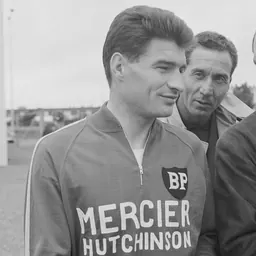
Decline Elliott's career started to fade from the mid-1960s. He moved in 1966 from Anquetil's team to the rival Mercier-BP, sponsored by a bicycle company and an oil company and led by Anquetil's rival, Raymond Poulidor. Elliott planned for retirement by opening a hotel in Loctudy in Brittany. He had no prior experience in the hospitality trade and that project took so much of his time that he could ride only local races. After promising Mercier-BP that he would make amends in the world championship, the chain came off his bicycle and he finished 15th.
Things grew worse. His marriage to Marguerite, failed. The hotel, too, failed and Elliott lost all his money.
To try to restore his situation, he sold a story to the British tabloid newspaper, The People, telling of drug-taking and bribery. The article went into few details but was enough for him to be snubbed by other professionals. The same had happened to Simpson when he sold his story to the same paper but while Simpson recovered despite reprimands from his agent, criticism in the cycling press and a threat of dismissal by his team, Elliott's career never regained momentum. British cycling journalist Jock Wadley, who had shared a room with Elliott at the Simplex training camp, said: "I knew times were hard for him but nobody knew just how hard until he had to do that.
Later years Elliott returned to Dublin in 1967 and set up a metal-working business in Prince's Street in the city centre,
Coverage In 2009 a documentary film, Cycle of Betrayal, about Shay Elliott, was shown in Ireland (first on Setanta Ireland) and the UK. A book, a section of a book, and many articles, have also been written about Elliott.
Major results
1953
1954
1955
1956 1st Grand Prix d'Isbergues 1st Stage 3 Tour des Provinces du Sud-Est 1957
3rd Paris–Bourges 3rd Grand Prix de Monaco 7th Tour of Flanders 7th Omloop Het Volk 1958 5th Overall Grand Prix du Midi Libre 6th Overall Four Days of Dunkirk
1st Stages 2 & 3 7th Gent–Wevelgem 9th Overall Paris–Nice 1959 1st Omloop Het Volk 1st Grand Prix de Denain 1st Manx Trophy 9th Tour of Flanders 1960 1st Grand Prix Stan Ockers 1st Stage 18 Giro d'Italia 1st Stage 3a Roma–Napoli–Roma 2nd Genoa–Nice 5th Overall Four Days of Dunkirk 1961 1st Stage 2 Four Days of Dunkirk 1962
2nd Paris–Camembert 3rd Overall Vuelta a España 1st Stage 4
3rd Omloop Mandel-Leie-Schelde 10th Overall Grand Prix du Midi Libre 1963 Tour de France 1st Stage 3
1st Stage 13 Vuelta a España 2nd Overall Tour de l'Oise 2nd Paris–Camembert 3rd Grand Prix du Parisien 6th Overall Euskal Bizikleta 7th Rund um den Henninger Turm Frankfurt 1964
1st Manx Trophy 1965
1st Stage 1 2nd Grand Prix de Monaco 3rd Overall Circuit du Morbihan 4th Overall Paris–Luxembourg 4th Gent–Wevelgem 10th Circuit de l'Aulne 1966 5th Gent–Wevelgem 6th Overall Paris–Luxembourg
Grand Tour general classification results timeline
+ Legend — Did not compete DNF Did not finish
Don’t just read it —
keep it.
Full-length biographies made to live with: read them, listen on the way to work, watch them tonight.
- E-book
- Audio
- Video
Instant download · yours to keep · every purchase keeps this site free
Important facts
People in Seamus Elliott's life
Named in this biography and alive at the same time





Related people
Same field, nearest in time



Contemporaries
People whose lives overlapped Seamus Elliott's



Frequently asked questions
Who was Seamus Elliott?
Irish racing cyclist (1934–1971)
When was Seamus Elliott born?
Seamus Elliott was born on 4 June 1934 in Dublin.
When did Seamus Elliott die?
Seamus Elliott died on 4 May 1971 in Dublin.
What was Seamus Elliott's occupation?
Seamus Elliott was a sport cyclist.
What nationality was Seamus Elliott?
Seamus Elliott was Irish.
Sources & further reading
Cite this page
APA: Biography.guide. (2026). Seamus Elliott. https://biography.guide/seamus-elliott/
MLA: "Seamus Elliott." Biography.guide, https://biography.guide/seamus-elliott/.
Chicago: "Seamus Elliott." Biography.guide. https://biography.guide/seamus-elliott/.
Data last updated: 2026-09-25 · Spot an error? Report a correction.
Page generated 2026-09-27 05:12 UTC