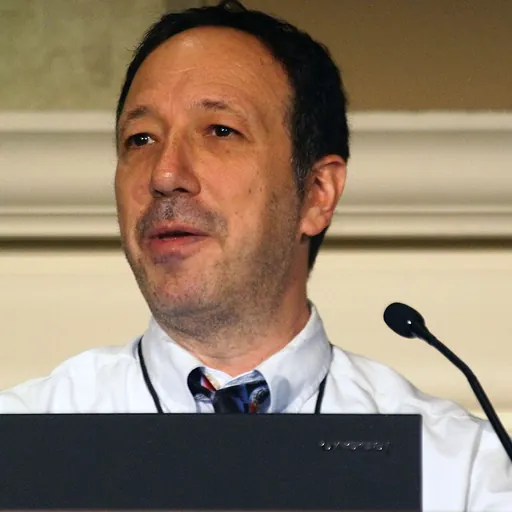
About Scott Lilienfeld
Lived 1960 – 2020 (aged 59). Scott Lilienfeld was an American psychologist, researcher and university teacher.
Scott Owen Lilienfeld He is known for his books 50 Great Myths of Popular Psychology, Brainwashed, and others that explore and sometimes debunk psychological claims that appear in the popular press. Along with having his work featured in major U.S. newspapers and journals such as The New York Times, The New Yorker, and Scientific American, Lilienfeld made television appearances on 20/20, CNN and the CBS Evening News. Growing up, he was interested in paleontology and astronomy, but decided to study psychology after a high school course, then later a few college courses, piqued his interest. He has stated: "Although my love for natural science never waned, I eventually fell in love with the mysteries of the internal world — the human mind — even more than those of the external world."
Lilienfeld studied psychology at Cornell University in Ithaca, New York, where he graduated with a Bachelor of Arts degree in 1982. As an undergraduate, he was influenced by the work of David T. Lykken on psychopathic personality.
From 1990 to 1994, Lilienfeld was an assistant professor of psychology at State University of New York in Albany, NY. From there, he moved to Emory University and served as associate professor until he earned full professorship in 2000.
In 2002, Lilienfeld founded the Scientific Review of Mental Health Practice. He was also a consulting editor for Skeptical Inquirer He was remembered by his colleague Stuart Vyse as "the foremost authority on pseudoscience in psychology and a preeminent scholar of psychopathology."
Career
Conspiracy Panel at CSICon (left to right: Ted Goertzel, Dave Thomas, Bob Blaskiewicz, and Scott O. Lilienfeld)
Lilienfeld, along with his colleague Sally Satel, has dedicated much of his career in psychology to debunking "the pop neuroscience that keeps making headlines". They target such practices as functional magnetic resonance imaging (or neuroimaging) to "detect" moral and spiritual centers of the brain, which they call "oversimplified neurononsense". He has stated: I predict, or at least hope, that the field [of psychology] will move to a more mature and nuanced understanding of the proper role of neuroscience in psychology. This will necessitate understanding that neuroscience can offer valuable insights for certain psychological questions but that different levels of analysis are more fruitful than neuroscience for other questions. the use of the Rorschach test to make psychological diagnosis, recovered memory therapy, real-world application of the concept of microaggressions, and misconceptions in autism research, such as the MMR vaccine controversy, noting that "multiple controlled studies conducted on huge international scales have debunked any statistical association between the MMR vaccine and autism", and fad treatments such as facilitated communication.
Lilienfeld also wrote critically about mindfulness and its derivates mindfulness-based stress reduction (MBSR) and mindfulness-based cognitive therapy (MBCT), calling its evidence "decidedly mixed", although ultimately conceded that evidence supports their usefulness in treating depression and anxiety disorders.
During a James Randi Educational Foundation panel at the 2014 Amaz!ng Meeting, Lilienfeld was asked if he thought rationality could be taught. He responded that rationality and critical thinking are not natural to the human species and to some degree it can be taught, but added that they are very domain specific and may not generalise to other areas; a person can be completely rational in one area and very irrational in others. He said "I see science in many ways as a set of safeguards against confirmation bias", and that, while the structure of general science and the scientific community work to reduce confirmation bias, individual scientists are generally as susceptible to confirmation bias as other people are. Therefore, he said, "It's up to the scientific community ... to hold their feet to the fire and make sure that their confirmation bias does not get in the way of their corroborating their own hypotheses."
Following Lilienfeld's death, in 2020, the Association for Science in Autism Treatment published a tribute issue of Science in Autism Treatment and invited colleagues to reflect on Lilienfeld's legacy. Psychotherapist Donald Meichenbaum remembered his scholarship and critical-mindedness and his wise insistence on healthy professional self-doubt and self-criticism. From the skeptical community, behavioral scientist Stuart Vyse pointed out that Lilienfeld, a fellow of the Committee for Skeptical Inquiry, "questioned and poked in all directions looking for the weaknesses of logic or evidence in any belief, while at the same time exhibiting unfailing respect for the people who might hold that belief." Shauna Bowes, a doctoral student at Emory University, emphasized the direct applicability of Lilienfeld's research to individuals' lives and remembered him as a passionate and dedicated teacher.
50 Great Myths of Popular Psychology
In his book, 50 Great Myths of Popular Psychology: Shattering Widespread Misconceptions about Human Behavior, written with Steven Jay Lynn, John Ruscio and Barry Beyerstein, Lilienfeld examines 50 common myths about psychology and provides readers with a "myth busting kit" to help learn critical thinking skills and understand sources of psychological myths, such as word of mouth, inferring causation from correlation, and misleading film and media portrayals. Lilienfeld argues that there is a large and growing difference between traditional psychology and "pop psychology", and that personal experiences, intuition and common sense fuel pop psychology and are compelling and powerful, but are also "limiting when testing theories... about the brain". He states that hundreds of self-help books are published every year because people want "quick, easy solutions" to their problems.
The book includes such topics as the percent of brain power people use, the use of products such as Baby Einstein in child development, subliminal messaging in advertising, the use of hypnosis for memory retrieval, and symbolism in dreams.
Though Lilienfeld understands that books like the 50 Great Myths will do little to fix people's credulity when it comes to popular myths, he is hopeful that maybe these books will have a 1% effect on changing minds. Association for Psychological Science Fellow The Scott O. Lilienfeld Prize for Scientific Thinking in Clinical Psychology was established in partnership with Cambridge University Press by Dr. Lilienfeld's colleagues Drs. Douglas Berstein, Bunmi Olatunji, and Bethany Teachman. Each year this prize is awarded to one undergraduate from any university course using their textbook, Introduction to Clinical Psychology: Bridging Science and Practice (2020).
Lectures and appearances Skeptical Psychology panel discussion with Susan Blackmore, Zbyněk Vybíral, Tomasz Witkowski and Michael Heap at the 17th European Skeptics Congress (September 2017). Can Rationality Be Taught? panel discussion with Daniel Dennett, Julia Galef, Barbara Drescher, Ginger Campbell at The Amaz!ng Meeting (July 2014) Does Psychology Get a Bad Rap? Why Many People View the Study of Human Nature as Unscientific, Quinnipiac University School of Law (March 2014) Speaker at CSICon 2011 (October 2011) Science, Nonscience, and Nonsense in Psychotherapeutic Practice, Misericordia University (March 2009)
Books Happiness, and Well-Being: Better Living through Psychological Science with Steven J. Lynn and William T. O'Donohue (Sage, 2015) "Would the world be better off without religion? A skeptic’s guide to the debate" with Rachel Ammirati (July/August 2014) "The 'immature teen brain' defense and the Dzhokhar Tsarnaev trial" with Sally Satel (May 2015) "The adolescent brain defense: The Tsarnaev death sentence and beyond" with Sally Satel (May 2015) "Science debunks fad autism theories, but that doesn't dissuade believers" (March 2015) "EMDR: Taking a closer look" with Hal Arkowitz (December 2007) "Is there really an autism epidemic?" with Hal Arkowitz (December 2007) "Why scientists shouldn't be surprised by the popularity of intelligent design" (May/June 2006) "The scientific status of projective techniques" with James M. Wood and Howard N. Garb (November 2000).
Don’t just read it —
keep it.
Full-length biographies made to live with: read them, listen on the way to work, watch them tonight.
- E-book
- Audio
- Video
Instant download · yours to keep · every purchase keeps this site free
Important facts
People in Scott Lilienfeld's life
Named in this biography and alive at the same time




Related people
Same field, nearest in time





Contemporaries
People whose lives overlapped Scott Lilienfeld's

Frequently asked questions
Who was Scott Lilienfeld?
American psychologist (1960-2020)
When was Scott Lilienfeld born?
Scott Lilienfeld was born on 23 December 1960 in New York City.
When did Scott Lilienfeld die?
Scott Lilienfeld died on 29 September 2020 in Atlanta.
What was Scott Lilienfeld's occupation?
Scott Lilienfeld was a psychologist, researcher and university teacher.
What nationality was Scott Lilienfeld?
Scott Lilienfeld was American.
Sources & further reading
Cite this page
APA: Biography.guide. (2026). Scott Lilienfeld. https://biography.guide/scott-lilienfeld/
MLA: "Scott Lilienfeld." Biography.guide, https://biography.guide/scott-lilienfeld/.
Chicago: "Scott Lilienfeld." Biography.guide. https://biography.guide/scott-lilienfeld/.
Data last updated: 2026-09-22 · Spot an error? Report a correction.
Portrait: Wikimedia Commons · author & licence
Page generated 2026-09-27 05:02 UTC