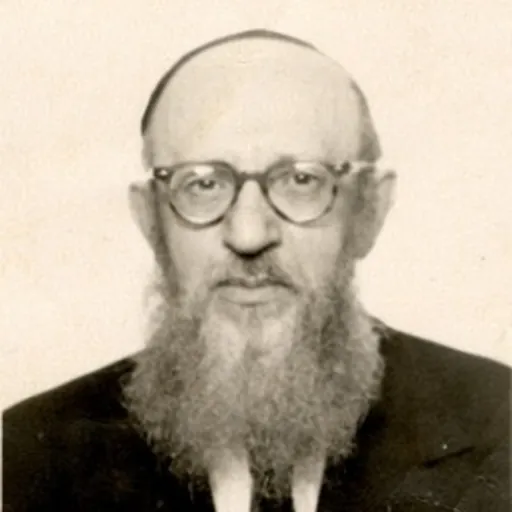
Schneour Zalman Schneersohn
French rabbi and resistance member
About Schneour Zalman Schneersohn
Lived 1898 – 1980 (aged 81–82). Schneour Zalman Schneersohn was a French rabbi and french resistance fighter.
Schneour Zalman Schneerson (1898–1980) was a Lubavitch Hasidic Chief Rabbi who was active in France during World War II. During the Nazi occupation of France, he ran homes for children who had been separated from their families, providing them with food, shelter, and a Jewish education. Later, as the situation in France worsened, he smuggled many of them to safety.
Biography Schneour Zalman Schneersohn was born in Gomel, Russian Empire (currently in Belarus) in 1898. He belonged to the Lubavitch hassidic dynasty.
Schneersohn was descended on both sides from prestigious Hasidic families. He was the son of Menachem Mendel Schneersohn, grandson of Levi Yitzchak Schneersohn, great grandson of Baruch Shalom Schneersohn, the oldest son of the Tzemach Tzedek (Menachem Mendel Schneersohn, the third Rebbe of the Lubavitch dynasty). His mother, Liba Leah, was the granddaughter of Levi Yitzchok of Berditchev, one of the main disciples of Dov Ber of Mezeritch, himself one of the main disciples and successor of the Baal Shem Tov, the founder of Hasidism. His daughter, Hadassah, married Eli Chaim Carlebach in 1949.
Schneersohn was active in the Jewish religious resistance in the USSR, distributing funds and prayer books with the help of the Political Red Cross.
In 1936, he created the Association des Israélites Pratiquants (AIP) (also Kehillat Haharedim), an association of Orthodox Jews promoting religious and educational activities throughout France. The organization "provided material relief to needy Jewish refugees...founded Hebrew schools and synagogues, set up kosher soup kitchens and distributed clothing and money."
Léon Poliakov, a French historian close with Rabbi Schneersohn, claims that "his orthodoxy, of an absolute intransigence, or his working methods, as flexible as they were, were disconcerting, not to mention his manners and his dress which did not appeal to his French colleagues." Poliakov would tell in 1997 that he became acquainted with of Chief Rabbi Schneersohn when he was looking for a rabbi to officiate at his father's funeral. Later, on the Canebière in Marseille, he met Chief Rabbi Schneersohn who offers him the position of secretary. Their collaboration lasted several months until Poliakov gave up following ideological differences – he opposed the idea to contact Joseph Goebbels – and religious differences. Poliakov later went on to found, together with Rabbi Schneersohn's cousin, Isaac Schneersohn, the Shoah Memorial, Center of Contemporary Jewish Documentation.
Timeline of locations February 1940 – January 1941: Château des Morelles, Brout-Vernet (Allier). April 1942: Villa Beaupin, in the Vieille Chapelle district of Marseilles November 1942: Domaine de Seignebon, at Dému (Gers). 1942–1944: successively : Grenoble. Château du Manoir, hameau de L'Étang-Dauphin, Saint-Étienne-de-Crossey (Isère), Beginning in March 1943. pension Cavalier and Hôtel Rivoli, at Nice. 1943 (...-October 1943). Château du Manoir (return) from October 1943 to December 1943, then dispersal of the children in three hamlets close to Voiron (Isère): La Manche, hameau de Saint-Jean-de-Moirans (Isère), in December 1943. La Martellière, Voiron (Isère), also in December 1943. 16 children, aged 7 to 21, and two adults are arrested there by the milice during the night of 23 March to March 1944, following a denunciation. The children are deported in the Convoi 71 of 13 April 1944 and the Convoi n° 73 of 15 May 1944. hameau de Chirens (Isère) and Saint-Étienne-de-Crossey (a room), starting in October 1943.
Descriptions of Schneersohn In his book on Jewish Résistance in France, Lucien Lazare describes the role of Schneersohn:Having moved to Vichy, then to Marseille, the AIP had gathered together a community of sixty or so persons, composed of a Synagogue, a welfare office, a Yeshiva, a home for children and a workshop for vocational placement. Chneerson intended his services to Orthodox Judaism. Placed in the marginality of the Jewish organizations, the AIP was the expression of a particular category of the Jewish identity. Very popular before the war in Central Europe and Eastern Europe as well as in Palestine, Hasidism counted fervent followers within the community of the Jewish immigrants in Paris. Rejecting at once emancipation, Zionism and Socialism, Chneerson only conceived Jewish existence in the jealous observance of rites and put up an impenetrable barrier against the influence of the environment and modernity. His experience of secular persecutions had taught him to respond by establishing a community with unfailing cohesion, devoting itself to the study of sacred texts and the observance of the Mitzvot in the enthusiastic atmosphere of the hassidic tradition. It is in this framework that he himself and his follower felt safe, leaving it to Providence. Chneerson had not discerned the novel and fatal character of the nazi threat, and the AIP was particularly vulnerable to the deportations.In "L'Auberge des musiciens", Léon Poliakov describes Schneersohn ("red beard, limping slightly in his caftan according to the Polish custom") and his activities at Marseille:About a hundred or so persons prayed in the oratory of the rue Sylvabelle in a rich-looking building in of the most beautiful neighborhoods at Marseille [...] [There] two large rooms and a hall in the first floor, a kitchen and two rooms in the mezzanine [...]. The rabbi taking refuge with his family on the first floor. The kitchen doesn't stay empty either: furtive shadows appeared in the evening and vanished in the morning; these are escapees of the internment camps of Vichy to whom the rabbi gives refuge. One of the rooms of the first floor serves as an office and as a function room – a never-ending stream of Jewish miseries -, the other, the office of the rabbi, is at the same time a synagogue and a classroom; there weddings are celebrated and divorces are settled and even financial disputes.In his private diary, Raymond-Raoul Lambert, who headed the UGIF-Sud, the Vichy government's Union of French Jews, writes on 17 August 1943:The 28 (28 July 1943) I go, with Simone and the children, to visit a home for children close to Voiron, headed by an orthodox rabbin who resembles Rasputin. In such a milieu I feel Christian and Latin. The Israeli historian Richard Cohen thus explains Lambert's reaction:It's about rabbi Isaac Chneerson [sic] who was responsible of an ultra-orthodox charitable organization (Association des Israélites pratiquants de France, Kehillath Haharedim), affiliated to the 3e Direction de l'UGIF (Santé). The "assimilated" response by RRL [Raymond-Raoul Lambert] is not surprising, considering the content of the letter by the latter (2 August 1943, YIVO: RG 340, dossier 3) which deals into the details of his fantastic project to establish a Jewish State based on strictly orthodox principles.In a recent book entitled Les enfants de la Martellière, Delphine Deroo reconstitutes the life of this institution. She is openly admiring of the rabbi's work:To each threat corresponds a defense. To the wish of physical and spiritual elimination of the "Jewish Race", these men and women opposed themselves as Jews, assuming with pride their endangered Jewishness. And this moral resistance, that on my part I encounter in the insistence of rabbi Chneerson [Schneour Zalman Schneersohn] to strictly observe the religious laws – showing for him the very essence of his directly threatened Judaism -, strikes me and dazzles me by its strength and by its heroism.
After the war After the war, Schneersohn worked to promote non-consistorial Orthodox Judaism from his office at 10 rue Dieu, in the 10th arrondissement of Paris near Place de la République. He continued to direct the AIP, organizing religious services and Jewish schools, as well as locating and rehabilitating children hidden in Christian homes during the war.
Several personalities later attested to the influence of his teaching, including Olga Katunal, according to whom Zalman Schneurson was her greatest teacher,
In the 1960s, Schneour Zalman Schneersohn immigrated to the United States, and continued to work as a teacher in Brooklyn, New York, where he founded and directed SHEVET Y'HUDAH Resnick Institute of Technology (SYRIT).
He died in New York at the age of 82.
Don’t just read it —
keep it.
Full-length biographies made to live with: read them, listen on the way to work, watch them tonight.
- E-book
- Audio
- Video
Instant download · yours to keep · every purchase keeps this site free
Important facts
People in Schneour Zalman Schneersohn's life
Named in this biography and alive at the same time





Related people
Same field, nearest in time


Contemporaries
People whose lives overlapped Schneour Zalman Schneersohn's


Frequently asked questions
Who was Schneour Zalman Schneersohn?
French rabbi and resistance member
When was Schneour Zalman Schneersohn born?
Schneour Zalman Schneersohn was born in 1898.
When did Schneour Zalman Schneersohn die?
Schneour Zalman Schneersohn died on 2 July 1980 in Brooklyn.
What was Schneour Zalman Schneersohn's occupation?
Schneour Zalman Schneersohn was a rabbi and french resistance fighter.
What nationality was Schneour Zalman Schneersohn?
Schneour Zalman Schneersohn was French.
Sources & further reading
· Wikipedia: Schneour Zalman Schneersohn
· DBpedia: Schneour Zalman Schneersohn
Cite this page
APA: Biography.guide. (2026). Schneour Zalman Schneersohn. https://biography.guide/schneour-zalman-schneersohn/
MLA: "Schneour Zalman Schneersohn." Biography.guide, https://biography.guide/schneour-zalman-schneersohn/.
Chicago: "Schneour Zalman Schneersohn." Biography.guide. https://biography.guide/schneour-zalman-schneersohn/.
Data last updated: 2026-09-20 · Spot an error? Report a correction.
Portrait: Wikimedia Commons · author & licence
Page generated 2026-09-27 04:57 UTC