About Savitribai Phule
Lived 1831 – 1897 (aged 66). Savitribai Phule was an Indian writer, poet, social reformer, teacher and activist, known for Girl's education and Women's emancipation.
Savitribai Phule (; 3 January 1831 – 10 March 1897) was an Indian educator, social reformer, and poet, widely regarded as the first Indian female teacher. Along with her husband, Jyotirao Phule, she took a pivotal role in advancing women's rights and education in Maharashtra, leaving a legacy that continues to influence social reform movements across India. She is also considered a front runner of India's feminist movement. She worked to abolish discrimination and the unfair treatment of people based on caste and gender. Savitribai Phule and her husband were trailblazers in women's education in India. In 1848, they established their first school for girls at the residence of Tatyasaheb Bhide, known as Bhide Wada in Pune. By 1851, they had established three girls' schools in Pune, with around 150 students. In total, the couple opened 18 schools. Later, she also co-founded the Satyashodhak Samaj in 1873 and led its women's wing.
In 1848, together with Jyotirao and Sagunabai Kshirsagar, she opened the nation's first girls' school at Bhidewada in Pune on a progressive syllabus of mathematics, science, and social studies, in spite of strong opposition from society.
Savitribai’s career was remarked by her relentless efforts in advancing education for girls and marginalized communities. By 1851, she and Jyotirao managed three girls’ schools in Pune with around 150 students. They opened a total of 18 schools, alongside initiatives such as "Mahila Seva Mandal" in 1851 to promote women's rights and the "Balhatya Pratibandhak Griha", an infanticide prevention center for widows in 1853. Savitribai’s literary contributions include Kavya Phule (1854) and Bavan Kashi Subhodh Ratnakar (1892). She died of bubonic plague in 1897. Today her legacy as the “Mother of Modern Education in India” endures, commemorated through memorials, institutional names, and cultural representations.
Early life Savitribai Phule was born on 3 January 1831, in the village of Naigaon in Satara District, Maharashtra. She was the youngest daughter of four children born to Laxshmi and Khandoji Nevse Patil, both of whom belonged to the Mali community. Savitribai married Jyotirao Phule, at the age of 9 in 1840, when he was 13 years old.
Education Savitribai was illiterate at the time of her marriage. She received her education from her husband, Jyotirao Phule, and his mother figure Sagunabai Kshirsagar, who taught her to read and write at home and while working on their farm. Once she completed her primary education with Jyotirao, she continued her studies under the guidance of her mentors, Sakharam Yeshwant Paranjpe and Keshav Shivram Bhavalkar. In 1846–47, she passed the third and fourth-year examinations in an English school, and in the same year, she helped Sagunabai establish a school for marginalized communities in Maharwada. She enrolled herself in two teachers' training programs: the first was at an institution run by an American missionary, Cynthia Farrar, in Ahmednagar, and the second course was at a Normal School in Pune. In January 1848, Savitribai and Jyotirao Phule, along with Sagunabai, started their own school at Bhidewada and it became India's first girls' school. Bhidewada was the home of Tatya Saheb Bhide, who was inspired by the work that the trio was doing. According to some sources, the school initially had 9 girls and later number increased to 25 students. The curriculum at Bhidewada included a traditional Western curriculum of mathematics, science, and social studies. Due to social opposition and ostracisation from orthodox community, the Phules relocated to the residence of their associate Usman Shaikh. There, Savitribai Phule and Fatima Sheikh –Usman’s sister, continued their efforts to educate girls in the local neighbourhood.
By the end of 1851, Savitribai and Jyotirao Phule were running three different schools for girls in Pune. Combined, the three schools had approximately one hundred and fifty students enrolled. Like the curriculum, the teaching methods employed by the three schools differed from those used in government schools. The author Divya Kandukuri believes that the Phule methods were regarded as being superior to those used by government schools. As a result of this reputation, the number of girls receiving their education at the Phules' schools outnumbered the number of boys enrolled in government schools. In 1852, there were three Phule schools in operation with 273 girls pursuing education in these schools, but by 1858 they had all been closed. Eleanor Zelliot blames the closure on private European donations drying up due to the Rebellion of 1857, withdrawal of government support, and Jyotirao resigning from the school management committee because of disagreement regarding the curriculum. In 1863, the Phule couple with their longtime friend Sadashiv Ballal Govande started an infanticide prevention centre called Balhatya Pratibandhak Griha
Personal life Savitribai and Jyotirao had no children of their own. Savitribai is believed to have arranged his marriage to the daughter of Dynoba Sasane, a worker in her organization, in February 1889. The clinic was established on the southern outskirts of Pune, in an area free of infection. Savitribai died after contracting the plague when tending to the son of Pandurang Babaji Gaekwad. Upon learning that he had contracted the plague in the Mahar settlement outside of Mundhwa, Savitribai Phule personally took him to the hospital. Savitribai Phule died at 9pm on 10 March 1897.
Activism As a result of her experience and work, she became an ardent feminist. She established the Mahila Seva Mandal to raise awareness for issues concerning women's rights. Savitribai also called for a gathering place for women that was free of caste discrimination or differentiation of any kind. Symbolic of this was that all the women that attended were to sit on the same mat. She was also an anti-infanticide activist. She opened a women's shelter called the Home for the Prevention of Infanticide, where Brahmin widows could safely deliver their children and leave them there to be adopted if they so desired. She also campaigned against child marriage and was an advocate of widow remarriage.
In a letter to her husband Jyotirao, Savitribai told the story about a boy about to be lynched by his fellow villagers for having relations with a woman of lower caste when Savitribai intervened. She wrote, "I came to know about their murderous plan. I rushed to the spot and scared them away, pointing out the grave consequences of killing the lovers under British law. They changed their mind after listening to me". and the "Balhatya Pratibandhak Griha" to support women's rights, widows and the victims of sexual violence.
Legacy
Savitribai Phule is widely recognised as the "Mother of Modern Education in India". Despite often being viewed through the lens of her association with Jyotirao Phule, scholars have noted that she developed an independent perspective shaped by her lived experiences as a lower-caste woman. According to political scientist Bidyut Chakrabarty, she envisioned an India free from gender and caste oppression, and considered "education" a most powerful tool to awaken self-respect among the oppressed and challenge Brahmanical dominance. Her 1854 poetry collection "Kavya Phule" reflects her thoughts on social emancipation, particularly concerning the upliftment of Shudras and women. Chakrabarty argued that Savitribai Phule was the sole female reformer of 19th-century India to explore the interplay of patriarchy with caste. Biographer Dhananjay Keer, in his work on Jotirao Phule, expressed regret over the inadequate recognition given to Savitribai’s contributions. He highlighted her decision to leave the security of her in-laws' home, endure hardships alongside Jotirao, and become the first native female teacher in India. Keer remarked, "There is hardly any parallel example in the nineteenth century that can be compared to Savitribai's noble life devoted to the cause of the uplift of the Indian woman."
Contemporary English newspapers like the Poona Observer and Deccan Weekly Reporter described the Phules' efforts as "the heralding of a new age in the history of Hindu culture".
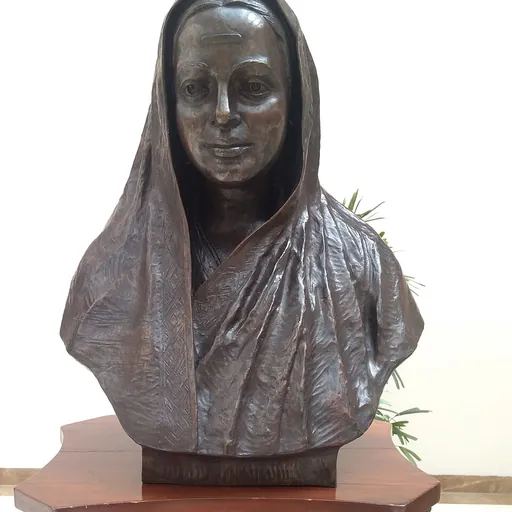
Bust of Savitribai Phule in PuneSavitribai Phule's legacy of work for girls' and women's education lives on today. Savitribai is also considered an important figure in Dalit feminism. Writer and critic Anita Bharti refers her as the backbone of the Dalit feminist movement and an ideal for the Indian feminist movement as a whole. Along with B. R. Ambedkar and Annabhau Sathe, Phule has become an icon in particular for the backward classes. Women in local branches of the Manavi Hakk Abhiyan (Human Rights Campaign, a Mang-Ambedkarite body) frequently organize processions on their Jayanti (birthday in Marathi and other Indian languages). Pune City Corporation created a memorial for her in 1983. On 10 March 1998 a stamp was released by India Post in honour of Phule. Savitribai's birthdate, 3 January, is celebrated as Balika Din in the state of Maharashtra, especially in girl's schools. In 2015, the University of Pune was renamed as Savitribai Phule Pune University in her honour. On 3 January 2017, the search engine Google marked the 186th anniversary of the birth of Savitribai Phule with a Google doodle. A newly discovered species of flowering plant found in Khairi-Umred forest in 2026 was named Crotalaria phulei in her honor in 2026.
In popular culture Krantijyoti Savitribai Phule, an Indian drama television series based on her life aired on DD National in 2016. iSavitri Jyoti, a Marathi drama television series based on the life and work of Savitribai and Jyotirao Phule aired on Sony Marathi in 2019–2020. Savitribai Phule, an Indian Kannada-language biopic was made about Phule in 2018. In 2021, Pune University created a 12.5-foot, life-size bronze metal statue of Phule. It was inaugurated in 2022. Phule, a Hindi-language biopic on Jyotirao and Savitribai Phule, was released in 2025. It stars Pratik Gandhi as Jyotirao Phule and Patralekha as Savitribai Phule.
Don’t just read it —
keep it.
Full-length biographies made to live with: read them, listen on the way to work, watch them tonight.
- E-book
- Audio
- Video
Instant download · yours to keep · every purchase keeps this site free
Important facts
Family & relationships
People in Savitribai Phule's life
Named in this biography and alive at the same time


Related people
Same field, nearest in time

Contemporaries
People whose lives overlapped Savitribai Phule's



Frequently asked questions
Who was Savitribai Phule?
Indian social reformer (1831-1897)
When was Savitribai Phule born?
Savitribai Phule was born on 3 January 1831 in Bombay Presidency, Company rule in India, Maharashtra, Naigaon.
When did Savitribai Phule die?
Savitribai Phule died on 10 March 1897 in Pune.
What was Savitribai Phule's occupation?
Savitribai Phule was a writer, poet, social reformer, teacher and activist.
What was Savitribai Phule known for?
Savitribai Phule was known for Girl's education and Women's emancipation.
What nationality was Savitribai Phule?
Savitribai Phule was Indian.
Sources & further reading
Cite this page
APA: Biography.guide. (2026). Savitribai Phule. https://biography.guide/savitribai-phule/
MLA: "Savitribai Phule." Biography.guide, https://biography.guide/savitribai-phule/.
Chicago: "Savitribai Phule." Biography.guide. https://biography.guide/savitribai-phule/.
Data last updated: 2026-09-22 · Spot an error? Report a correction.
Page generated 2026-09-27 05:09 UTC