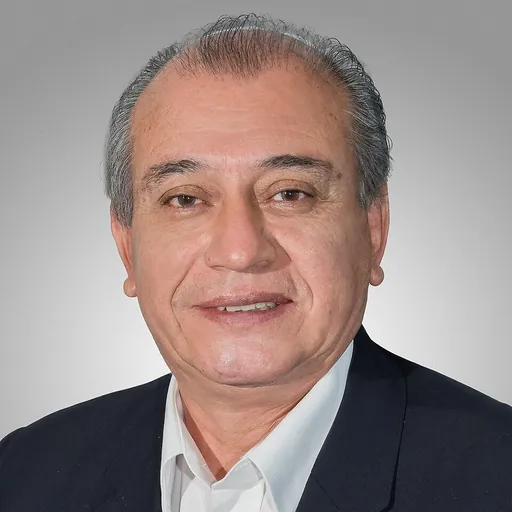
About Saúl Lara
Born 1957. Saúl Lara is a Bolivian politician, jurist, lawyer and association football player.
Saúl Octavio Lara Torrico (born 3 October 1957) is a Bolivian lawyer, jurist, and politician who has served as a party-list member of the Chamber of Deputies from Cochabamba since 2020. A member of Civic Community, he previously served as vice minister of the interior from 2003 to 2004 and as minister of government from 2004 to 2005. A graduate of the Higher University of San Simón, Lara spent much of his career as a legal advisor and consultant for various public and private institutions and corporations. From 1993 to 1997, he served as chief of staff to Foreign Minister Antonio Araníbar, during which time he joined the minister's party, the Free Bolivia Movement, of which he was secretary of finance. Appointed to head the Ministry of Government in 2004, Lara developed a lasting personal friendship with then-president Carlos Mesa, aiding his 2019 campaign to return to the presidency. The following year, he joined Civic Community's electoral list in the Cochabamba Department, netting a seat in the Chamber of Deputies in the 2020–2025 Legislative Assembly.
Early life and career Saúl Lara was born on 3 October 1957 in Villa Rivero, Cochabamba. He completed his secondary schooling at the Sucre National School before going on the attend the Higher University of San Simón, where he graduated as a lawyer with a master's in national development. A fan of association football, Lara joined Cochabamba's Club Aurora while in university, competing in the Professional League's 1980 and 1981 tournaments. His brief professional career was cut short by a double fracture of the tibia and fibula during a match against Wilstermann, leading him to retire from active play.
In the ensuing years, Lara dedicated himself to practicing law, establishing the firm Legal Bolivia, which provided consultancy to a variety of institutions and companies.
Minister of Government In 2003, in the early days of the Carlos Mesa administration, Lara was appointed to serve as vice minister of the interior. Though Mesa's government was officially non-partisan, many public officials within it—including Lara and his immediate superior, Alfonso Ferrufino—were active or historic members of the MBL. The party's leading cadres held much in common with the president, sharing his urban academic background, an openness to social issues, and a concern for ethics in politics.
When Ferrufino unexpectedly resigned in August 2004, citing health issues, Lara was promoted to the position of minister of government. His tenure as head of national public safety navigated a precarious path, balancing maintaining order amid ongoing social conflicts while simultaneously adhering to Mesa's pledge to avoid police violence and bloodshed where possible. Regarding Lara, Mesa, in his presidential memoir, stated that "without a doubt", he was "the best inheritance [Ferrufino] left me". "I will never stop thanking Saúl for demonstrating to the country that it is possible to preserve order without bloodshed or violation of human rights". However, Lara also faced criticism from peasant groups for his administration's decision to ramp up the government's anti-drug policy, which entailed the eradication of all coca in the Chapare. This despite the fact that Lara had once worked as an advisor to the region's coca growers and had previously defended the legality of Chapare coca.
Following the conclusion of his ministerial term, Lara largely retired from active politics, Together with figures like Loyola Guzmán and José Antonio Quiroga, Lara comprised part of the Broad Front's furthest left wing, a group whose representatives ultimately broke away from the coalition when Doria Medina forged an alliance with the right-wing Social Democratic Movement.
Chamber of Deputies Election
In the years succeeding his tenure as minister of government, Lara maintained a close personal relationship with Carlos Mesa. He directed Civic Community's campaign in the Cochabamba Department, even carrying out campaign events in the Chapare tropics, a region considered the bastion of the Movement for Socialism, where the physical safety of opposition political figures was often put in doubt. Though not a candidate himself in 2019, Lara was nominated for a seat in the Chamber of Deputies when the elections were rerun in 2020, a position he was elected to.
Tenure
Commission assignments Government, Defense, and Armed Forces Commission Fight Against Drug Trafficking Committee (20 November 2020 – present)
Electoral history + Year Office Alliance Votes Result . Total % . 2020 Deputy Civic Community 371,826 31.68% 2nd Source: Plurinational Electoral Organ Electoral Atlas
Publications
Don’t just read it —
keep it.
Full-length biographies made to live with: read them, listen on the way to work, watch them tonight.
- E-book
- Audio
- Video
Instant download · yours to keep · every purchase keeps this site free
Important facts
People in Saúl Lara's life
Named in this biography and alive at the same time


Related people
Same field, nearest in time




Contemporaries
People whose lives overlapped Saúl Lara's


Frequently asked questions
Who is Saúl Lara?
Bolivian politician (born 1957)
When was Saúl Lara born?
Saúl Lara was born on 3 October 1957 in Villa Rivero.
What is Saúl Lara's occupation?
Saúl Lara is a politician, jurist, lawyer and association football player.
What nationality is Saúl Lara?
Saúl Lara is Bolivian.
Sources & further reading
Cite this page
APA: Biography.guide. (2026). Saúl Lara. https://biography.guide/saul-lara/
MLA: "Saúl Lara." Biography.guide, https://biography.guide/saul-lara/.
Chicago: "Saúl Lara." Biography.guide. https://biography.guide/saul-lara/.
Data last updated: 2026-09-23 · Spot an error? Report a correction.
Portrait: Wikimedia Commons · author & licence
Page generated 2026-09-27 05:07 UTC