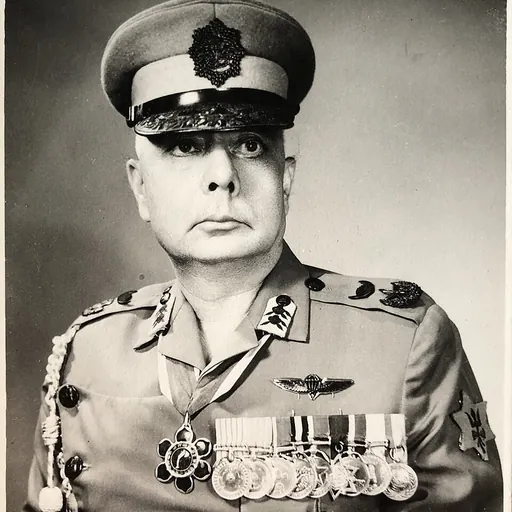
About Satchit Rana
Lived 1934 – 2007 (aged 73). Satchit Rana was a diplomat and ambassador.
Satchit Shamsher Jung Bahadur Rana (15 January 1934 – 4 May 2007) was the 34th Chief of Army Staff of the Royal Nepalese Army. He was a member of the Rana Dynasty of Nepal.
Early life Rana was born in Tansen Durbar, Lumbini Zone, to Lieutenant General Madhav Shamsher J.B. Rana and Rani Madhavi Kumari Rana. Lt General Madhav Rana was the Governor of Dhankuta during the Rana Dynasty. He was the fourth son. Rana had four brothers (three elder and one younger) and three sisters (two elder and one younger).
Rana belonged to a family with a history in military command and statesmanship. His paternal grandfather, Maharaj Kumar Commanding General Pratap Shamsher J.B. Rana, had been the Governor of Palpa (1924–1929) as well as the Commanding General of Northern Nepal (1932–1934). His paternal great-grandfather, Commanding General Maharaja Sir Bir Shumsher J.B. Rana, had been the 11th Prime Minister of Nepal and the Maharaja of Lamjung and Kaski (1885–1901).
Rana completed most of his further education in India. He passed the admission examination of the Benares Hindu University in 1949. He was awarded his Intermediate of Arts Degree in 1951. He then began pursuing a BA degree at BHU but dropped out in the last year due to his successful results in the Officer Cadre Selection Examination for the Royal Nepalese Army.
Military career
Junior officer After his selection, he chose the Royal Military Academy Sandhurst to undertake his military training in 1953. He completed his training and was commissioned into the Royal Nepalese Army in the rank of second lieutenant on 22 July 1955. At the time, the then Lieutenant Rana was the second officer in the Royal Nepalese Army to have received training from Sandhurst.
In his first posting, he was assigned to the Shree Shreenath Battalion. During this posting, he was appointed the Joint Team Leader of the Nepal-China Border Team. The objective of the team was to resolve the border disputes taking place at the time. After being promoted to captain in 1962, he underwent further training at the Nepalese Military Academy which at that time was based in Nagarkot. He was then assigned to the No.1 Home Guard of the Barda Bahadur Battalion. During this period, he was promoted to Assistant Battalion Commander and afterwards, Acting Battalion Commander. Here they established military camps from where they would launch attacks into the Chinese Autonomous Region of Tibet. In addition to carrying out illegal military activity, the Khampa fighters had been pillaging, plundering and killing members of the local communities. Before the deployment of the entire taskforce, the then Lieutenant Colonel Rana led a small reconnaissance team to gather military intelligence in order to formulate the procedure of disarmament. Consequently, Rana was given the leadership of the ground operations.
1979 student protests and Director of Military Operations Rana returned to Nepal in 1979. Whilst he had been in Lebanon, Rana had been promoted to the rank of brigadier general. Upon his return, he was appointed commander of the 1st Infantry Brigade. The Brigade was based in Kathmandu when the protests began. Rana was involved in the minimisation of violence and vandalism which was being carried out by certain reactionary groups of the protest. Afterwards, Rana commanded the 2nd Infantry Brigade in 1980. During his tenure as COAS, which lasted four years, he planned and executed multiple military and civil missions. 252 people perished, more than a thousand were injured and thousands of houses collapsed due to the earthquake. Rana was responsible for coordinating search and rescue operations. Initially, Rana after discussions with King Birendra, did not want to take military action against the protestors. In an effort to deescalate the situation, Rana ordered units of the Army to move into the centre of Kathmandu. To avoid further such violence, a curfew was put in place in the Kathmandu Valley. Rana advocated that the new constitution should continue to keep the King as the Supreme Commander of the Army.
During his tenure, he aided in the establishment of the Shree Birendra Army Hospital in the Chauni District of Kathmandu and the Birendra Sainik Awasiya Mahavidyalaya in Bhaktapur. During his ambassadorship, Rana worked to enhance the relationship between Nepal and Myanmar. During this period, Myanmar supported Nepal's application for membership in the BIMSTEC. With the escalation of the Maoist Insurgency in Nepal, King Gyanendra appointed Rana as a Rt. Honourable Member of the Privy Council Standing Committee. During this period, Rana was critical of the Maoist forces and their methods of engagement. Consequently, he was considered a target by the Maoist insurgents. A resort owned by Rana was attacked by Maoist insurgents in September 2003. In August 2005, Rana's residence in Kathmandu was bombed by the Maoists. In both terror attacks, there were no fatalities. According to him, democratic parties negotiating with an insurgency group undermined the interests of the state. Rana believed that in trying to gain political power, the democratic parties had compromised on national interests. He is survived by his wife and four children.
Personal life Rana was married to Rani Asha Rana (née Shah). They had three daughters and one son:
Mrs Satchida Rajya Laxmi Singh Mrs Saktida Rajya Laxmi Singh Captain Sadaya Shamsher Jung Bahadur Rana (Retd) Mrs Sukirti Rajya Laxmi Bhatta
In his retirement, Rana involved himself in agriculture and tourism. He established the Gurkha Hill Resort, which is still open in the Gorkha Municipal District, and began apple farming in Mangchet, Rasuwa District. He was also an avid golfer.
Don’t just read it —
keep it.
Full-length biographies made to live with: read them, listen on the way to work, watch them tonight.
- E-book
- Audio
- Video
Instant download · yours to keep · every purchase keeps this site free
Important facts
People in Satchit Rana's life
Named in this biography and alive at the same time

Related people
Same field, nearest in time


Contemporaries
People whose lives overlapped Satchit Rana's






Frequently asked questions
Who was Satchit Rana?
Nepali army general
When was Satchit Rana born?
Satchit Rana was born on 15 January 1934.
When did Satchit Rana die?
Satchit Rana died on 4 May 2007.
What was Satchit Rana's occupation?
Satchit Rana was a diplomat and ambassador.
Sources & further reading
Cite this page
APA: Biography.guide. (2026). Satchit Rana. https://biography.guide/satchit-rana/
MLA: "Satchit Rana." Biography.guide, https://biography.guide/satchit-rana/.
Chicago: "Satchit Rana." Biography.guide. https://biography.guide/satchit-rana/.
Data last updated: 2026-09-21 · Spot an error? Report a correction.
Portrait: Wikimedia Commons · author & licence
Page generated 2026-09-27 04:59 UTC