Sangamitta
Indian Buddhist nun
About Sangamitta
Lived 282 BC – 203 BC (aged 78–79). Sangamitta was an Indian buddhist nun.
Background Sanghamitta bringing a sapling of the right branch of the Bodhi tree to Sri Lanka. Kelaniya Raja Maha Vihara Sanghamitra is known for the proselytisation activity among women that she pursued as her lifetime goal in Sri Lanka, along with her brother, Mahendra (called Mahinda in Sri Lanka) at the initiation of her father, Emperor Ashoka of the Maurya dynasty who ruled in India in the 3rd century BC. Ashoka, after adopting Buddhism, took to spreading tenets of Buddhism in nine other countries of the region. His contemporary in Sri Lanka, King Devanampiya Tissa, in close alliance with Ashoka, saw the arrival of Buddhism in Sri Lanka. as popularly known in published texts was as the second child of Ashoka and younger sister of brother Mahindra. She was born in Ujjeini (present day Ujjain in Madhya Pradesh in India). Her mother did not join Ashoka when he was crowned and her two children had embraced Buddhism. She was married at the age of 14 to Agribrahma, a nephew of Emperor Ashoka, who was also an Arhant. She had a son, Saamanera Sumana who also later became an Arhant and went along with his uncle Mahindra to Sri Lanka to preach Buddhism. Her teacher was Ayupala. She was ordained at the age of 18 into the Theravada Buddhism Order by their preceptor Dhammapala. Her brother was also ordained at the same time. With her dedicated perseverance to Dhamma she became an Arhant Theri and resided in Pataliputra (now known as Patna).
Middle life Mahindra’s mission in Sri Lanka was very successful. Among his new converts was Princess Anula, King Tissa’s sister-in-law who became Sotapanna and requested ordination. King Tissa wrote to Emperor Ashoka to depute Sangamitta for the purpose. Mahindra also wrote to his father to depute his sister Sanghamitta to Sri Lanka as requested by King Tissa. In addition, the delegation headed by the Sri Lankan Ambassador Prince Athitha, which returned to Sri Lanka, comprised the Chief priestess Sangamitta and ten other priestesses, eight people of royal lineage of Magadha (Bogut, Sumitta, Sangot, Devgot, Damgot, Hirugot, Sisigot and Jutindhara), eight members of nobility (families of ministers), eight Brahmins, eight Vaishyas (traders), herdsmen, Hyaenna, Sparrow-hawk, Nagas, Yakkas, craftsmen, weavers, potters and many members of other castes.
A legend mentioned related to the journey of Sangamitta to Sri Lanka is that Nagas encircled the Bodhi tree. Sangamitta drove them away by assuming the form of Garuda (half-man half-bird form). The ordination covered not only the royalty but also common people of various strata of the society. She pursued every effort to enhance the status of women, with sustained devotion, dedication and diligence.
Bodhi tree and celebrations
Sangamittā carried the right south branch of the Bodhi Tree (selected by Ashoka from the Maha Bodhi Tree in Gaya) on a ship to Anurādhapura, during the 12th year of Ashoka's reign. The sapling was planted by Devānāmpiya Tissa in the Mahāmeghavana in Anuradhapura. It seems that "the Buddha, on his death bed, had resolved five things, one being that the branch which should be taken to Ceylon should detach itself". The journey route followed by Sangamitta who carried the tree branch was from Gayā to Pātaliputta and then to Tāmalittī in Bengal. Here, it was placed in a golden vase on the ship and transported to Jambukola across the sea. The entourage reached Anurādhapura, staying en route at Tivakka.
The planting of the Bodhi Tree was a grand ceremony performed by the king himself with assistance from the nobles of Kājaragāma, Candanagāma and Tivakka, in the presence of Sangamitta and her brother Mahindra. The tree took eight roots and yielded fruits and seeds. As fresh eight saplings emerged, they were moved and planted at Jambukola (present Colombogaon in north Sri Lanka), in the village of Tivakka, at Thūpārāmā, at Issaramanārāma, in the court of the Pathamacetiya, in Cetiyagiri, in Kājaragāma and Candanagāma. in the ninth year of the reign of King Uttiya at her residence in Hatthaloka Upasikaramaya Anuradhapura. Uttiya performed her last rites. The occasion was also marked with observances in her honour throughout Sri Lanka, for one week.
In 429 AD, Bhikkuni Devasara had realised that Bhikkuni Sanga, on account of war and famine, could vanish from Sri Lanka. She, therefore, had led a mission to China to establish the Bhikkuni Sasana. The original Theravada Bhikkuni lineage established in China since 429 AD has continued to function to this day. However, Asarana Sarana Saranankara Maha Thera re-introduced the Higher Ordination from Thailand. He is credited with re-establishing the Order of Monks in Sri Lanka in 1753 AD. It is now said that there are more than 400 Bhikkunis in the country.
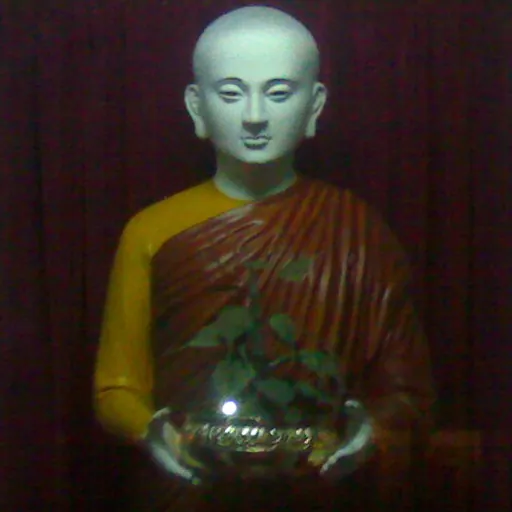
In Thailand, the lineage is well established. A clay statue of Sanghamitta made by Dhammananda in 2002, is deified in a shrine room at Songdhammakalyani Monastery in Nakhonpathom. Her image is flanked by images of 13 Arahat Theris.
It is also reported that a few women from Western countries practising the Theravada tradition and a few women from Thailand have been ordained to bhikkuni order in Sri Lanka in recent years.
Uduvapa Poya festival Unduvapa Poya festival is observed in Sri Lanka on the Full Moon of December to commemorate two specific events namely, Theri Sangamitta day of arrival from India to establish the Order of Nuns and to also mark her bringing a sapling of the sacred Bodhi-Tree from Bodh Gaya and planting it in Anuradhapura. The festival day has been designated as "Sanghamitta Day". On this day, ten ordained nuns initiate the festive celebrations every year. This observance was revived in 1903 at the suggestion of the Mahabodhi Society of Sri Lanka.
This Observance is performed by Buddhists by first following the 'Five Precepts'; bathing, shaving, wearing white robes, and kneeling with clean bare feet in a shrine before a Buddha statue. The kneeling and bowing are done the first three times with feet, hands, elbows, knees and head touching the floor. This is followed by reciting loudly the memorised prayers, with folded hands (palms at the heart). The prayers offered from sunrise until the next dawn starting with the words are:
It is also a prayer offered on this day for the revival of Bhikkuni Sasana in Sri Lanka with the hope that it will flourish in the future. It is proposed that the day should also be celebrated as the International Women’s Day, as a mark of honour to Sangamitta who established the women's Order.
Don’t just read it —
keep it.
Full-length biographies made to live with: read them, listen on the way to work, watch them tonight.
- E-book
- Audio
- Video
Instant download · yours to keep · every purchase keeps this site free
Important facts
People in Sangamitta's life
Named in this biography and alive at the same time

Related people
Same field, nearest in time




Contemporaries
People whose lives overlapped Sangamitta's

Frequently asked questions
Who was Sangamitta?
Indian Buddhist nun
When was Sangamitta born?
Sangamitta was born in 282 BC in Ujjain.
When did Sangamitta die?
Sangamitta died in 203 BC in Anuradhapura.
What was Sangamitta's occupation?
Sangamitta was a buddhist nun.
What nationality was Sangamitta?
Sangamitta was Indian.
Sources & further reading
Cite this page
APA: Biography.guide. (2026). Sangamitta. https://biography.guide/sangamitta/
MLA: "Sangamitta." Biography.guide, https://biography.guide/sangamitta/.
Chicago: "Sangamitta." Biography.guide. https://biography.guide/sangamitta/.
Data last updated: 2026-09-22 · Spot an error? Report a correction.
Portrait: Wikimedia Commons · author & licence
Page generated 2026-09-27 05:01 UTC