
About Kṣemā
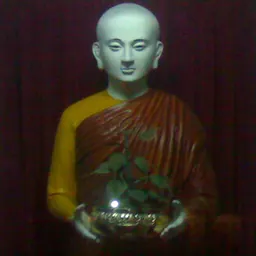
Born 550 BC. Kṣemā was a buddhist nun and philosopher.
Khema (Pali: Khemā; Sanskrit: Kṣemā) was a Buddhist bhikkhuni, or nun, who was one of the top female disciples of the Buddha. She is considered the first of the Buddha's two chief female disciples, along with Uppalavanna. Khema was born into the royal family of the ancient Kingdom of Madra, and was the wife of King Bimbisara of the ancient Indian kingdom of Magadha. Khema was convinced to visit the Buddha by her husband, who hired poets to sing about the beauty of the monastery he was staying at to her. She attained enlightenment as a laywoman while listening to one of the Buddha's sermons, considered a rare feat in Buddhist texts. Following her attainment, Khema entered the monastic life under the Buddha as a bhikkhuni. According to Buddhist tradition, the Buddha declared her his female disciple foremost in wisdom. Her male counterpart was Sariputta.
Background In Buddhist belief, when a fully enlightened Buddha appears in the world, he always has a set of chief disciples. For the current Buddha, Gautama, his chief male disciples were Sariputta and Moggallana, while his chief female disciples were Khema and Uppalavanna.
According to Theravada commentaries, in a previous life Khema was born a woman in the time of Padumattara Buddha and encountered Padumattara Buddha's chief male disciple foremost in wisdom. The woman then makes an offering to the monk and makes a resolution to have wisdom like his under a future Buddha. Ānandajoti Bhikkhu notes that this commentary story stands out compared to stories of other nuns because she makes the wish after seeing a chief male disciple rather than a chief female disciple. However, in the Apadāna texts the woman is described as having made the resolution after seeing Padumattara Buddha appoint a nun his chief female disciple. This wish came true in the time of Gautama Buddha, when she was reborn as Khema. Her name means "security" and is sometimes used as a synonym for Nirvana. Khema was described as being immensely beautiful and having a radiant golden complexion. Hearing about the beauty of the monastery, Khema became curious and went to visit the monastery. |name=|group=note Buddhist writer Susan Murcott notes that the story of Khema's enlightenment is a rare case of a laywoman attaining enlightenment before becoming a monastic.
Chief disciple After going forth as a bhikkhuni, Buddhist texts state that Khema became known for her wisdom. At one point after her ordination, Mara attempted to guide Khema away from the monastic life. Mara takes the form of a young man and attempts to seduce her, but in a drastic shift from her previous conceit, Khema describes her disgust for the human body and explains that she has moved beyond any attachment to the senses. In one jataka tale, she is even the wife of the bodhisattva who would become Gautama Buddha, a role in the jataka tales that is rare for figures other than Yasodhara. The Buddha also praised her for her teaching and leadership skills, declaring Khema and Uppalavanna his chief female disciples that other nuns should take as their model. Uppalavanna and Khema share the title of chief disciples with their male counterparts, Maha Moggallana and Sariputta. Supakwadee Amatayakul notes that Khema is mentioned in the Anguttara Nikaya as one of the thirteen female disciples of the Buddha and in the Therigatha as one of the seventy three bhikkhunis, each to whom a set of verses is dedicated. Sanskrit and Pali scholar Gisela Krey notes that Khema spiritually surpassed her husband, King Bimbisara, who got no farther than stream-entry. According to German Pali scholar Hellmuth Hecker, Khema's unusually fast attainment of arahantship was no accident, but was something she earned from the great merit that she accumulated over numerous lifetimes, as described in the jatakas.
Murcott argues that Khema's exchange with a powerful king such as King Pasenadi in the Khema Sutta shows how well respected she was, given that society at the time did not even allow female nuns to teach male monks. In the Khema Sutta, King Pasenadi's servant talks about reports spreading of Khema's great wisdom and King Pasenadi himself acknowledges Khema's superiority to him by paying respect to her. Krey argues that Khema's mastery of the Dhamma as shown in teaching the Khema Sutta, as well as the acknowledgment of her wisdom by contemporary figures, provides evidence that women could reach the same level of spiritual development as men.
Don’t just read it —
keep it.
Full-length biographies made to live with: read them, listen on the way to work, watch them tonight.
- E-book
- Audio
- Video
Instant download · yours to keep · every purchase keeps this site free
Important facts
Related people
Same field, nearest in time



Frequently asked questions
Who was Kṣemā?
Disciple of Gautama Buddha
When was Kṣemā born?
Kṣemā was born in 550 BC in Sagala.
What was Kṣemā's occupation?
Kṣemā was a buddhist nun and philosopher.
Sources & further reading
Cite this page
APA: Biography.guide. (2026). Kṣemā. https://biography.guide/ksema/
MLA: "Kṣemā." Biography.guide, https://biography.guide/ksema/.
Chicago: "Kṣemā." Biography.guide. https://biography.guide/ksema/.
Data last updated: 2026-09-20 · Spot an error? Report a correction.
Page generated 2026-09-27 05:17 UTC