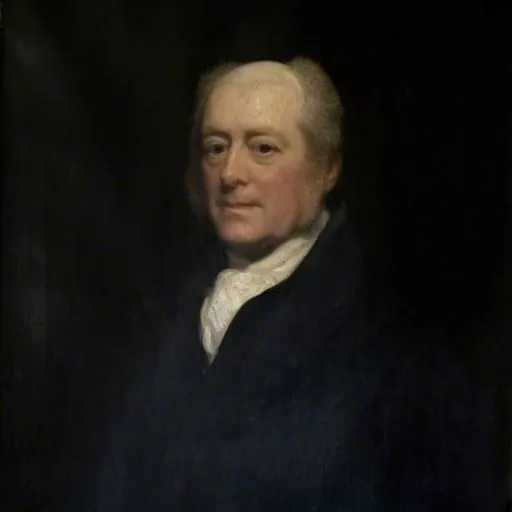
About Samuel Wilson Warneford
Lived 1763 – 1855 (aged 92). Samuel Wilson Warneford was a British cleric and philanthropist.
Samuel Wilson Warneford (1763 – 11 January 1855) was an astute and eccentric English cleric and philanthropist from an old but generally impoverished family. He married into money, as his father had done, and thereafter spent his life trying to dispose of his fortune to the benefit of religious, educational and medical causes in England and abroad. A zealot, long widowed and childless, his domestic life was frugal and he left nothing to his family.
Life Samuel Warneford was born in 1763, possibly in the village of Sevenhampton, near Highworth in Wiltshire, England. His father, an ordained minister called Francis Warneford, came from a long-established but often penurious landowning family whose family seat was Warneford Place, in Sevenhampton, where they owned all of the land. The family's finances had been much improved when Francis married his second wife, Catherine, the daughter of a wealthy London-based drug merchant; after her death, he married Samuel's mother, also called Catherine. Samuel was the younger of two sons and had at least two sisters, who never married and lived with him in adult life.
From 1779, Warneford attended University College, Oxford, from where he was awarded a BA degree in 1783 and an MA in 1786. He was ordained in 1787 and became curate at what is now called Brize Norton and was then known as Norton Broyne, supplementing his qualifications with the degree of BCL in 1790.
In September 1796, like his father, Samuel married into money: his wife, Margaret, was a daughter of Edward Loveden Loveden, a cheese merchant and Member of Parliament. Margaret's father objected to the arrangement but its progression brought together the fortunes of two families and was then further enhanced by a legacy of £34,000 left to his sickly wife by her grandfather. He bought the advowsons of Lydiard Millicent, in Wiltshire, and Bourton-on-the-Hill, in Gloucestershire, in 1809 and 1810, respectively, and the latter became his principal place of residence.
Warneford died on 11 January 1855 at his rectory in Bourton, aged 92, and was buried in the church there. and his donations were often made incrementally so that he could monitor progress and, in particular, remedy perceived problems. His considerable and detailed interest in that project may have been spurred by his wife's insanity: he had rejected suggestions that she should be hospitalised, preferring to nurse her at home after being appalled during his inspections of several possible institutes. His gifts to the value of £25,000 provided for chaplaincies as well as scholarships, a professorial chair in pastoral theology and new buildings. but his interest in the project was somewhat neglected at his death because of his concern that it had not developed according to his expectations.
Officers at both King's and Queen's sometimes frustrated him with their concerns regarding his zealotry. Whyte says that Warneford – in life "a grasping, avaricious, bigoted reactionary" – and John Owens – "a parsimonious, work-obsessed, easily offended bachelor, who gave little to charity in his lifetime" and whose legacy was the basis for Owens College in Manchester – were "disagreeable men, with deep pockets and few friends". The two institutions were very different but in the characters of their benefactors lie fundamental similarities often found in history, that philanthropy is not necessarily selfless and that "the good are not always very nice".
Don’t just read it —
keep it.
Full-length biographies made to live with: read them, listen on the way to work, watch them tonight.
- E-book
- Audio
- Video
Instant download · yours to keep · every purchase keeps this site free
Important facts
People in Samuel Wilson Warneford's life
Named in this biography and alive at the same time

Related people
Same field, nearest in time

Contemporaries
People whose lives overlapped Samuel Wilson Warneford's





Frequently asked questions
Who was Samuel Wilson Warneford?
English cleric and philanthropist
When was Samuel Wilson Warneford born?
Samuel Wilson Warneford was born on 17 January 1763.
When did Samuel Wilson Warneford die?
Samuel Wilson Warneford died on 17 January 1855.
What was Samuel Wilson Warneford's occupation?
Samuel Wilson Warneford was a cleric and philanthropist.
What nationality was Samuel Wilson Warneford?
Samuel Wilson Warneford was British.
Sources & further reading
· Wikipedia: Samuel Wilson Warneford
· DBpedia: Samuel Wilson Warneford
Cite this page
APA: Biography.guide. (2026). Samuel Wilson Warneford. https://biography.guide/samuel-wilson-warneford/
MLA: "Samuel Wilson Warneford." Biography.guide, https://biography.guide/samuel-wilson-warneford/.
Chicago: "Samuel Wilson Warneford." Biography.guide. https://biography.guide/samuel-wilson-warneford/.
Data last updated: 2026-09-23 · Spot an error? Report a correction.
Portrait: Wikimedia Commons · author & licence
Page generated 2026-09-27 05:07 UTC