
About Samuel L. Myers Sr.
Lived 1919 – 2021 (aged 101). Samuel L. Myers Sr. was an American economist.
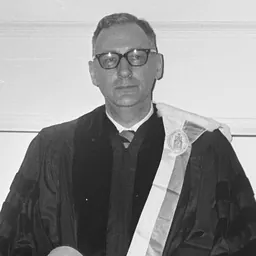
Samuel Lloyd Myers Sr. (April 18, 1919 – January 8, 2021) was an American economist, university president, education adviser and civil rights advocate. One of Myers' most significant contributions to society occurred during his 18-year tenure as the president of the National Association for Equal Opportunity (NAFEO) where he fought to sustain the establishment of historically black colleges by providing them access to a billion dollars of federal aid.
Early life and education Samuel Myers was born in Baltimore, Maryland, in April 1919, to David and Edith Myers, Jamaican immigrants. which was segregated but renowned, where he graduated in 1936. During his time there, he was the editor of the school newspaper, a varsity football player, and participant on the debate team. Upon returning to college, he concluded that his focus would be in the social sciences and committed his education and life's work to combat these issues.
After graduating from Morgan State with a B.A. in social sciences, Myers enrolled at Boston University, where he attained an M.A. degree in economics, writing a thesis titled "Consumers' Cooperation: A Plan for the Negro". His thesis speaks to the lack of successful cooperatives in the United States compared to European nations, and more so the lack of local Negro cooperatives. Myers speaks of the benefit of cooperatives to African Americans in the long run in ways of increased consumer bargaining power and concerted action power. The thesis illustrates the plan as a social economic salvation for African Americans, which is also noted in Jessica Gordon Nembhard's book Collective Courage: A History of African American Cooperative Economic Thought and Preface.
After graduation, Myers was drafted into the Army and was stationed in a training school at Camp Lee, Alabama. Despite eventually rising to the rank of captain, he faced racial discrimination, which was still very present in the Army during this period. He and other black soldiers were often subject to cleaning the barracks of white soldiers. At one point, Myers was nearly court marshaled after protesting the exclusion of black officers from the general officers' club. He was later stationed in Okinawa, Japan, where he guarded Japanese prisoners of war.
After the war, Myers went on to pursue his doctorate degree in economics at Harvard University. He was a recipient of the coveted Julius Rosenwald Fellowship, which assisted him in completing his doctorate in 1949. Myers was one of the first African Americans to receive a Ph.D. in economics from Harvard University.
Professional career
Through his relationship with and tutelage under John D. Black, Myers was exposed to numerous governmental positions. In April 1950, he was hired as a research economist for the Bureau of Labor Statistics at the U.S. Department of Labor. During his term, Myers was known as a strong advocate of success in the classroom and rewarded such success with presidential recognition. As the new leader of Bowie, he increased and expanded the university's curriculum, and increased student enrollment. which works to diversify campuses and corporate work sites. For the students, the issue did not lie in the administration of the school, but in the state government and its consistent lack of attention to their needs. Governor Spiro T. Agnew, along with his education official, refused to meet with or listen to the students. Instead, Agnew provided ultimatums to the students, ordering them to vacate the buildings or be met with force. However, Myers was able to calm the students, bringing their focus back on education. Myers' wife Marion is also credited with being a critical figure in subduing the tensions of students. She aided in the positive image of her husband as she spoke with the students in the midst of protests. She invited them to her and her husband's campus home, often late at night, and gave them home cooked meals. With only a few students arrested in the midst of the protests, the riots for the most part worked in favor of the students. The protests received national attention, provoking a visit to the school from Attorney General Francis B. Burch, during which he confirmed the inadequate conditions of several facilities. Myers spent the next 18 years as the president, the longest term in the organization's history. NAFEO also focused on empowering black students. The need to provide career opportunities to hardworking, intelligent black students was clear to Myers and the organization.
In the fall of November 1984, NAFEO held a reception announcing the plan to introduce one hundred corporations to its own Student Talent Identification Bank. With this, the organization could pair the brightest, most motivated students in black colleges and universities with top executives from corporations around the world.
In the late 1970s and early 1980s, enrollment was decreasing at black colleges and universities, and funding was an undeniable problem. When Myers took office at NAFEO, the U.S. government was in the midst of deciding whether to sustain funding for these institutions. Much of the country's focus was on establishing and increasing the prestige of "white, Ivy League and research institutions".
Personal
Myers lived in Bethesda, Maryland. He and his wife Marion had three adult children, Samuel Myers, Jr, Yvette Myers, and Judge Tama Rose Myers Clark. Commandeur de L'Ordre National de Cote d Ivoire Gold Standard for members of Sigma Pi Phi
Publications Consumers Cooperation. Myers. Thesis. Masters of Arts 1940. Product Testing and Labeling with special Reference to Textiles. Doctorate Dissertation. 1949. Textile and Apparel Testing and Labeling. Harvard Studies in Marketing, Farm Products.1954 Economic Issues and Black Colleges. 1986. Dissertation in Higher Education. 1989. "The Evolving Face of Capitalism and prospects for Black Economic Empowerment." The Review of Black Political Economy. 1994. "Understanding Consumer Behavior." Journal of Marketing Research. A book review. 1964.
Don’t just read it —
keep it.
Full-length biographies made to live with: read them, listen on the way to work, watch them tonight.
- E-book
- Audio
- Video
Instant download · yours to keep · every purchase keeps this site free
Important facts
People in Samuel L. Myers Sr.'s life
Named in this biography and alive at the same time




Related people
Same field, nearest in time



Contemporaries
People whose lives overlapped Samuel L. Myers Sr.'s




Frequently asked questions
Who was Samuel L. Myers Sr.?
American economist (1919-2021)
When was Samuel L. Myers Sr. born?
Samuel L. Myers Sr. was born on 18 April 1919 in Baltimore.
When did Samuel L. Myers Sr. die?
Samuel L. Myers Sr. died on 8 January 2021.
What was Samuel L. Myers Sr.'s occupation?
Samuel L. Myers Sr. was an economist.
What nationality was Samuel L. Myers Sr.?
Samuel L. Myers Sr. was American.
Sources & further reading
· Wikipedia: Samuel L. Myers Sr.
· DBpedia: Samuel L. Myers Sr.
Cite this page
APA: Biography.guide. (2026). Samuel L. Myers Sr.. https://biography.guide/samuel-l-myers-sr/
MLA: "Samuel L. Myers Sr.." Biography.guide, https://biography.guide/samuel-l-myers-sr/.
Chicago: "Samuel L. Myers Sr.." Biography.guide. https://biography.guide/samuel-l-myers-sr/.
Data last updated: 2026-09-20 · Spot an error? Report a correction.
Page generated 2026-09-27 05:26 UTC