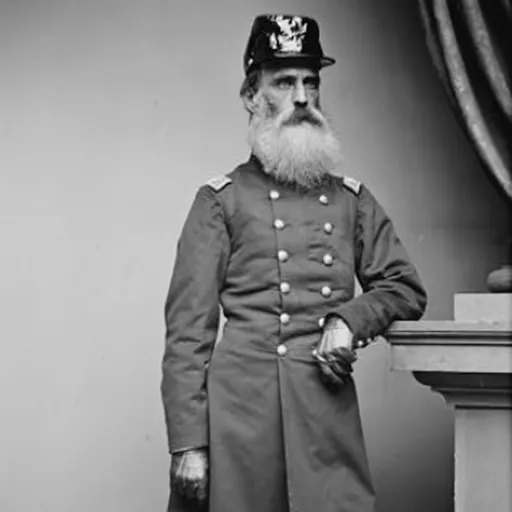
About Samuel H. Starr
Lived 1810 – 1891 (aged 81). Samuel H. Starr was a military personnel.
Samuel Henry Starr (July 31, 1810 – November 23, 1891) was a career United States Army officer, regimental commander and prisoner of war. A collection of his letters provide a rare view of military life, the War with Mexico, Indian conflicts, the Civil War, his fall from grace, recovery and post Civil War service. Despite his rough demeanor he was a religious man and reflective of the times he served.
He was known for his discipline and blistering tongue-lashings directed at friend and foe who performed unsuitably in his eyes. In the later part of 1862, he saber-slapped (hit with the flat edge of his saber) an inattentive camp guard and loudly declared the soldier an "SOB." Because of his "abuse of the guard," he resigned his rank of colonel, his command and subjected himself to a rigorous religious revival then an active recruiting effort.
Forgiven by the press and apparently by the Army, he rejoined the active military as a major in command of a cavalry regiment. He commanded the Cavalry Reserve Brigade briefly, but was denied the promotion and command when another officer his junior took command. He is noted for his July 1863 actions at the Battle of Fairfield where his small cavalry regiment took on two crack Confederate Cavalry Regiments reinforced with light artillery. He was severely wounded in the melee and his right arm had to be amputated while he was a prisoner of war. "Old Paddy" was exchanged on parole in September of that year.
Achsah Catharine (Kate) Starr (about 1843–?) in New York state. Kurtz Henry Starr (1846–1847) in New York. Annie Martha Starr (about 1849–?) in Austin, Texas. Jo Ursula Starr (about 1851–?) in Fort Graham, Texas. Samuel Benjamin Starr (1857–?) in Burlington, New Jersey.
Military service alt=A computer generated reproduction of the insignia of the Union Army cavalry branch. The insignia is displayed in gold and consists of two sheafed swords crossing over each other at a 45 degree angle pointing upwards
Samuel Starr enlisted in the United States Army as a private on October 27, 1832, in Company G, 4th United States Artillery to October 26, 1837. On June 23, 1846, he enlisted with Company A, an engineer battalion during the Mexican War reaching the rank of sergeant and given a brevet promotion to second lieutenant on June 28, 1848, and he was discharged on July 13, 1848. He sent letters to his wife's home from Matamoros, Mexico in 1846. Other letters were sent from Victoria, Mexico dated January 12, 1847, and two from Tampico dated February 9 and 22, 1847. His nickname was "Paddy" reflective of his Irish ancestry.
In one letter dated March 14, 1847, from an engineer camp near the city of Veracruz, he mentions some skirmishing near San Juan. His letter of March 30, mentions the surrender of Veracruz to American forces. Another letter dated April 22, 1847, describes following Mexican General Santa Anna to Xalapa. The letter was written from the "Castle of Perote."
Fall from grace and redemption Starr had always been a strict taskmaster and disciplinarian typical of a pre-war army sergeant with a mouth that matched. To those who admired him, he earned the nickname of "Old Paddy" and to those that didn't "Old Nose Bag." The latter term comes from an old company punishment for transgression that required the offender mount astride a fence rail, with his arms secured behind him and with his feet tied together. The crowning came with a horse feed bag (the nose bag) placed over the face of the individual. Other forms of company punishment included being strapped to a wagon wheel or being forced to walk a post for hours in full uniform and gear. The harsh discipline was maintained for both officers and enlisted men. Starr had been warned after the September 25, 1861, letter of complaint from his officers. The volunteers would not put up with the harsh discipline of the pre-war regulars.
The Army of the Potomac was initially under Major General Joseph Hooker then under Major General George G. Meade on June 28, 1863. The Cavalry Corps was commanded by Major General Alfred Pleasonton, with divisions commanded by Brigadier Generals John Buford, David McM. Gregg, and H. Judson Kilpatrick. Beverly Ford, Virginia, June 9, at the Battle of Brandy Station. The 6th was under Buford's right wing. The Battle of Upperville: Harper's Weekly, issue date July 18, 1863. Benton's Mill, Virginia, June 17, an engagement near Middleburg. Middleburg, Virginia, June 21, at the Battle of Middleburg. Upperville, Virginia, June 21, at the Battle of Upperville Fairfield, Pennsylvania, July 3, at the Battle of Fairfield – This is where Starr was wounded and taken prisoner. Williamsport, Maryland, July 6, an engagement. Funkstown, Maryland, July 7, a small engagement. Boonesboro, Maryland, July 8 and 9, at the Battle of Boonsboro. Funkstown, Maryland, July 10, at the Battle of Funkstown.
Battle of Fairfield
On July 3, 1863, reports of a slow moving Confederate wagon train were reported in the vicinity of Fairfield, Pennsylvania, and attracted the attention of newly commissioned Union Brigadier General Wesley Merritt of the Reserve Brigade, First Division, Cavalry Corps. He ordered the 6th U.S. Cavalry under (Brevet Colonel) Major Starr to scout Fairfield and locate the wagons, resulting in the Battle of Fairfield. Starr dashed forward under orders after the Confederate supply train. His scouts spotted the wagons and Starr charged forward. When his forward units under Lieutenant Christian Balder encountered Virginia cavalry and came racing back, Starr decided to fight. He deployed his men in a defensive posture with a portion of them mounted ready for offensive action on the road.
It was a cavalryman's worst nightmare of a roiling twisted fight with pistols and blades by an overwhelming mounted force. In the violent melee Starr was struck by a saber in the head then hit in the arm by a pistol ball. He fell from his horse severely wounded. The Virginia cavalry cleared Starr's forces off the ridge inflicting heavy casualties and taking many prisoners. The 6th Cavalry had 6 men listed as killed in action, 5 officers and 23 men wounded and 203 officers and men missing out of 400.
The 6th Cavalry's stand was considered one of the most gallant in its history and helped influence the outcome the battles being fought around Gettysburg. While the 6th Cavalry regiment was cut to pieces, it fought so well that its squadrons were regarded as the advance of a large body of troops. The Confederate senior officer of those brigades was later criticized severely for being delayed by such an inferior force. Private George Crawford Platt, later Sergeant, an Irish immigrant serving in Carpenter's Troop H, was awarded the Medal of Honor on July 12, 1895, for his actions that day at Fairfield. His citation reads, "Seized the regimental flag upon the death of the standard bearer in a hand-to-hand fight and prevented it from falling into the hands of the enemy." His "commander" was an eyewitness and documented Private Platt's "beyond the call of duty" behavior that day.
As a prisoner of war, Starr was taken into Fairfield by the Confederates. He had his wounds attended to and unfortunately his right arm had to be amputated. He spent a few days in Fairfield until he recovered enough to be transported south. "Old Paddy" was later exchanged in the following September (not November).
Samuel Starr left a legacy of many letters, correspondence, military papers regarding his service with various military units. This includes notes and comments from his daughters, especially Kate Price. They are part of the Samuel H. Starr Papers, 1846–1904 at the Missouri Historical Society Archives in St. Louis, Missouri.
The collection is arranged into eight series: Personal Correspondence from Samuel Starr to Family, Personal Correspondence to Samuel Starr (includes letters from veterans regarding reunions and veterans' organizations), Military Correspondence of Samuel Starr (Mexican War, the Civil War, and the Sioux Indian expedition), Military Papers of Samuel Starr (includes forms for quartermaster stores, charges against Starr, and lists of casualties. The series also includes three folders of General and Special Orders.), Papers of Other Members of the Starr Family, Papers of William D. Price, Papers of Other Members of the Price Family, and Miscellaneous.
Don’t just read it —
keep it.
Full-length biographies made to live with: read them, listen on the way to work, watch them tonight.
- E-book
- Audio
- Video
Instant download · yours to keep · every purchase keeps this site free
Important facts
People in Samuel H. Starr's life
Named in this biography and alive at the same time




Related people
Same field, nearest in time

Contemporaries
People whose lives overlapped Samuel H. Starr's





Frequently asked questions
Who was Samuel H. Starr?
Mexican War of 1848, American Civil War, Indian Wars
When was Samuel H. Starr born?
Samuel H. Starr was born on 31 July 1810 in Leiden.
When did Samuel H. Starr die?
Samuel H. Starr died on 23 November 1891 in Philadelphia.
What was Samuel H. Starr's occupation?
Samuel H. Starr was a military personnel.
Sources & further reading
Cite this page
APA: Biography.guide. (2026). Samuel H. Starr. https://biography.guide/samuel-h-starr/
MLA: "Samuel H. Starr." Biography.guide, https://biography.guide/samuel-h-starr/.
Chicago: "Samuel H. Starr." Biography.guide. https://biography.guide/samuel-h-starr/.
Data last updated: 2026-09-24 · Spot an error? Report a correction.
Portrait: Wikimedia Commons · author & licence
Page generated 2026-09-27 05:08 UTC