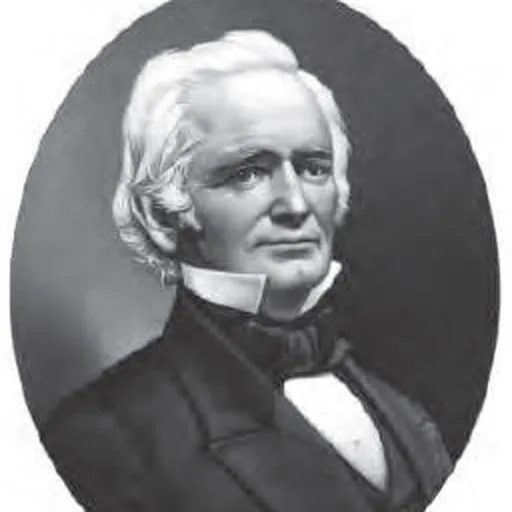
About Samuel D. Lockwood
Lived 1789 – 1874 (aged 84). Samuel D. Lockwood was an American lawyer, judge and politician.
Samuel Drake Lockwood (August 2, 1789 – April 23, 1874) was an Illinois lawyer and politician who served as the state's Attorney General, Secretary of State, Justice of the Illinois Supreme Court and the state's trustee on the board of the Illinois Central Railroad.
Early and family life Lockwood was born in Poundridge, New York. His father, Joseph Lockwood (1764-1799), was an innkeeper who died of yellow fever (as did his infant son Cornelius) when Samuel was ten. His mother, Mary (1765-1819), was the daughter of Col. Samuel Drake and would remarry after about a year, to Duncan McCall. Samuel was the oldest of Lockwood's four children, and would be sent to boarding school in New Jersey with his brother Jesse Close Lockwood (b.1791), when his mother moved to Canada with her new husband and young daughter Rebecca (1792-1827; who would marry Jacob Potts in Canada). Samuel studied law with Drake and was admitted to the bar in Batavia, New York in 1811.
In 1826 Lockwood married Virginia-born Mary V. S. Nash (1800-1875), who would survive him by less than a year. They had four daughters. By 1850, Lockwood also had two 20-year-old male clerks living with his family and sharing his last name (R.A. Lockwood and J. Lockwood), so he may have repaid his uncle's tutelage of himself and his brother by raising other young relatives.
Law career Lockwood had practiced law in Batavia, the seat of Genesee County, New York for a year before relocating his practice somewhat eastward. He then practiced in Sempronius, Cayuga County, New York for about a year and a half. From 1815 until August 1818, he had a law partnership in nearby Auburn, New York with George B. Throop. Lockwood ended that practice when he decided to move westward to the new state of Illinois. and further land when such became available in the 1830s. He lived in Morgan County for more than two decades. Lockwood would move further north following his judicial retirement, and finally settled with his family in Batavia, Kane County, Illinois in 1853.
Political career In 1821, Illinois voters elected Lockwood the young state's third Attorney General. During his brief tenure in that office, Lockwood successfully prosecuted the only known duel to come to trial in Illinois. Judge Lockwood took office on January 19, 1825 (as perhaps its only anti-slavery member) and served until December 1848. Early on, Lockwood revised the Illinois Criminal Code, and he resigned after the 1848 Constitution (which he helped draft and supported) reduced the Court's membership to three judges. The Court had also reorganized in 1841, after which Lockwood became responsible for the first judicial circuit.
In 1837, Lockwood was the only dissenting judge in a case concerning the pre-emption homestead rights of trader Jean Baptiste Beaubien (brought by then fellow Morgan County lawyer Murray McConnell) shortly before the formal closing of Fort Dearborn following the 1833 Treaty of Chicago. The United States Supreme Court would overrule the other Illinois justices in Wilcox v. Jackson in 1839, before the federal government sold the contested land as the "Fort Dearborn Addition" to the town (which had incorporated as a city in 1837).
Several times, Lockwood adjudicated cases involving slaves who claimed freedom based on being brought and/or living in Illinois, as well as to Illinois residents who assisted. He upheld slave status on several occasions, both as a trial and appellate judge, citing "comity" with laws of southern states that permitted slavery, and that the slaves were only traveling through the free state. In Phoebe v Jay, Lockwood, despite his previous anti-convention and abolitionist views, held that the 40 year indenture of Phoebe (entered into in 1814) could be transferred to Joseph Jay's heir, his son William Jay, reasoning that the new state's Constitution superseded the anti-slavery provisions of the Northwest Ordinance. However, Illinois courts began chipping away at the state's Black Code and indenture laws around 1843, led by Judge John D. Caton, who threw out a charge against Owen Lovejoy for harboring "Nancy", a black woman without freedom papers. In 1844, Lockwood was the only dissenter in the case of abolitionist William Hayes for assisting "Sukey", slave of Andrew Borders who moved to Galesburg, kidnapped her two sons from jail and sold them southward, the remaining judges upholding the transaction. In 1845, the Court found Joseph Jarrott not a slave, although his mother Pelagie had been since her purchase in 1798 when she was four years old; it thereafter held that slaves born in Illinois after the Northwest Ordinance were born free (overruling Phoebe v. Jay. Nonetheless, the road to abolition was slow. Lockwood participated in two other underground railroad conductor convictions, of Jacksonville's perhaps most visible abolitionist, Julius Willard and his son Samuel Willard (Illinois' governor Pat Quinn pardoned both posthumously in 2014). Lockwood became one of the framers of Illinois' second Constitution in 1848, representing Morgan County at that assembly. With the demise of the Whig Party, and because he remained anti-slavery, Lockwood joined the new Republican Party, whose Presidential candidate in 1860 he knew well from his days in Morgan County and tenure on the Illinois Supreme Court, Abraham Lincoln. In both the 1860 and 1870 federal censuses, Lockwood characterized himself as a farmer in Batavia. President Lincoln characterized Lockwood as "one of the best men in the world" upon receiving a letter from him in December 1864. After the American Civil War, Lockwood also accepted an appointment by Governor Palmer and served on a committee to find a site for an insane asylum in northern Illinois in 1869 (perhaps in part because he was a trustee of the asylum at Jacksonville), at which Mary Todd Lincoln would briefly reside in 1874.,
Retirement and death Lockwood died at his home in Batavia in 1874, at age 85. After a funeral at the Congregational Church, he was interred in the West Batavia cemetery across from his home (and to which he had donated some land to enable a stone fence).
Don’t just read it —
keep it.
Full-length biographies made to live with: read them, listen on the way to work, watch them tonight.
- E-book
- Audio
- Video
Instant download · yours to keep · every purchase keeps this site free
Important facts
People in Samuel D. Lockwood's life
Named in this biography and alive at the same time





Related people
Same field, nearest in time



Contemporaries
People whose lives overlapped Samuel D. Lockwood's


Frequently asked questions
Who was Samuel D. Lockwood?
American judge (1789-1874)
When was Samuel D. Lockwood born?
Samuel D. Lockwood was born on 2 August 1789 in Pound Ridge.
When did Samuel D. Lockwood die?
Samuel D. Lockwood died on 23 April 1874 in Batavia.
What was Samuel D. Lockwood's occupation?
Samuel D. Lockwood was a lawyer, judge and politician.
What nationality was Samuel D. Lockwood?
Samuel D. Lockwood was American.
Sources & further reading
· Wikipedia: Samuel D. Lockwood
Cite this page
APA: Biography.guide. (2026). Samuel D. Lockwood. https://biography.guide/samuel-d-lockwood/
MLA: "Samuel D. Lockwood." Biography.guide, https://biography.guide/samuel-d-lockwood/.
Chicago: "Samuel D. Lockwood." Biography.guide. https://biography.guide/samuel-d-lockwood/.
Data last updated: 2026-09-22 · Spot an error? Report a correction.
Portrait: Wikimedia Commons · author & licence
Page generated 2026-09-27 05:04 UTC