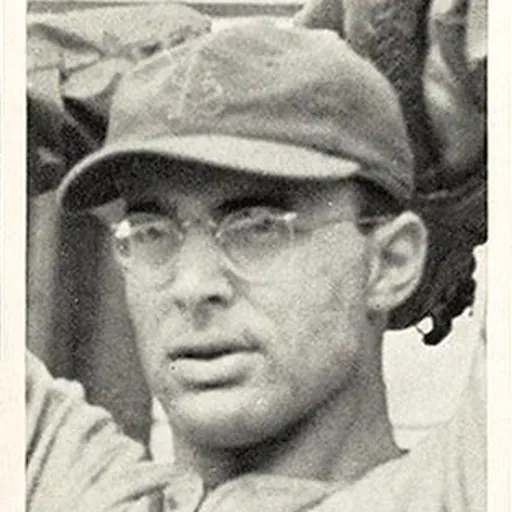
About Sam Nahem
Lived 1915 – 2004 (aged 88). Sam Nahem was an American baseball player.
Samuel Ralph Nahem (October 19, 1915 – April 19, 2004), nicknamed "'Subway Sam", was an American pitcher for the Brooklyn Dodgers, St. Louis Cardinals (1941), and Philadelphia Phillies (1942 and 1948). His professional baseball playing was interrupted by military service (1942–1946) with the United States Army in the European Theater of Operations during World War II. Articles have been written and a talk at Cooperstown given on his role in the integration of American baseball, because as manager and pitching star he insisted on having Black players on his O.I.S.E. team roster, and in an exciting best of five series they beat an all-White, much more professional team, with the final game ironically played in Nuremberg stadium, known as Stadion der Hitler-Jugend from 1933 until 1945, when the U.S. army temporarily named it Soldier's Field.
Early and personal life Nahem was born to Sephardic Jewish parents in New York City. His parents, Isaac and Emilie ("Milo", née Sitt) Nahem had immigrated from Aleppo, Syria, to the United States, first to the Lower East Side in Manhattan where Samuel was initially raised, and then in the Bensonhurst section of Brooklyn, and finally Ocean Parkway. His first language was Arabic, as his family spoke Arabic.
His father, who owned an import-export business, drowned when the British passenger steamship SS Vestris sank off the coast of Virginia on November 12, 1928. Nahem then attended Brooklyn College, where he pitched for the school's baseball team and played quarterback and fullback for its football team, graduating in 1935.
While in the college he also started participating in Communist Party activities. He joked that he played for so many teams, he became known as "formerly of ..., as in 'Sam Nahem, formerly of ..."
He made his major league debut in 1938 at the age of 22. In June 1940, he was traded by the Dodgers with Carl Doyle, Bert Haas, and Ernie Koy to the St. Louis Cardinals for Curt Davis and future Hall of Famer Joe Medwick.
In 1941, he pitched a career-high 81 innings, and had a record of 5–2 with an ERA of 2.98 for the Cardinals.
As a left-wing radical and a Jew who had faced anti-Semitism in various guises, Nahem was sympathetic to the plight of African Americans, and believed in equalizing civil rights and social status. “I was in a strange position. The majority of my fellow ballplayers, wherever I was, were very much against black ballplayers, and the reason was economic and very clear. They knew these guys had the ability to be up there and they knew their jobs were threatened directly and they very, very vehemently did all sorts of things to discourage black ballplayers."
Nahem and Cardinals general manager Branch Rickey, who played an immense role in baseball’s integration, knew Sam, and knew his political leaning. He actually had had a talk with Nahem that helped restore his confidence. According to Nahem, Rickey told him that he had faith in him. “He said I was his boy, and he was picking me to make good. He told me I would pitch well the rest of the season, and darned if I didn’t.”
Nahem went overseas in late 1944, serving with an anti-aircraft artillery division. From his base in Reims, France, he was assigned to run two baseball leagues for servicemen in France, while also managing and pitching for his own team, the Oise All-Stars, representing Communications Zone (Com Z), composed mainly of semi-pro, college, and ex-minor-league players. They represented the army command in charge of communication and logistics in the liberated areas. Besides Nahem, only one other Oise player had major league experience — Russ Bauers, who had a 29-29 record with the Pirates between 1936 and 1941. Defying the military establishment and baseball tradition, Nahem and his associate, Captain Robert H. Wormhoudt, wanted African Americans on the team, and secured two Negro League stars: Willard Brown, an outfielder with the Kansas City Monarchs and one of the Negro Leagues’ most feared sluggers, and Leon Day, a star pitcher for the Newark Eagles. In the fourth game, the 3rd Army’s minor league pitcher Bill Ayers shut out the Oise squad, beating Day by a 5-0 margin.
In October 1945, a month after this victory which showed to thousands of Americans how integration could work, Nahem’s former boss Branch Rickey announced that Jackie Robinson had signed a contract with the Dodgers.
Later career Upon joining the military in 1942, Nahem spent two years at Fort Totten, where he pitched for the Anti-Aircraft Redlegs of the Eastern Defense Command. He set a Sunset League record with an ERA of 0.85, and came second in batting with a .400 average.
Nahem combined practicing law and working as a longshoremen while playing semi-professionally with the Brooklyn Bushwicks, in 1947 pitching the team to a 3–0 one-hit victory over the World Series All-Stars, which included Major League players Eddie Stanky, Ralph Branca, and Phil Rizzuto. After his second spell with the Phillies, for whom he pitched his last game in September 1948 at 32 years of age, he was released.
Later life Nahem moved to the East Bay in the San Francisco Bay area in 1955, and then to Berkeley, California, in 1964, partly due to McCarthyite blacklisting which made it difficult for him to secure employment. He worked at the Chevron chemical plant in Richmond for 25 years, retiring in 1980. During his time there he was also a rank-and-file organizer and leader for the Oil, Chemical and Atomic Workers International Union.
Nahem died at his home in Berkeley, at the age of 88.
Don’t just read it —
keep it.
Full-length biographies made to live with: read them, listen on the way to work, watch them tonight.
- E-book
- Audio
- Video
Instant download · yours to keep · every purchase keeps this site free
Important facts
People in Sam Nahem's life
Named in this biography and alive at the same time


Related people
Same field, nearest in time
Contemporaries
People whose lives overlapped Sam Nahem's





Frequently asked questions
Who was Sam Nahem?
American baseball player (1915-2004)
When was Sam Nahem born?
Sam Nahem was born on 19 October 1915 in New York City.
When did Sam Nahem die?
Sam Nahem died on 19 April 2004 in Berkeley.
What was Sam Nahem's occupation?
Sam Nahem was a baseball player.
What nationality was Sam Nahem?
Sam Nahem was American.
Sources & further reading
Cite this page
APA: Biography.guide. (2026). Sam Nahem. https://biography.guide/sam-nahem/
MLA: "Sam Nahem." Biography.guide, https://biography.guide/sam-nahem/.
Chicago: "Sam Nahem." Biography.guide. https://biography.guide/sam-nahem/.
Data last updated: 2026-09-22 · Spot an error? Report a correction.
Portrait: Wikimedia Commons · author & licence
Page generated 2026-09-27 05:01 UTC