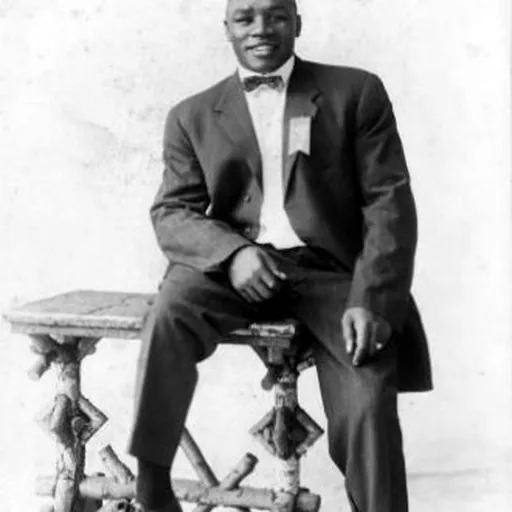
About Sam Langford
Lived 1883 – 1956 (aged 72). Sam Langford was an American and Canadian boxer.
Samuel Edgar Langford (March 4, 1886 – January 12, 1956) was a Canadian professional boxer who competed from 1902 to 1926. Called the "Greatest Fighter Almost Nobody Knows" by ESPN, Langford is considered by many boxing historians to be one of the greatest fighters of all time. Originally from Weymouth Falls, Nova Scotia, he moved to Boston, Massachusetts as a teenager, and began his professional boxing career there in 1902. Langford was known as "the Boston Bonecrusher", "the Boston Terror", and, most famously, "the Boston Tar Baby". Langford stood and weighed in his prime. He fought from lightweight to heavyweight and defeated many world champions and legends of the time in each weight class. Considered a devastating puncher even at heavyweight, The Ring rated Langford second on their list of the "100 greatest punchers of all time". One boxing historian described Langford as "experienced as a heavyweight James Toney with the punching power of Mike Tyson".
He was denied a shot at many World Championships due to the colour bar and the refusal of Jack Johnson, the first African-American World Heavyweight Champion, to fight him in a rematch. Langford was the World Colored Heavyweight Champion, a title vacated by Johnson after he won the World Championship, a record five times. Alongside this, Langford also defeated the reigning Lightweight Champion Joe Gans, the first African-American World Champion in boxing history and widely regarded as one of the greatest boxers of all time, in a non-title bout. Many boxing aficionados consider Langford to be the greatest boxer not to have won a world title. On August 13, 2020, the WBC granted Langford an honorary world champion title. BoxRec ranks him as the 22nd greatest Canadian boxer of all time.
Early life Langford was born in Weymouth Falls, Nova Scotia, a rural black community that his grandfather, a former slave from the United States, helped settle. His birthdate was reported as March 4, 1886, although he later stated that this "is just a date he thought up." Langford left home as a youth to escape an abusive father.
Professional career
Langford boxed in multiple weight classes, including the lightweight, welterweight, middleweight, and heavyweight divisions. Buffalo News concurred, stating that Langford "appeared to be somewhat afraid" of Gans for the first three rounds, but by the last eight he was dominating the champion. Langford won the fight by decision, a victory that few predicted beforehand.
Langford's most memorable fights were his numerous encounters against fellow Black boxers Sam McVey, Battling Jim Johnson, Joe Jeanette and Harry Wills, who all experienced similar barriers in their fighting careers.
He fought Jack Blackburn, trainer of the legendary Joe Louis, six times. The first three fights were draws, the fourth a decision win for Langford, the fifth another draw and the sixth a no contest.
World Welterweight title fight
Although Langford is often credited as the greatest fighter to never challenge for a world title, he fought World Welterweight Champion Barbados Joe Walcott, a black man, on September 5, 1904, at Lake Massabesic Coliseum in Manchester, New Hampshire for his title. Both fighters weighed in at 142 lbs. The fight lasted fifteen rounds and resulted in a draw via decision; thus, Walcott retained his title. The Boston Globe claimed that Langford won a clear victory, as he "brought the champion to one knee" in the third round while he himself "went through the entire fifteen rounds without a perceptible scratch". They argued the draw decision largely resulted from Walcott's role as the primary aggressor in the fight.
World Colored Middleweight Championship
Sam Langford traveled to England in early 1907. It was rumored that Langford was set to fight Gunner Moir, the English heavyweight champion, despite not being in the same weight class. Instead, Langford defeated Tiger Smith by fourth-round knockout to claim the middleweight championship of England in May of 1907. Langford returned to the United States in September of the same year, having, in the words of the Buffalo Evening News, "whipped every man he met in his class."
Langford fought welterweight Young Peter Jackson for the World Colored Middleweight Championship on November 12th, 1907. The match took place at the Pacific Athletic Club in Los Angeles over 20 rounds. Betting odds were 10-to-6 in favor of Jackson, but Langford won the decision at the end of the twentieth round.
Langford fought World Middleweight Champion Stanley Ketchel on April 27, 1910 in a six-round non-title fight. The fight was a no-decision draw, with rumors suggesting a re-match was planned. Ketchell was murdered six months later, and no rematch took place.
World Colored Heavyweight Championship
Langford vs. Joe Jeanette, boxing match, at Luna Park, in Paris, France, in 1913
Sam Langford won the World Colored Heavyweight Championship a record five times between 1910 and 1918. Jack Johnson had reigned as the World Colored Heavyweight Champion from 1903 to 1908, when he relinquished the title after winning the World Heavyweight Championship. Joe Jeanette and Sam McVey fought in Paris in February 1909 to fill the vacant title, with McVey the victor. Jeanette took the title away from McVey two months later.
Subsequently, Langford claimed the title during Jeanette's reign after Johnson refused to defend the World Heavyweight Championship against him. For a year there were two duelling claimants to the world-coloured heavyweight crown, Jeanette, the "official" champ, and Langford, the pretender, the man whom Jack Johnson "ducked". On September 6, 1910, in Boston, Massachusetts, Langford became the undisputed coloured champ by winning a 15-round bout with Jeanette on points. Still, Jack Johnson refused to give him a title shot.
Langford fought Sam McVey at Cirque de Paris on April 1st, 1911. They fought for 20 rounds in total, after which the fight was called a draw. The Times noted that the crowd disapproved of the verdict, largely siding with Langford.
In 1912, Langford was one of the contenders for the World Colored Heavyweight Championship fought at various venues across Australia. Sam McVey his opponent, McVey ranked alongside Jack Johnson, Joe Jeanette, Sam Langford, and Harry Wills as the top black heavyweights of their generation. Prior to his win, Langford stayed at the Nedlands Park Hotel where he:
Failure to secure World Heavyweight Championship title shot
Jack Johnson, the first African American, world heavyweight champion, defeated Langford but refused to offer him a rematch, circa 1910–1915.
Ironically, the colour bar that had marred the world heavyweight title by blackballing boxers of colour remained in force even under Jack Johnson. Once he was the World's Heavyweight Champion, Johnson did not fight a black opponent for the first five years of his reign. In addition to Langford, he denied matches to black heavyweights Joe Jeanette and to the young Harry Wills (who was Colored Heavyweight Champion during the last year of Johnson's reign as World Heavyweight Champion).
Langford fought Jack Johnson only once, on April 26th, 1906, before Johnson became the first black World Heavyweight Champion. Their match took place in Chelsea, Massachusetts, and lasted the full 15 rounds. Langford knocked Johnson down for a nine counts in the first round, but Johnson came back in the remaining rounds to win by decision. Langford later said that the match showed that "a good big man can lick a good little man". Johnson, meanwhile, said of Langford, "I don’t want to fight that little smoke. He's got a chance to win against anyone in the world. I'm the first black [heavyweight] champion and I'm going to be the last." However, after defeating Burns in March, Johnson changed his mind, citing the purse: "Now that I am at the top, I intend to go out hard after the coin." Johnson also claimed that Langford would have no chance to win a fight, citing their previous bout.
Langford still left for London on April 29th, 1909. Instead of fighting Jack Johnson for the world heavyweight championship, Langford fought Ian Hague for the English heavyweight championship for a purse of $9,000 . Both boxers hoped to challenge Jack Johnson, who set off for England on May 25th, if they won. Langford weighed in at 168 pounds, 12 pounds under Hague's 180;
One story characterizing his career involved Langford in a bout where he had been ordered not to throw any knockout punches until after the 7th round. So walking out for the 8th round, after 21 minutes of patting away, Langford touched gloves with his opponent. "What's the matter, Sam, it ain't the last round!" said his mystified opponent. "Tis for you son," said Langford, who promptly knocked his opponent out. Another story involves Langford at a fight where just before it began he apologized to the audience and said he would have to make it a quick fight as he had a train to catch very soon. He then knocked out his opponent within the first round, apologized to the audience once again, and left, just in time to catch his train.
His last fight was in 1926, when his failing eyesight finally forced him to retire. Langford was 43 years old and almost completely blind.
Life after boxing
When Al Laney sought out Sam Langford to write an article in 1944, Langford was forgotten or considered dead by many. Laney reported that Langford was amiable and intelligent, an engaging storyteller, and did not want pity.
Legacy
Sam Langford is a significant figure in Nova Scotian sports history. Langford was one of the inaugural inductees of the Nova Scotia Sport Hall of Fame when it was founded in 1964. Langford was later ranked fifth in a selection of the greatest 15 athletes in Nova Scotia's history.
Langford has also been ranked among the greatest boxers of his era. ESPN labeled Langford "the greatest fighter almost nobody knows," citing sportswriter Bert Sugar who ranked Langford 16th, the best-ranking non-champion, among the top 100 boxers in history. In their 2003 yearbook, The Ring ranked Langford second among the "100 greatest punchers of all time", just behind Joe Louis. In the 1973 book In This Corner... former world heavyweight champion Jack Dempsey said, "I think Sam Langford was the greatest fighter we ever had." He recalled refusing a fight with Langford as a young boxer in 1916 because Dempsey feared getting his "brains knocked out" due to a lack of experience.
The musical trio Tarbaby released an avant-garde jazz album entitled Ballad of Sam Langford through Hipnotic Records in 2013. In 2016, Jacob Sampson premiered the play Chasing Champions, a dramatization of Langford's life which Sampson both wrote and starred in as Langford. The play won six Robert Merritt Awards, including Outstanding New Play by a Nova Scotian. A thirteen-minute short film entitled Bonecrusher was produced in 2020 based on the Sam Langford v. Jim Flynn fight of 1923. The director Jim Morrison expressed his desire to eventually make a feature-length film about Sam Langford's life as well, and stated that a script was already prepared.
Professional boxing record All information in this section is derived from BoxRec, unless otherwise stated.
Official record
All newspaper decisions are officially regarded as “no decision” bouts and are not counted in the win/loss/draw column.
Unofficial record
Record with the inclusion of newspaper decisions in the win/loss/draw column.
Don’t just read it —
keep it.
Full-length biographies made to live with: read them, listen on the way to work, watch them tonight.
- E-book
- Audio
- Video
Instant download · yours to keep · every purchase keeps this site free
Important facts
People in Sam Langford's life
Named in this biography and alive at the same time



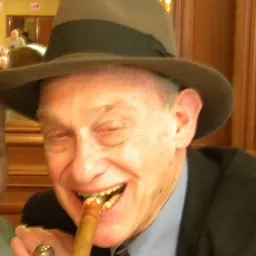
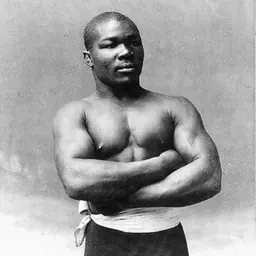
Related people
Same field, nearest in time

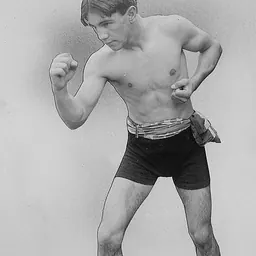
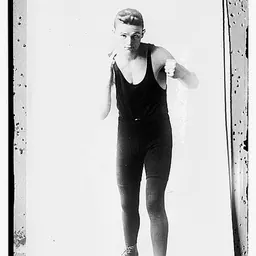

Contemporaries
People whose lives overlapped Sam Langford's



Frequently asked questions
Who was Sam Langford?
Canadian boxer (1886–1956)
When was Sam Langford born?
Sam Langford was born on 4 March 1883 in Weymouth.
When did Sam Langford die?
Sam Langford died on 12 January 1956 in Cambridge.
What was Sam Langford's occupation?
Sam Langford was a boxer.
What nationality was Sam Langford?
Sam Langford was American and Canadian.
Sources & further reading
Cite this page
APA: Biography.guide. (2026). Sam Langford. https://biography.guide/sam-langford/
MLA: "Sam Langford." Biography.guide, https://biography.guide/sam-langford/.
Chicago: "Sam Langford." Biography.guide. https://biography.guide/sam-langford/.
Data last updated: 2026-09-23 · Spot an error? Report a correction.
Portrait: Wikimedia Commons · author & licence
Page generated 2026-09-27 05:05 UTC