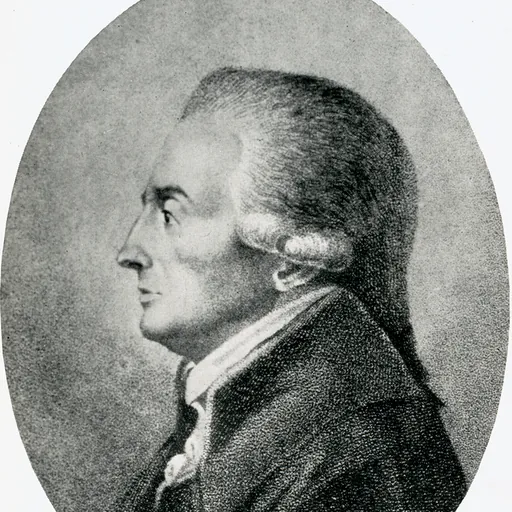
About Salomon Maimon
Lived 1754 – 1800 (aged 45–46). Salomon Maimon was a Polish and Russian philosopher.
Salomon Maimon (; ; ; Shlomo ben Yehoshua Maimon; 1753 – 22 November 1800) was a philosopher born of Lithuanian Jewish parentage in the Grand Duchy of Lithuania, present-day Belarus. His work was written in German and in Hebrew.
Biography
Early years Salomon Maimon was born Shlomo ben Joshua He ridiculed the Maggid's adherents for their enthusiasm, and charged the Maggid with manipulating his followers. He also wrote that the Maggid's ideas are "closer to correct ideas of religion and morals" than those he was taught in cheder.
In Germany In his mid-twenties Maimon left his home area in the direction of the German-speaking lands. His first attempt to take up residence in Berlin in 1778 failed. He was expelled for possession of a draft of a commentary on the Moreh Nebukhim of Maimonides. A later attempt to convert to Protestantism in Hamburg failed due to admitted lack of belief in Christian dogma. His second attempt to settle in Berlin in 1780 succeeded; he established a close connection with Moses Mendelssohn and entered the circles of the Haskalah (the Jewish Enlightenment movement) in Berlin. a young Silesian nobleman, and moved to the latter's estate in Siegersdorf near Freystadt in Schlesien in Prussian Silesia. Maimon died there at the age of 48 from apparent alcoholism. He was buried in Głogów, and because he was considered a Heretic by the city's Jewish community, they buried him next to the latrine of the graveyard, did not place a tombstone on his grave, and burned some of his writings.
Thought
Thing-in-itself He seizes upon the fundamental incompatibility of a consciousness that can apprehend, and yet is separated from, the thing-in-itself. That which is object of thought cannot be outside consciousness; just as in mathematics "–1" is an unreal quantity, so things-in-themselves are ex hypothesi outside consciousness, i.e. are unthinkable. The Kantian paradox he explains as the result of an attempt to explain the origin of the given in consciousness. The form of things is admittedly subjective; the mind endeavours to explain the material of the given in the same terms, an attempt which is not only impossible but involves a denial of the elementary laws of thought. Knowledge of the given is, therefore, essentially incomplete. Complete or perfect knowledge is confined to the domain of pure thought, to logic and mathematics. Thus the problem of the thing-in-itself is dismissed from the inquiry, and philosophy is limited to the sphere of pure thought.
Application of the categories The Kantian categories are demonstrable and true, but their application to the given is meaningless and unthinkable. By this critical scepticism Maimon takes up a position intermediate between Kant and Hume. Hume's attitude to the empirical is entirely supported by Maimon. The causal concept, as given by experience, expresses not a necessary objective order of things, but an ordered scheme of perception; it is subjective and cannot be postulated as a concrete law apart from consciousness.
Doctrine of differentials Whereas Kant posed a dualism between understanding and sensibility, or between concepts and the given, Maimon refers both these faculties back to a single source of cognition. Sensibility, in Maimon's view, is therefore not completely without conceptual content, but is generated according to rules that Maimon calls differentials. In calling them this, Maimon is referring to the differentials from the calculus, which are entities that despite being neither qualitative nor quantitative, can nevertheless give rise to a determinate quantity and quality when related to other differentials. The operations of the faculty of sensibility are for Maimon therefore not principally different from those of mathematical intuition: seeing the color red is the same procedure as drawing a geometrical figure such as a line in a circle in thought. The reason that qualities are nevertheless 'given' is that it is only an infinite understanding that can grasp the rules for the generation of qualities in the way that a human understanding can grasp the rules for drawing a circle.
Kant's comments Kant had received the first chapter of Maimon's book in manuscript from Markus Herz. In a letter to Herz from 26 May 1789, Kant writes the following:
"I had half decided to send the manuscript back in its immediately .... But one glance at the work made me realize its excellence and that not only had none of my critics understood me and the main questions as well as Herr Maimon does but also very few men possess so much acumen for such deep investigations as he..."
Nevertheless, Kant does not agree with Maimon's assessment. For Kant, the question of the relationship of the faculties is adequately answered by the Transcendental Deduction, in which Kant argues that the categories make experience possible. Furthermore, as an explanation of the harmony of the faculties, Kant offers the Leibnizian account of a pre-established harmony.
Don’t just read it —
keep it.
Full-length biographies made to live with: read them, listen on the way to work, watch them tonight.
- E-book
- Audio
- Video
Instant download · yours to keep · every purchase keeps this site free
Important facts
People in Salomon Maimon's life
Named in this biography and alive at the same time

Related people
Same field, nearest in time



Contemporaries
People whose lives overlapped Salomon Maimon's





Frequently asked questions
Who was Salomon Maimon?
Lithuanian Jewish philosopher (1753–1800)
When was Salomon Maimon born?
Salomon Maimon was born in 1754 in Žukaŭ Barok.
When did Salomon Maimon die?
Salomon Maimon died on 22 November 1800 in Zebrzydowa, Podbrzezie Dolne.
What was Salomon Maimon's occupation?
Salomon Maimon was a philosopher.
What nationality was Salomon Maimon?
Salomon Maimon was Polish and Russian.
Sources & further reading
Cite this page
APA: Biography.guide. (2026). Salomon Maimon. https://biography.guide/salomon-maimon/
MLA: "Salomon Maimon." Biography.guide, https://biography.guide/salomon-maimon/.
Chicago: "Salomon Maimon." Biography.guide. https://biography.guide/salomon-maimon/.
Data last updated: 2026-09-21 · Spot an error? Report a correction.
Portrait: Wikimedia Commons · author & licence
Page generated 2026-09-27 05:01 UTC