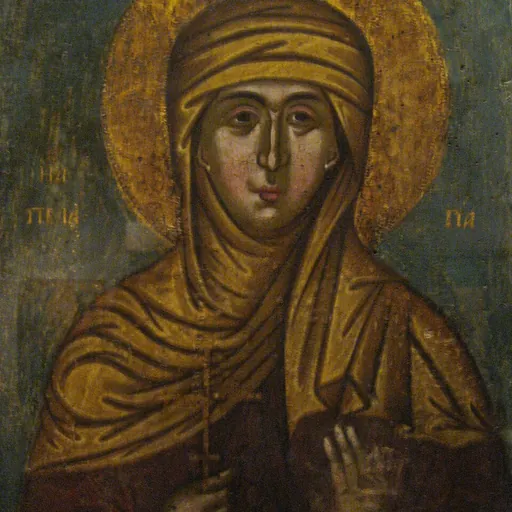
About Saint Pelagia
Lived 400 – 457. Saint Pelagia was an anchorite, actor, prostitute, mystic, dancer and mimus.
Pelagia (, d. 457 ), distinguished as Pelagia of Antioch, Pelagia the Penitent, and Pelagia the Harlot, was a Christian saint and hermit in the 4th or 5th century. Her feast day was celebrated on 8 October, originally in common with Saints Pelagia the Virgin and Pelagia of Tarsus. Pelagia died as a result of extreme asceticism, which had emaciated her to the point she could no longer be recognized. According to Orthodox tradition, she was buried in her cell on the Mount of Olives. Upon the discovery that the renowned monk had been a woman, the holy fathers tried to keep it a secret, but the gossip spread and her relics drew pilgrims from as far off as Jericho and the Jordan valley.
Saint Pelagia is one of several classical Christian desert ascetics whose gender identity is often up for debate. This is due to physical descriptors used within the mythos often leaning towards masculine.
Legend Pelagia's story is attributed to James or Jacob , deacon of the church of Heliopolis (modern Baalbek). He states that Margarita was the "foremost actress" and a prominent harlot in Antioch. During one of the city's church councils, she passed by on a donkey surrounded by her entourage and a "worldly crowd". Perfumed and "immodestly bareheaded", the outlines of her body were "clearly visible" beneath her gold cloth, pearls, and precious stones, which ran from her bare shoulders to her feet. Most of the fathers were shamed into looking away, but the bishop Nonnus stared openly and confessed himself "delighted". Mocking his fellows, he condemned both them and himself for taking less care of their souls than she had of her body.
She lived there for three or four years, disguising herself as a male recluse and eunuch under the name Pelagi. She then died, the cause having been alluded to extreme asceticism, which had emaciated her to the point she could no longer be recognized. According to Orthodox tradition, Pelagia was buried in her cell. refers to the archbishop as Flavianus ( 381–404), although Cameron dismisses its testimony.
History The historical lives of saints have long been used as a tool of inspired conversion. Due to this controversy, two major theories about her origins have formed. The first theory states that the historical Saint Pelagia of Antioch as described by Saint Ambrose, which had appeared almost a thousand years prior to James the Deacon's account is the origin of the monk Pelagius discussed in this article. and in two sermons by John Chrysostom, was an Antiochene virgin who was martyred because of her refusal to offer pagan sacrifice during the Diocletianic Persecution. Chrysostom's sermon also mentions an anonymous (but apparently famous) actress and prostitute "from a wicked city in Phoenice" (possibly Heliopolis) who seduced "the empress's brother" but converted "in our own day".
Don’t just read it —
keep it.
Full-length biographies made to live with: read them, listen on the way to work, watch them tonight.
- E-book
- Audio
- Video
Instant download · yours to keep · every purchase keeps this site free
Important facts
People in Saint Pelagia's life
Named in this biography and alive at the same time
Related people
Same field, nearest in time



Contemporaries
People whose lives overlapped Saint Pelagia's



Frequently asked questions
Who was Saint Pelagia?
Antiochene saint
When was Saint Pelagia born?
Saint Pelagia was born in 400 in Antioch.
When did Saint Pelagia die?
Saint Pelagia died in 457 in Mount of Olives.
What was Saint Pelagia's occupation?
Saint Pelagia was an anchorite, actor, prostitute, mystic, dancer and mimus.
Sources & further reading
Cite this page
APA: Biography.guide. (2026). Saint Pelagia. https://biography.guide/saint-pelagia/
MLA: "Saint Pelagia." Biography.guide, https://biography.guide/saint-pelagia/.
Chicago: "Saint Pelagia." Biography.guide. https://biography.guide/saint-pelagia/.
Data last updated: 2026-09-23 · Spot an error? Report a correction.
Portrait: Wikimedia Commons · author & licence
Page generated 2026-09-27 05:05 UTC