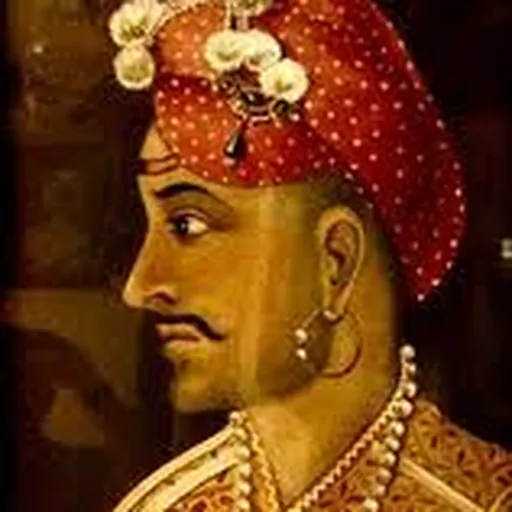
Sadashivrao Bhau
Maratha Army commander
About Sadashivrao Bhau
Lived 1730 – 1761 (aged 30).
Sadashivrao Bhau Bhatt (4 August 1730 – 14 January 1761) was the son of Chimaji Appa (younger brother of Baji Rao I) and Rakhmabai of the Pethe family, and the nephew of Baji Rao I. He held administrative responsibilities and served as a finance minister during the reign of Maratha ruler Rajaram II.
He was appointed sarsenapati (commander-in-chief) of the Maratha army and led its forces during the Third Battle of Panipat on 14 January 1761. The battle was fought against the army of Ahmad Shah Abdali and was one of the largest and bloodiest battles of the 18th century in India.
His role in the battle, both as a military commander and administrator, is remembered as a combination of organizational skill and the limitations imposed by logistical and strategic challenges.
Early life
Sadashivrao Bhau was born in Satara into a Marathi Chitpavan Brahmin family. He was named after the Hindu deity Shiva. His father, Chimaji Appa, was the brother of Bajirao I. His mother, Rakhmabai, died when he was about a month old, and his father passed away when he was ten. He was subsequently raised by his grandmother Radhabai and aunt Kashibai. Sadashivrao received his education in Satara under Ramchandra Baba Shenvi.
Sadashivrao undertook his first military campaign in Karnataka in 1746, accompanied by his political advisers Mahadoba Purandare and Sakharam Bapu. He won his first battle at Ajra, south of Kolhapur, and captured thirty-six parganas during this campaign.
In 1760, Sadashivrao led another campaign in the Carnatic region. He conquered territories from the Nawab of Savanur and annexed the cities of Kittur, Parasgad, Gokak, Yadwad, Bagalkot, Badami, Navalgund, Umbal, Giri, Torgal, Haliyal, Harihar, and Basavapatna. During this campaign, he suppressed the revolt led by Yamaji Shivdev. He also led the Battle of Udgir, which weakened the authority of the Nizam of Hyderabad.
Third Battle of Panipat
In January 1760, news reached Peshwa Balaji Baji Rao, that Ahmad Shah Durrani, better known as Ahmad Shah Abdālī, had invaded and captured the Punjab region.
Abdali formed an alliance against the Marathas with other Rohilla chieftains, principally Najib-ul-Daula, and the Nawab of Awadh, Shuja-ud-Daula. Abdali also recruited Afghans displaced by the war.
Balaji Baji Rao, at the zenith of his power after defeating the Nizam at Udgir, appointed Sadashivrao Bhau to lead the Maratha army to Delhi. Unlike Malharrao Holkar and Raghunathrao, who were familiar with the politics and leaders of the northern regions of the Indian subcontinent, Sadashivrao lacked knowledge of the region. This lack of experience contributed to his mishandling of regional rulers and failure to form strategic alliances, which became a major reason for the Marathas’ eventual defeat.
An army of about 55,000 men set out from Patdur (modern Partur) on 14 March 1760, accompanied by roughly 200,000 non-combatants, including families and pilgrims seeking safety with the army. Forces under Holkar and Scindia joined en route.
Sadashivrao adapted the hit-and-run tactics of the Maratha cavalry to integrate French-style heavy artillery and infantry, resulting in victories such as at Udgir. However, some generals, like Holkar, were hesitant to adopt these changes fully and felt the new units were incompatible with the rest of the army. Despite these concerns and limited resources, Sadashivrao established a force of 10,000 infantry and 50 artillery pieces.
Holkar and Scindia urged Sadashivrao to form alliances with Suraj Mal, Jat ruler of Bharatpur, the Rajputs, Sikhs, Shuja-ud-Daula, and other northern leaders. The Rajputs refused to support the Marathas, citing previous interference in their succession disputes, while Suraj Mal initially distrusted Sadashivrao. Eventually, Holkar and Scindia persuaded Suraj Mal to join the Maratha forces, securing his personal safety.
Sadashivrao's overconfidence in artillery and strong personality caused him to neglect alliances with the Jats, Rajputs, and Sikhs. He also failed to heed Suraj Mal’s advice to leave civilians in Agra, resulting in severe shortages of food and supplies, which would prove critical at the Battle of Panipat.
The Maratha army reached Delhi on 1 August 1760, taking the city the next day with artillery playing a key role. Supplies were limited due to Sadashivrao's strained relations with regional rulers, forcing him to move about north to Karnal and capture Kunjpura fort about northeast of Karnal. Using artillery and combined cavalry-musketeer attacks, the Marathas destroyed the fort and killed the entire garrison.
The Kunjpura victory provoked Abdali to cross the swollen Yamuna River at Baghpat on 23–25 October 1760, taking Marathas by surprise while they were preoccupied with sacking Kunjpura. The Afghan forces effectively cut off Maratha supply lines.
By November 1760, Abdali’s army of 45,000 blocked the Marathas’ access south to Delhi. The ensuing two-month siege led to severe food shortages in the Maratha camp, which included roughly 100,000 non-combatants. By late December 1760 or early January 1761, famine struck the camp, and many civilians and livestock died. Sakalrajkaryadhurandhar Sadashivraobhau, book by Kaustubh Kasture in Marathi.
Don’t just read it —
keep it.
Full-length biographies made to live with: read them, listen on the way to work, watch them tonight.
- E-book
- Audio
- Video
Instant download · yours to keep · every purchase keeps this site free
Important facts
Family & relationships
People in Sadashivrao Bhau's life
Named in this biography and alive at the same time

Contemporaries
People whose lives overlapped Sadashivrao Bhau's






Frequently asked questions
Who was Sadashivrao Bhau?
Maratha Army commander
When was Sadashivrao Bhau born?
Sadashivrao Bhau was born on 4 August 1730 in Pune.
When did Sadashivrao Bhau die?
Sadashivrao Bhau died on 20 January 1761 in Panipat.
What nationality was Sadashivrao Bhau?
Sadashivrao Bhau's recorded nationality: Maratha Empire.
Sources & further reading
Cite this page
APA: Biography.guide. (2026). Sadashivrao Bhau. https://biography.guide/sadashivrao-bhau/
MLA: "Sadashivrao Bhau." Biography.guide, https://biography.guide/sadashivrao-bhau/.
Chicago: "Sadashivrao Bhau." Biography.guide. https://biography.guide/sadashivrao-bhau/.
Data last updated: 2026-09-20 · Spot an error? Report a correction.
Portrait: Wikimedia Commons · author & licence
Page generated 2026-09-27 04:58 UTC