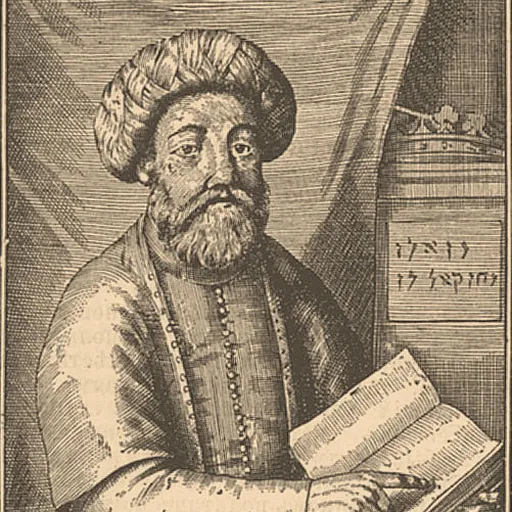
About Sabbatai Zevi
Lived 1626 – 1676 (aged 50). Sabbatai Zevi was a Turkish mystic, rabbi and false messiah.
Sabbatai Zevi (, August 1, 1626 – ), or Shabtai Tzvi, was a former Jewish mystic and rabbi from Smyrna who converted to Islam. His family were Romaniote Jews from Patras. This antinomian doctrine led Zevi and his followers to deliberately violate Jewish commandments, a controversial practice that later inspired movements like the Frankists.
Upon arriving in Constantinople in February 1666, Sabbatai was imprisoned on the order of the grand vizier Köprülüzade Fazıl Ahmed Pasha. In September, after being moved from different prisons around the capital to the imperial courts' seat in Adrianople (now Edirne), he was convicted of fomenting sedition. Sabbatai was given the choice of death or conversion to Islam by the Grand Vizier representing Sultan Mehmed IV. He chose conversion, donning an Islamic turban from then on. The heads of the Ottoman state rewarded him with a generous pension for complying with their political and religious plans. About 300 families who followed Zevi also converted to Islam and became known as the Dönme, Turkish for "converts".
Subsequently, the Ottomans banished him twice, first within Constantinople, and, after he was heard singing Psalms with Jews there, to a small town known today as Ulcinj in what is now Montenegro. He died in isolation.
Early life and education
Sabbatai Zevi was born in the Ottoman city of Smyrna, allegedly on Tisha B'Av, one of Judaism's fast days, during The Three Weeks in 1626. In Hebrew, Sabbatai means Saturn; in Jewish tradition, "the reign of Sabbatai", the highest planet, was often linked to the advent of the Messiah.
Zevi's family were Romaniote Jews from Patras. His father, Mordecai, was a poultry dealer in the Morea. During the Ottoman–Venetian wars, Smyrna became the center of Levantine trade, and Mordecai became the Smyrnan agent of an English trading house, achieving some wealth in the process. Scholars are still assessing how much English and Dutch Calvinist millenarianism influenced the messianic movement that developed around Zevi's activities.
Claims to being the expected Jewish Messiah
Along with general messianic beliefs, there was another computation based on a passage in the Zohar, a famous Jewish mystical text, that the Israelites would be redeemed by the long-awaited Jewish Messiah in 1648.
Shabbatai revealed his claim to being the Messiah early on to Isaac Silveyra and Moses Pinheiro, the latter the grandfather of the Italian rabbi Joseph Ergas. The Jewish community of Avignon, France, prepared to emigrate to the new kingdom in the spring of 1666. Samuel Primo, who became Sabbatai's secretary when he went to Smyrna, directed the following circular to all of the Jews in the name of the Messiah: The first-begotten Son of God, Shabbethai Tsebi, Messiah and Redeemer of the people of Israel, to all the sons of Israel, Peace! Since ye have been deemed worthy to behold the great day and the fulfilment of God's word by the Prophets, your lament and sorrow must be changed into joy, and your fasting into merriment; for ye shall weep no more. Rejoice with song and melody, and change the day formerly spent in sadness and sorrow into a day of jubilee, because I have appeared. Nehemiah reached Abydos in September 1666 after a three-month journey. The meeting did not go well, and Nehemiah declared Sabbatai an impostor. Some Sabbataians are said to have contemplated murdering Nehemiah as a rival. His biographer Gershom Scholem writes that his tomb was visited by Dönme pilgrims from Salonika until the early 20th century.
Legacy
By the 19th century, the Dönme had become prominent in the tobacco and textile trades. They established progressive schools, and some members became politically active. Many joined the Committee of Union and Progress (CUP), the revolutionary party known as the Young Turks. With the major Dönmeh city of Selanik (now Thessaloniki) becoming part of Greece in 1912, Greece expelled the Muslims, including the Dönme, from its territory, with most migrating to Turkey. This was finalized with the 1923 population exchange between Greece and Turkey. By the mid-20th century, they had become highly assimilated. They have been described as presenting themselves as Muslim in public whilst practising their own forms of messianic/mystical Jewish beliefs in private. Some claim that Dönme still play a role in Turkish politics (one of interference), particularly some political parties in Turkey like the MHP. Others dismiss this as an antisemitic conspiracy theory.
The Dönme eventually split into three sects, each with quite different beliefs, as Ottoman Jewish scholars Abraham Danon and Joseph Nehama wrote in French-language articles in the Jewish Studies journal over 100 years ago. In the 1930s a comprehensive study on the history of the sects was also published in French by Abraham Galanté. More recently, Cengiz Şişman published a study called The Burden of Silence.
Don’t just read it —
keep it.
Full-length biographies made to live with: read them, listen on the way to work, watch them tonight.
- E-book
- Audio
- Video
Instant download · yours to keep · every purchase keeps this site free
Important facts
more
Shabbatai Zevi, Shabbethai Zebi, Shabbetai Ẓevi, Shabbatai, Shabtai Tsevi, Sabbatai Zebi, Shabtay Zvi, Sabetha Sebi, Sampatai Tsevi, Șabbatai ȚeviPeople in Sabbatai Zevi's life
Named in this biography and alive at the same time

Related people
Same field, nearest in time




Contemporaries
People whose lives overlapped Sabbatai Zevi's




Frequently asked questions
Who was Sabbatai Zevi?
mystic, rabbis
When was Sabbatai Zevi born?
Sabbatai Zevi was born on 23 July 1626 in İzmir.
When did Sabbatai Zevi die?
Sabbatai Zevi died on 17 September 1676 in Ulcinj.
What was Sabbatai Zevi's occupation?
Sabbatai Zevi was a mystic, rabbi and false messiah.
What nationality was Sabbatai Zevi?
Sabbatai Zevi was Turkish.
Sources & further reading
Cite this page
APA: Biography.guide. (2026). Sabbatai Zevi. https://biography.guide/sabbatai-zevi/
MLA: "Sabbatai Zevi." Biography.guide, https://biography.guide/sabbatai-zevi/.
Chicago: "Sabbatai Zevi." Biography.guide. https://biography.guide/sabbatai-zevi/.
Data last updated: 2026-09-21 · Spot an error? Report a correction.
Portrait: Wikimedia Commons · author & licence
Page generated 2026-09-27 05:00 UTC