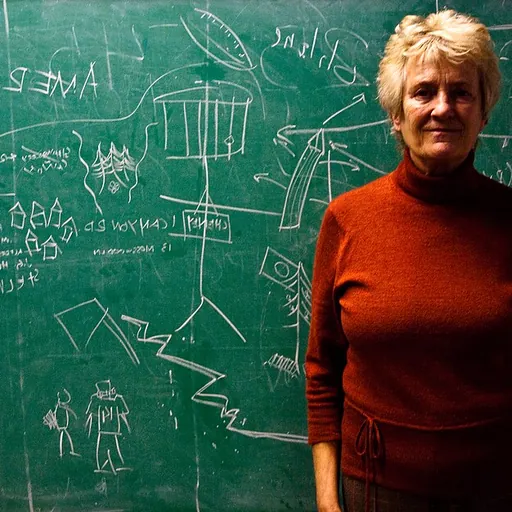
About Ruth Tringham
Born 1940. Ruth Tringham is a British anthropologist and archaeologist.
Ruth Tringham (born 14 October 1940) is an anthropologist, focusing on the archaeology of Neolithic Europe and southwest Asia. She is a Professor of the Graduate School (Anthropology) at the University of California, Berkeley and Creative Director and President of the Center for Digital Archaeology (CoDA), a recently established non-profit organization. Before going to Berkeley, she taught at Harvard University and University College London. Tringham is probably best known for her work at Selevac (1976–1979) and Opovo (1983–1989), Serbia, at the Eneolithic tell settlement of Podgoritsa, Bulgaria, and at the well-known site of Çatalhöyük (1997-), Turkey. She was the middle sibling with two older brothers and a younger brother and sister. When she was five years old, her family moved to London where she attended primary school until she was eleven. After she won a scholarship to an all-girls high school, part of the Girls Public Day School Trust in north London, her family moved to Hampstead. During high school she learned Latin and Greek and was active in children's clubs at the Natural History Museum in London, where she was introduced to proper research methods. As she was growing up, her mother encouraged her to question authority and realize the contexts in which these authorities are based. This early advice would lead to some of her innovative ideas and methods. She was a member of Great Britain's 1972 women's Olympic volleyball team.
Education Having first excavated in the Natural History Club at age thirteen, she knew she wanted to be an archaeologist by the time she was sixteen. It was here where she became fascinated with the archaeology of Eastern Europe and her research interests, although altered to a certain extent, still remain in that region. She wrote both her senior B.A. thesis and Ph.D. dissertation on Eastern Europe. The former was on Neolithic clay figurines of Eastern Europe, while the latter was called The Earlier Neolithic in Central Europe: A Study of the Linear Pottery Culture and their Relationships with the Contemporary Cultures of South-East Europe. She received her Ph.D. from the University of Edinburgh in 1966. Five years later she dedicated her first book, Hunters, Fishers, and Farmers: 6,000-3,000 B.C, to V. Gordon Childe, Stuart Piggott, Bohumil Soudsky, and Peter Ucko.
Professional career
Research and theoretical interests Throughout her career, Tringham has brought many innovative ideas to archaeology and challenged its traditional perspectives. She attempts to influence the methods used by archaeologists, thus giving more identity to the past. Some of her specific interests include prehistoric archaeology, European prehistory, archaeology and popular culture, and architecture and gender aspects in prehistory. Lately, her research has been on the life history of buildings and the construction of built space. In her own words, "How to express the complexities of a feminist practice of archaeology-multiple interpretations of archaeological data at multiple scales, allowing multiple voices from past and present to be heard." Earlier in her career she avoided defining gender relations, but now she states that studying the household in archaeology is crucial to not only gender relations, but also archaeology as a whole. Although she has feminist views on certain things, such as emphasizing the importance of microscale aspects in prehistory, this does not mean that she loses her objectivity to other ideas. Margaret Conkey and Ruth Tringham have collaborated on a public multimedia device that challenges the Goddess movement, which tries to portray the past matricentrically. To them, the movement is based primarily on a feminist agenda.
Notable excavations
Çatalhöyük, Turkey Çatalhöyük is a tell of an extremely well preserved Neolithic and Chalcolithic site located in the Konya-Karaman Plain in modern day Turkey. Çatalhöyük is one of the oldest cities on record archaeologists, and it was inhabited from around 7100 BCE to 5600 BCE. She tries to trace the evolution of the village once food technology is introduced and making it a permanent, sedentary village.
Opovo-Ugar Bajbuk, Serbia Located at Vojvodina in the lower valley of the Timis River, north of the Danube, Opovo-Ugar, which was occupied between 4700 and 4500 BCE, belongs to the Vinča-Pločnik culture and is another site that provides information on the socioeconomic developments during the Neolithic. The importance of this site, which was excavated in the 1980s, was the method of excavation and the analysis of architecture technology. In other words, the project wanted to investigate the degree of settlement permanence by looking at the occupation duration of the houses. Furthermore, she wanted to investigate the emergence of the household as a primary social unit and how it changes throughout history. This ties in with her future interests that deal with gender relations and microscale aspects in archaeology. However, at this time she said she was a ‘remedial’ feminist archaeologist because she believed that it was not credible to give "faces" to people of prehistory in order to "recreate" life as it actually was.
She was awarded the Presidential Chair in Undergraduate Teaching in 1998 for her approach to incorporating multimedia techniques in teaching archaeology.
Selected publications 1966 The Earlier Neolithic in Central Europe: A Study of the Linear Pottery Culture and their Relationships with the Contemporary Cultures of South-East Europe. Ph.D. dissertation, University of Edinburgh. Archaeology 1971 Hunters, Fishers and Farmers of Eastern Europe 6,000-3,000 B.C. Hutchinson: London. 1972 Man, Settlement, and Urbanism (with Peter Ucko). Schenkman Pub. Co.: Cambridge. 1973 Territoriality and Proxemics: Archaeological and Ethnographic Evidence for the Use and Organization of Space. (Ed.) Warner Modular Publications: Andover. 1973 Urban Settlements: the Process of Urbanization in Archaeological Settlements. (Ed.) Warner Modular Publications: Andover. 1973 Ecology and Agricultural Settlements: An Ethnographic and Archaeological Perspective. (Ed.) Warner Modular Publications: Andover. 1974 "South Russia, the Caucasus, and the Near East: an Alternative Model for Cultural Change" in American Journal of Archaeology 78, No. 4 (October): pp. 348–349 1985 "The Opovo Project: A Study of Socioeconomic Change in the Balkan Neolithic" (with B. Brukner and B. Voytek) in Journal of Field Archaeology 12, No. 4 (Winter): pp. 425–444. 1990 Selevac: A Neolithic Village in Yugoslavia. (with Dusan Krstic). University of California, Los Angeles: Los Angeles. 1991 "Households with Faces: The Challenge of Gender in Prehistoric Architectural Remains" in Engendering Archaeology: Women in Prehistory by Gero, J. and Conkey, M. Blackwell Publishers: Oxford. pp. 93–131. 1993 Nationalism and Internationalism in Writing the Prehistory of the New East Europe. University of California, Berkeley 1995 Conkey, Margaret and Tringham, R. "Archaeology and the Goddess: Exploring the Contours of Feminist Archaeology" in Feminisms in the Academy: Rethinking the Disciplines. University of Michigan Press: Ann Arbor.
Awards 1998: Presidential Chair in Undergraduate Teaching 1998: Chancellor's Cybersemester Award 2001: Educational Initiatives Award
Don’t just read it —
keep it.
Full-length biographies made to live with: read them, listen on the way to work, watch them tonight.
- E-book
- Audio
- Video
Instant download · yours to keep · every purchase keeps this site free
Important facts
People in Ruth Tringham's life
Named in this biography and alive at the same time



Related people
Same field, nearest in time



Contemporaries
People whose lives overlapped Ruth Tringham's


Frequently asked questions
Who is Ruth Tringham?
British archaeologist
When was Ruth Tringham born?
Ruth Tringham was born on 14 October 1940 in Bedfordshire.
What is Ruth Tringham's occupation?
Ruth Tringham is an anthropologist and archaeologist.
What nationality is Ruth Tringham?
Ruth Tringham is British.
Sources & further reading
Cite this page
APA: Biography.guide. (2026). Ruth Tringham. https://biography.guide/ruth-tringham/
MLA: "Ruth Tringham." Biography.guide, https://biography.guide/ruth-tringham/.
Chicago: "Ruth Tringham." Biography.guide. https://biography.guide/ruth-tringham/.
Data last updated: 2026-09-20 · Spot an error? Report a correction.
Page generated 2026-09-27 05:10 UTC