
About Ruth Sanger
Lived 1918 – 2001 (aged 82). Ruth Sanger was an Australian geneticist and hematologist, known for Fellow of the Royal Society.
Ruth Ann Sanger She was Director of the Medical Research Council Blood Group Unit, of the Lister Institute of Preventive Medicine from 1973 to 1983.
She worked closely with Robert Russell Race from the 1940s, and they married in 1956. They co-authored many papers after 1948, and co-wrote six editions of a leading work on blood groups, Blood Groups in Man, which helped make blood transfusions safer. The book was known as "Race and Sanger", which were published between 1950 and 1975.
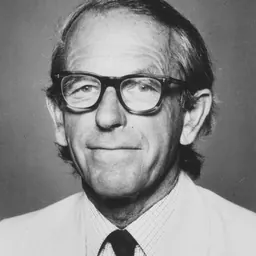
Education and early life Sanger was born in Southport, Queensland, Australia and had four siblings. Her father, Rev. Hubert Sanger, became headmaster of Armidale School in New South Wales. She was first cousins with Frederick Sanger, the biochemist and two-time winner of the Nobel prize.
She received her early education in New South Wales at three schools: Harleyville Ladies College (1924–1926), New England Girls school, Armidale (1926–1927), and Abbotsleigh Wahrounga (1928–35). and earned a PhD from the University of London (1948). In 1946, she moved to England to work with R.R. Race at the Medical Research Counsil (MRC), Blood Group Unit. While there, she received a doctorate from the University of London in 1948 on the variety of blood group systems. She returned to Australia after receiving her doctorate, but then moved permanently to the United Kingdom in 1950 and remained at the MRC until 1973.
The first edition of Blood Groups in Man was published in August 1950, based on the systematic analysis of blood groups in her PhD thesis.
In 1973, she succeeded R.R. Race as Director of the Medical Research Council's Blood Group Unit at the Lister Institute of Preventive Medicine in London. She retired in 1983.
Honours and awards
Karl Landsteiner Memorial Award, USA (1957), joint with R. R. Race Fellow of the Royal Society (FRS) (1972) Gairdner Foundation International Award (1972, Canada), joint with R. R. Race Oliver Memorial Award from the British Red Cross (1973) Received an honorary Doctor of Medicine (MD (Honoris Causa)) from the Helsinki University (1990)
Death Ruth Sanger died in Putney in 2001. She had three step-children.
Selected publications Sanger, Ruth A. (1946-10). "The Incomplete Antibody : a Quantitative Aspect". Nature. 158 (4014): 487–487. doi:10.1038/158487a0. ISSN 1476-4687. Race, R. R.; Mourant, A. E.; Lawler, Sylvia D.; Sanger, Ruth (1948-06-01). "THE Rh CHROMOSOME FREQUENCIES IN ENGLAND". Blood. 3 (6): 689–695. doi:10.1182/blood.V3.6.689.689. ISSN 0006-4971. Sanger, Ruth (1955-12). "An Association Between the P And Jay Systems of Blood Groups". Nature. 176 (4494): 1163–1164. doi:10.1038/1761163a0. ISSN 1476-4687.
Don’t just read it —
keep it.
Full-length biographies made to live with: read them, listen on the way to work, watch them tonight.
- E-book
- Audio
- Video
Instant download · yours to keep · every purchase keeps this site free
Important facts
Family & relationships
People in Ruth Sanger's life
Named in this biography and alive at the same time

Related people
Same field, nearest in time



Contemporaries
People whose lives overlapped Ruth Sanger's


Frequently asked questions
Who was Ruth Sanger?
Australian haematologist (1918–2001)
When was Ruth Sanger born?
Ruth Sanger was born on 6 June 1918 in Southport.
When did Ruth Sanger die?
Ruth Sanger died on 4 June 2001 in London Borough of Wandsworth.
What was Ruth Sanger's occupation?
Ruth Sanger was a geneticist and hematologist.
What was Ruth Sanger known for?
Ruth Sanger was known for Fellow of the Royal Society.
What nationality was Ruth Sanger?
Ruth Sanger was Australian.
Sources & further reading
Cite this page
APA: Biography.guide. (2026). Ruth Sanger. https://biography.guide/ruth-sanger/
MLA: "Ruth Sanger." Biography.guide, https://biography.guide/ruth-sanger/.
Chicago: "Ruth Sanger." Biography.guide. https://biography.guide/ruth-sanger/.
Data last updated: 2026-09-26 · Spot an error? Report a correction.
Page generated 2026-09-27 05:16 UTC