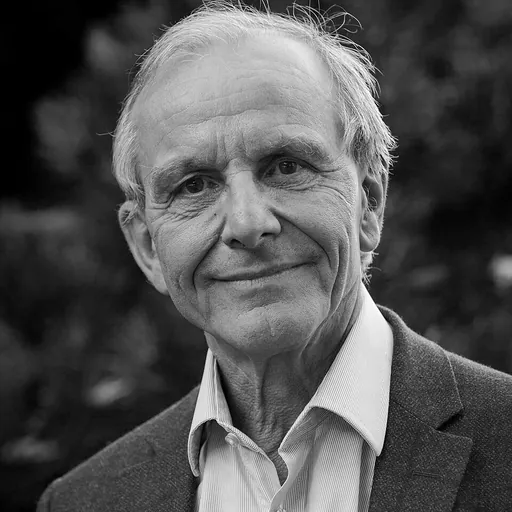
About Axel Kahn
Lived 1944 – 2021 (aged 76). Axel Kahn was a French geneticist, politician, university teacher, science communicator, physician and researcher.
Axel Kahn (; 5 September 1944 – 6 July 2021 ) was a French geneticist. He was the brother of the journalist Jean-François Kahn and the chemist Olivier Kahn. He was a member of the French National Consultative Ethics Committee from 1992 to 2004 and worked in gene therapy. He first entered the INSERM with a specialization in biochemistry. He was named in 2002 as a counsellor for biosciences and biotechnologies matters by the European Commission. Head of French laboratories specialized in biomedical sciences between years 1984 and 2007, he was elected President of the Paris Descartes University in December 2007, as the sole candidate.
Kahn is known in France for his appearances in the media where he attempts to explain genetics and ethics to the public. As a civil servant, he was the head of the committee in charge of genetically modified crops for Europe.
Views on science Kahn, the editor of French biomedical journal (Médecine/Sciences; 2005 Impact Factor: 0.541), said in 1999 that "80 to 90 percent of what is published [in scientific journals] is of little real interest" and most journals are consulted infrequently.
Kahn has said that Oxford biologist Richard Dawkins's view of the "selfish gene" and genetic determinism is incorrect, saying: "Personally, I am strongly against the theory of ultra-genetic determinism and the Dawkins theory of 'the egoistic gene'."
In 2004, Kahn signed a petition and threatened to resign from his post as head of the Paris-based, publicly financed Cochin Institute, due to cuts in government spending on research.
Views and positions on medical procedures Gene therapies Kahn was against germline gene therapies, saying that they have no therapeutical value, and he was working to outlaw them worldwide through the World Health Organization.
Stem cells He has said of stem cells as a therapy, "Science alone is not sufficient for making decisions on stem cells, but we cannot discuss the ethical issues without clarifying the scientific facts."
Kahn has said that embryos which are kept frozen after in vitro fertilization procedures and will be destroyed anyway should be used for scientific advances, because whether or not the embryo has the potential to be human, at that point its only fate is to be used for research or destruction and its only chance to contribute to a "human project" is to help with scientific research. This view (Kahn referred to himself as a humanist) has been viewed by some religious theorists as disrespectful of the embryos.
Infertility treatments In 1995, Kahn was a notable opponent of intracytoplasmic sperm injection, which he saw as an experimental treatment not to be used by those with infertility, which was not serious enough to justify the risks he perceived the procedure as having.
Kahn has also spoken out against family members carrying children for other family members who are infertile. In speaking out against the case of a 62-year-old Frenchwoman who gave birth after being implanted in the United States with the sperm of her brother, Kahn protested what he called "social incest" and continued, "The most important thing is that doctors were involved in this process, and they did it because they were paid handsomely."
Cloning Kahn has said: "But, from the ethical point of view, I'm totally opposed -for some reasons- to the legitimisation of the cloning-based reproduction of human beings. This authorisation would entitle some individuals to create human beings in their own image… This kind of subjection -even though it is only corporal- is intolerable. What could give somebody the right to choose the sex, the eyes' or hair's colour, the chin's shape or any other characteristic of a human being? As a consequence, I see no reason for legitimating reproductive cloning. As regards therapeutic cloning, a problem can be pointed out: before making a supposedly therapeutic cloning, a human-cloning technique must be found." He called for the boycott of Israeli products.
Books authored Transgenic Plants in Agriculture (1998) (And man in all of this?), by Axel Kahn (with Fabrice Papillon, 2000), pub. Nil, Paris, 2001 (2004) (with Fabrice Papillon, 2005) ("Future is Not Yet Written") , by Axel Kahn and Christian Godin, Stock edition, Paris, 2008.
Awards and honors Lauréat of the Académie Nationale de Médecine Medal of Francophony of the Académie Française CNRS Silver Medal Doctorat Honoris Causa from the Université Catholique de Louvain, the University of Liège, the Université de Montréal, the Université Laval and the Université de Sherbrooke.
Death Kahn died of bone cancer on 6 July 2021 in Paris at the age of 76.
Don’t just read it —
keep it.
Full-length biographies made to live with: read them, listen on the way to work, watch them tonight.
- E-book
- Audio
- Video
Instant download · yours to keep · every purchase keeps this site free
Important facts
People in Axel Kahn's life
Named in this biography and alive at the same time



Related people
Same field, nearest in time


Contemporaries
People whose lives overlapped Axel Kahn's



Frequently asked questions
Who was Axel Kahn?
French geneticist
When was Axel Kahn born?
Axel Kahn was born on 5 September 1944 in Le Petit-Pressigny.
When did Axel Kahn die?
Axel Kahn died on 6 July 2021 in 15th arrondissement of Paris.
What was Axel Kahn's occupation?
Axel Kahn was a geneticist, politician, university teacher, science communicator, physician and researcher.
What nationality was Axel Kahn?
Axel Kahn was French.
Sources & further reading
Cite this page
APA: Biography.guide. (2026). Axel Kahn. https://biography.guide/axel-kahn/
MLA: "Axel Kahn." Biography.guide, https://biography.guide/axel-kahn/.
Chicago: "Axel Kahn." Biography.guide. https://biography.guide/axel-kahn/.
Data last updated: 2026-09-22 · Spot an error? Report a correction.
Portrait: Wikimedia Commons · author & licence
Page generated 2026-09-27 05:03 UTC