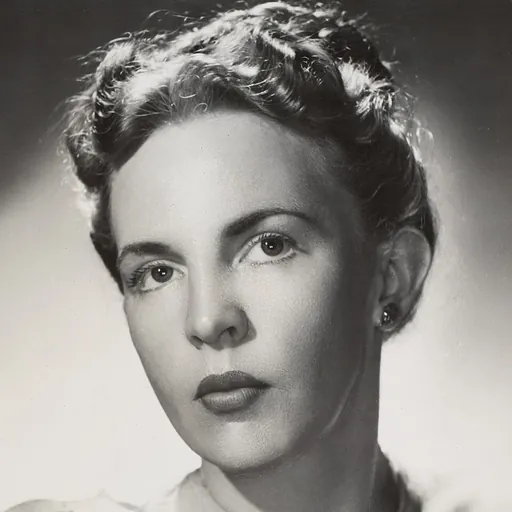
About Ruth Park
Lived 1917 – 2010 (aged 93). Ruth Park was a New Zealand and Australian writer, novelist and children's writer.
Rosina Ruth Lucia Park AM (24 August 191714 December 2010) was a New Zealand–born Australian author. Her best known works are the novels The Harp in the South and Playing Beatie Bow (1980), and the children's radio serial The Muddle-Headed Wombat (1951–1970), which also spawned a book series (1962–1982).
Personal history Park was born in Auckland to a New Zealand father whose father was Scottish and mother Irish and a New Zealand mother whose father was Swedish and mother was Irish. Her family later moved to the town of Te Kūiti further south in the North Island of New Zealand, where they lived in isolated areas. She completed an external degree course at Auckland University.
Park's first break as a professional writer came when she was hired by the Auckland Star newspaper as a journalist, but she found the assignments she was given unchallenging. Wishing to expand her horizons, she accepted a job offer from the San Francisco Examiner, but the tightening of United States' entry requirements after the bombing of Pearl Harbor forced a change of plan. Instead, she moved to Sydney, Australia, in 1942, where she had lined up a job with another newspaper.
That same year she married the budding Australian author D'Arcy Niland (1917–1967), with whom she had been corresponding as pen pals for some years, and whom she had finally met on a previous visit to Sydney. There she embarked on a career as a freelance writer. Park and Niland had five children, of whom the youngest, twin daughters Kilmeny and Deborah, went on to become book illustrators.
Her first novel was The Harp in the South (1948) – a graphic story of Irish slum life in Sydney, which has been translated into 37 languages. Even though it was acclaimed by literary critics, the book proved controversial with sections of the public due to its candour, with some newspaper letter-writers calling it a cruel fantasy because as far as they were concerned, there were no slums in Sydney. However, the newly married Park and Niland did live for a time in a Sydney slum located in the rough inner-city suburb of Surry Hills and vouched for the novel's accuracy. It has never been out of print. Sydney slum life recurs in her novel for children, Playing Beatie Bow (1980).
Park built on her initial success with the 1949 publication of a follow-up novel titled the Poor Man's Orange. During the 1950s, despite the demands of raising a family, she wrote tirelessly. According to a 2010 tribute article printed in the Sydney Morning Herald and written by her literary agent Tim Curnow, she produced more than 5,000 radio scripts alone during this decade, as well as contributing numerous articles to newspapers and magazines and penning weightier works of fiction.
She subsequently wrote Missus (1985), a prequel to The Harp in the South, among other novels, and created scripts for film and television. Her autobiographies, A Fence Around the Cuckoo (1992) and Fishing in the Styx (1993), deal with her life in New Zealand and Australia respectively. She also penned a novel set in New Zealand, One-a-pecker, Two-a-pecker (1957), about gold mining in Otago. (It was later renamed The Frost and The Fire.)
Park never remarried. Between 1946 and 2004, she received numerous awards for her contributions to literature in both Australia and internationally. She was made a Member of the Order of Australia in 1987. (Her awards and honours are listed below.)
From 1974 to 1981 Park dwelt on Norfolk Island, where she was the co-owner of a shop selling books and gifts. Her later years, however, were spent living in the Sydney harbourside suburb of Mosman. She died in her sleep on 14 December 2010, at the age of 93.
Awards 1946: Inaugural Sydney Morning Herald-sponsored writers' competition: Best Novel award for The Harp in the South (published 1948) 1954: Catholic Book Club Choice selected: Serpent's Delight 1961: Inaugural Commonwealth Television Play Competition: British award for television play won for No Decision, with D'Arcy Niland 1962: Children's Book Council of Australia (CBCA): highly commended for The Hole in the Hill 1975: CBCA Children's Book of the Year Award Winners: highly commended for Callie's Castle 1977: Miles Franklin Award for Swords and Crowns and Rings 1977: National Book Council: highly commended for Swords and Crowns and Rings 1979: Children's Book of the Year Award Winners: highly commended for Come Danger, Come Darkness 1981: Children's Book of the Year Award Winners: won for Playing Beatie Bow 1981: Ethel Turner Prize for Young People's Literature (NSW Premier's Literary Awards): won for When the Wind Changed 1982: Parents' Choice Award for Literature: won for Playing Beatie Bow 1982: Boston Globe-Horn Book Award: for Playing Beatie Bow 1982: International Board on Books for Young People (Australia): Honour Diploma for Playing Beatie Bow 1982: Guardian Fiction Prize (UK): runner-up for Playing Beatie Bow 1986: Young Australians' Best Book Award for picture book When the Wind Changed (illustrated by Deborah Niland) 1987: Member of the Order of Australia (AM): for services to literature 1992: The Age Book of the Year#Non-fiction Award: won for A Fence around the Cuckoo 1993: Talking Book of the Year Award (Royal Blind Society) won for A Fence around the Cuckoo 2008: Dromkeen Medal 2020: a River-class ferry on the Sydney Ferries network was named in her honour.
Don’t just read it —
keep it.
Full-length biographies made to live with: read them, listen on the way to work, watch them tonight.
- E-book
- Audio
- Video
Instant download · yours to keep · every purchase keeps this site free
Important facts
Family & relationships
People in Ruth Park's life
Named in this biography and alive at the same time



Related people
Same field, nearest in time




Contemporaries
People whose lives overlapped Ruth Park's

Frequently asked questions
Who was Ruth Park?
New Zealand-born Australian writer (1917–2010)
When was Ruth Park born?
Ruth Park was born on 24 August 1917 in Auckland.
When did Ruth Park die?
Ruth Park died on 14 December 2010 in Sydney.
What was Ruth Park's occupation?
Ruth Park was a writer, novelist and children's writer.
What nationality was Ruth Park?
Ruth Park was New Zealand and Australian.
Sources & further reading
Cite this page
APA: Biography.guide. (2026). Ruth Park. https://biography.guide/ruth-park/
MLA: "Ruth Park." Biography.guide, https://biography.guide/ruth-park/.
Chicago: "Ruth Park." Biography.guide. https://biography.guide/ruth-park/.
Data last updated: 2026-09-22 · Spot an error? Report a correction.
Portrait: Wikimedia Commons · author & licence
Page generated 2026-09-27 05:02 UTC