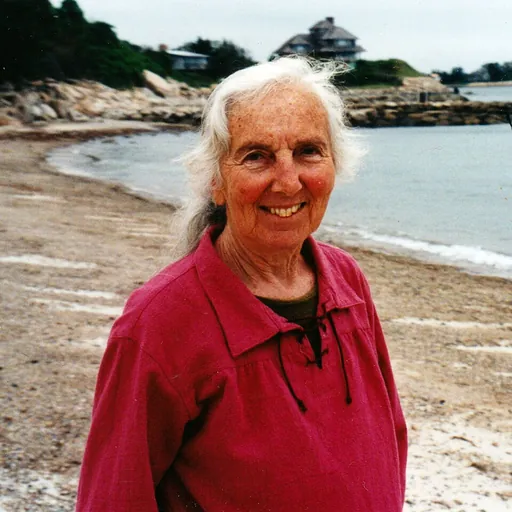
About Ruth Hubbard
Lived 1924 – 2016 (aged 92). Ruth Hubbard was an American biologist and biochemist.
Ruth Hubbard (March 3, 1924 – September 1, 2016) was a professor of biology at Harvard University, where she was the first woman to hold a tenured professorship position in biology.
During her active research career from the 1940s to the 1960s, she made important contributions to the understanding of the biochemistry and photochemistry of vision in vertebrates and invertebrates.
Early life and education In 1924, Hubbard was born Ruth Hoffmann in Vienna, Austria. Her parents, Richard Hoffmann and Helene Ehrlich Hoffmann, were both physicians and leftist intellectuals. Her mother was also a concert-quality pianist, and as a child, Ruth showed promise on the piano as well. When Nazi Germany annexed Austria in 1938, the Hoffmanns immigrated to the United States to escape. The family settled first in Brookline, Massachusetts, where Ruth graduated Brookline High School, and then in Cambridge.
Ruth decided to enroll at Radcliffe College with the intent to pursue a pre-medicine degree, which she attributes to the fact that everyone around her was a doctor. According to an interview given by Ruth, together they built on the work that Wald had researched during a fellowship following his own doctorate degree. He had confirmed the long-held belief that vitamin A was related to vision. Not only did he find that light absorption liberated vitamin A, he also found an intermediate of the visual pigment rhodopsin and vitamin A. This intermediate was the base of Ruth’s early work, where she attempted to determine the chemistry of the rhodopsin cycle. In 1952, Ruth received a Guggenheim Fellowship at the Carlsberg Laboratory in Copenhagen, Denmark. She showed that this is the only direct action of light on the visual system. Hubbard also described the bleaching and resynthesis of the rhodopsin molecule each time a photon is absorbed. She also discovered retinene isomerase (now called RPE65) that converts all-trans retinal (the post-illumination form) back into 11-cis retinal. She also studied the visual pigments in several new species. Her early work focused on the basic properties of rhodopsin, which is a combination of the chromophore (retinal) and a protein called opsin, which is reutilized in the resynthesis of rhodopsin. Hubbard published at least 31 scientific papers devoted to vision.
Social commentary and political activity In the late 1960s and early 1970s, Hubbard became interested in social and political dimensions of biological issues. In her book The Politics of Women's Biology, she wrote that she had been a "devout scientist" from 1947 until the late 1960s, but the Vietnam War and the women's liberation movement led her to change her priorities.
Hubbard describes an instance where she was working with squid as one of the pivotal moments where her interests shifted from scientific research to social relevance. Despite working with squid, cattle, and frogs for years when researching the complexities of vision, at that instant it suddenly began to bother her. She said, “I began to have the feeling that nothing I could find out was worth killing another squid.”
One such interest manifested itself in the new seminar course she taught at Harvard titled “Biology 109 - Biology and Women’s Issues.” “Women and nonwhite, working-class and poor men have largely been outside the process of science-making,” Dr. Hubbard told The New York Times in 1981. “Though we have been described by scientists, by and large we have not been the describers and definers of scientific reality. We have not formulated the questions scientists ask, nor have we answered them. This undoubtedly has affected the content of science, but it has also affected the social context and the ambience in which science is done.”
She became known as a strong critic of sociobiology. Geneticist Richard Lewontin has said, "No one has been a more influential critic of the biological theory of women's inequality than Ruth Hubbard." In a 2006 essay entitled "Race and Genes," she wrote:
It is beyond comprehension, in this century which has witnessed holocausts of ethnic, racial, and religious extermination in many parts of our planet, perpetrated by peoples of widely different cultural and political affiliations and beliefs, that educated persons—scholars and popularizers alike—can come forward to argue, as though in complete innocence and ignorance of our recent history, that nothing could be more interesting and worthwhile than to sort out the "racial" or "ethnic" components of our thoroughly mongrelized species so as to ascertain the root identity of each and everyone of us. And where to look for that identity if not in our genes? Ruth also became a critic of recombinant DNA research, in a time when the field was booming. She was concerned that people were attempting to assign every trait, disease, and behavior a genetic cause, leading to an oversimplification of science which does not consider the complexities of nature and outside factors. She termed this craze “genomania.”
Commentary on gender and science In her essay "Science and Science Criticism," published in 2001 as a chapter of The Gender and Science Reader, Hubbard iterates that she is a scientist and states that "ature is part of history and culture", but not vice versa. She goes on to say that scientists are largely unable to grasp the concept of nature being part of life--- noting how she needed several years to understand the statement. Going into her scientific history, the narrator mentions how she originally never questioned how her efforts fit into society. Narrowing her focus, she exposits that the Vietnam-era women's rights and women's liberation movements helped teach her of the roles of science in society.
The essay asserts that women scientists must ultimately and paradoxically turn away from the sciences to make their stand against male supremacy as opposed to the many female and feminist poets, novelists, and artists that can illustrate their points clearly and easily. She notes that politics seems to vanish within the sciences, exemplifying this point by noting social classes aren't a specific category listed under US health studies. The point she makes is that social and political realities can be blended or integrated subtly into all mediums. The subtlety of the integration ultimately creates great difficulty in discerning fact from prejudice. In addition, artists, novelists, and poets can compose their works without being victim to review under the funding agencies that makes the use of scientific fact tedious and less effective. The author leads in to surmise that the issues around women's rights must be raised and brought into public focus. After bringing up how science integrates itself into culture, she exemplifies the point by noting the prominence of biological terms in historical terminology and alluringly points out a biologist's tendency to place humanity above all other animals--- not unlike how men view women and their desire for equality. She raises the question of whether or not women can improve the sciences but makes an attempt to bring into attention her belief that women can make an impact. Hubbard closes by saying that scientists never want their work to be forgotten and lost, and that she sides with feminism for political insight and analytic testing on the scientific assumptions about women.
Ruth had met her second husband, George Wald, while they were both at Harvard. Wald was a Professor of Biology and Ruth’s boss in the research lab. However, the two began and kept their love affair a secret for more than a decade since they were married to other people at the time. After their respective divorces to previous partners, Ruth and George married in 1958. Like her brother, Ruth Hubbard was an outspoken activist. However, she was not only known for her commentary on science in society but was also as an antiwar and antinuclear war activist, for which she was once arrested on charges of civil disobedience.
Like her second husband, Ruth remained scientifically active until about 1975, and she made an excellent scientific presentation of George Wald's work at a symposium in his honor. George Wald was 17 years older than Hubbard and he died in 1997.
Partial bibliography
Selected articles
Ruth Hubbard (2006), Race & Genes, in Is Race Real?, a web forum sponsored by the Social Science Research Council, June 7, 2006
Books Ruth Hubbard (1990), The Politics of Women's Biology, Rutgers University Press. , Ruth Hubbard and Elijah Wald (1993), Exploding the Gene Myth: How Genetic Information Is Produced and Manipulated by Scientists, Physicians, Employers, Insurance Companies, Educators, and Law Enforcers, Beacon Press. , Ruth Hubbard (1995), Profitable Promises: Essays on Women, Science & Health, Common Courage Press. ,
Don’t just read it —
keep it.
Full-length biographies made to live with: read them, listen on the way to work, watch them tonight.
- E-book
- Audio
- Video
Instant download · yours to keep · every purchase keeps this site free
Important facts
Family & relationships
People in Ruth Hubbard's life
Named in this biography and alive at the same time


Related people
Same field, nearest in time


Contemporaries
People whose lives overlapped Ruth Hubbard's




Frequently asked questions
Who was Ruth Hubbard?
Austrian-American biochemist
When was Ruth Hubbard born?
Ruth Hubbard was born on 3 March 1924 in Vienna.
When did Ruth Hubbard die?
Ruth Hubbard died on 1 September 2016 in Cambridge.
What was Ruth Hubbard's occupation?
Ruth Hubbard was a biologist and biochemist.
What nationality was Ruth Hubbard?
Ruth Hubbard was American.
Sources & further reading
Cite this page
APA: Biography.guide. (2026). Ruth Hubbard. https://biography.guide/ruth-hubbard/
MLA: "Ruth Hubbard." Biography.guide, https://biography.guide/ruth-hubbard/.
Chicago: "Ruth Hubbard." Biography.guide. https://biography.guide/ruth-hubbard/.
Data last updated: 2026-09-22 · Spot an error? Report a correction.
Portrait: Wikimedia Commons · author & licence
Page generated 2026-09-27 05:04 UTC