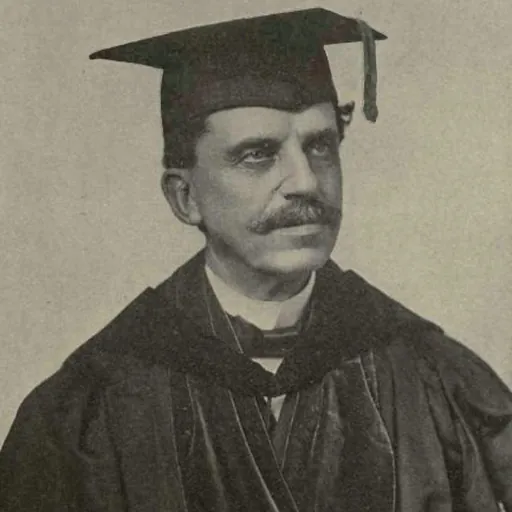
About Russell Conwell
Lived 1843 – 1925 (aged 82). Russell Conwell was an American writer, christian minister, lawyer, academic administrator and orator, known for Temple University.
Russell Herman Conwell (February 15, 1843 – December 6, 1925) was an American Baptist minister, orator, philanthropist, author, lawyer, and writer. He is best remembered as the founder and first president of Temple University in Philadelphia, as the Pastor of The Baptist Temple, and for his inspirational lecture, "Acres of Diamonds". He was born in South Worthington, Massachusetts.
Biography Early life Hailing from a New England family of English descent and the son of Massachusetts farmers, Conwell left home to attend the Wilbraham Wesleyan Academy and later Yale University. In 1862, before graduating from Yale, he enlisted in the Union Army during the American Civil War. Conwell desired to enlist in the war effort shortly after its outbreak in 1861, but could not initially gain the approval of his father, Martin Conwell. His abolitionist father ultimately changed his mind, allowing Conwell to enlist in Company "F" of the 27th Massachusetts Volunteers, better known as the "Mountain Boys". Conwell and the Mountain Boys served in North Carolina and first engaged the opposition at Kinston, North Carolina.
Two months into his detention, and prior to the completion of the investigation, Conwell was assigned to Nashville, Tennessee, in June 1864 to join General MacPherson's movement against Atlanta.
The December 4, 1882 issue of The Public Ledger reported the following about the new minister and church:
Conwell ended evening services by holding an hour of prayer, leading song services, and giving commentary relevant to his sermons. The musical pastor often performed a solo piece during evening services.
Conwell's personality attracted large crowds that the church outgrew its capacity to seat all that wanted to come.
Hattie May Wiatt Reverend Conwell used the story of Hattie May Wiatt and her 57 cents to spur phenomenal fundraising to build a new church. Hattie May lived nearby, and she and other children were gathered outside when Conwell walked up one Sunday morning. Conwell carried Hattie May on his shoulders and sat her in a corner in the back. When he ran into her walking the streets one day, he told her not to worry that one day they'd build a new church so all the children could come in. Hattie May died at six years of age. When she died from diphtheria, she had saved 57 cents to contribute to the cause. The girl's mother told Reverend Conwell that Hattie May had been saving money to help build a bigger church and gave him the coins. Reverend Conwell had the 57 cents turned into 57 pennies, told the congregation the story of little Hattie May, and auctioned the pennies for a return of about $250. In addition, 54 of the 57 pennies were returned to Reverend Conwell, and he later put them up on display.
On June 28, 1886, a nearby house at the corner of Broad and Berks streets, referred to as The Temple because the property owner did not want the house to be called a church until the mortgage was fully paid, was investigated for purchase by the Wiatt Mite Society, which was organized for the purpose of taking the 57 cents and enlarging on them sufficiently to buy the property for the Primary Department of the Sunday school. A few days later, the congregation agreed to purchase the lot. The first payment for the lot was 57 cents. The property was conveyed to the church on January 31, 1887. In that same house, the first classes of Temple College, later Temple University, were held. The house was later sold to allow Temple College to move and the Baptist Temple (now the Temple Performing Arts Center) to grow, and still, more of that money went towards founding the Samaritan Hospital. This story so touched Conwell that he repeated it many times. The transcript for the sermon where Conwell tells this story in full is available at Temple University Libraries.
In September 1887, at the Centennial Celebration of the United States Constitution, money received from the Wiatt Mite Society was given "for the success of the new Temple". This was the first time the name "Temple" was used in place of the church name.
In 1888, the youth group considered becoming a worldwide organization. The pastor was a speaker at a Christian Endeavor convention. Conwell was very impressed by the purpose and enthusiasm of the group. He later recommended the Christian Endeavor to the youth group of the church. On September 10, 1888, the Society of Christian Endeavor was finally organized. The Christian Endeavor youth groups continued to meet at the Church until the 1960s.
Charles M. Davis, a young deacon, approached the pastor with his desire to preach; however, Davis had little education and was without sufficient funds to continue his studies. Conwell agreed to tutor him. Over the next few days, seven prospective students met with Conwell, and Temple College was conceived. Conwell became president of the college, now known as Temple University.
As the membership continued to grow to over one thousand and the Sunday School to even greater numbers, a larger facility was needed. Consequently, on March 29, 1889, a contract was negotiated to build the new church. The ground was broken for the new building on March 27, 1889, and the cornerstone was laid on July 13, 1889.
On February 15, 1891, Conwell preached his last sermon in the old church at Marvine and Berks Streets. He preached the first sermon at the new building on March 1. Sixty people were baptized in the afternoon, and several addresses were given. The Rev. L. B. Hartman, the first minister, was present. The celebration continued throughout the week, and the church was filled to capacity for all of its services. The new church later became known as The Baptist Temple. The work began as a speech, "at first given," wrote Conwell in 1913, "before a reunion of my old comrades of the Forty-sixth Massachusetts Regiment, which served in the Civil War and in which I was captain." It was delivered as a lecture on the Chautauqua circuit prior to his becoming pastor of the Grace Baptist Church in Philadelphia in 1882 and was first published in book form in 1890 by the John Y. Huber Company of Philadelphia. Before his death in 1925, Conwell would deliver it over 6,152 times around the world.
Conwell's capacity to establish Temple University and his other civic projects largely derived from the income that he earned from this speech. The book has been regarded as a classic of New Thought literature since the 1870s. After Conwell's death, proceeds from this speech were dedicated to the Sunday Breakfast Association, a homeless shelter in Philadelphia.
The film Johnny Ring and the Captain's Sword (1921) is based upon Conwell's writings regarding his experiences in the Civil War.
The elementary school in Worthington, Massachusetts, his home town, bears his name.
It is rumored that Conwell's body is frozen and stored in the basement of Wachman Hall for preservation and the possibility of reanimation.
Selected works Acres of Diamonds Life of Charles Haddon Spurgeon, the World's Greatest Preacher, 1892 Every Man His Own University, 1917 Increasing Personal Efficiency, 1917 The Key to Success, 1917 Health Healing and Faith, 1921 Praying for Money, 1921 Subconscious Religion, 1921 Why Lincoln Laughed, 1922 The Romantic Rise of a Great American (biography of John Wanamaker), 1924
Don’t just read it —
keep it.
Full-length biographies made to live with: read them, listen on the way to work, watch them tonight.
- E-book
- Audio
- Video
Instant download · yours to keep · every purchase keeps this site free
Important facts
People in Russell Conwell's life
Named in this biography and alive at the same time


Related people
Same field, nearest in time

Contemporaries
People whose lives overlapped Russell Conwell's

Frequently asked questions
Who was Russell Conwell?
American academic administrator
When was Russell Conwell born?
Russell Conwell was born on 15 September 1843 in South Worthington Historic District.
When did Russell Conwell die?
Russell Conwell died on 6 December 1925 in Philadelphia.
What was Russell Conwell's occupation?
Russell Conwell was a writer, christian minister, lawyer, academic administrator and orator.
What was Russell Conwell known for?
Russell Conwell was known for Temple University.
What nationality was Russell Conwell?
Russell Conwell was American.
Sources & further reading
Cite this page
APA: Biography.guide. (2026). Russell Conwell. https://biography.guide/russell-conwell/
MLA: "Russell Conwell." Biography.guide, https://biography.guide/russell-conwell/.
Chicago: "Russell Conwell." Biography.guide. https://biography.guide/russell-conwell/.
Data last updated: 2026-09-23 · Spot an error? Report a correction.
Portrait: Wikimedia Commons · author & licence
Page generated 2026-09-27 05:05 UTC