
About Ruhollah Khaleqi
Lived 1906 – 1965 (aged 58–59). Ruhollah Khaleqi was an Iranian conductor, composer, music educator, music journalist and musician.
Ruhollah Khaleqi ( ; 1906 – 12 November 1965) was a prominent Iranian composer, conductor and author. He is best known for composing the patriotic song "Ey Iran".
He was the father of Golnoush Khaleghi—Iran's first female conductor.
Early life and education
Khaleqi was born in Mahan, a small town near Kerman, in a musically minded family. He first became acquainted with the tar, but later started to learn to play the violin.
As soon as Ali-Naqi Vaziri established his school of music, Khaleqi left school and joined Vaziri's school, where he studied for eight years. Soon he became his master's assistant and was placed in charge of teaching music theory.
He later continued his education and obtained a BA in Persian language and literature at the University of Tehran.
Career
In 1944, Khaleqi established the National Music Society. In 1949, he founded the School of National Music and established the Tehran-based National Music Society and Persian National Music Conservatory. After his first journey to the Soviet Union in 1955, he became involved in the Iran-Soviet Society and was selected as a member of its board of directors. He also served as the director of the magazine .
Gravestone of Ruhollah Khaleqi in Zahir o-dowleh cemetery, Darband, Shemiran, Tehran.
For many years, he worked as a musical advisor for Radio Iran and was one of the founders of the program known as (; ). He also conducted the Golhā Orchestra, for which he composed many pieces and revised the original compositions of his contemporaries as well as older masters, such as Aref Qazvini and Ali Akbar Sheyda. Although revised, the compositions retained all their original characteristics.
He believed that Persian classical music should turn into a polyphonic music to become more attractive.
He died in 1965 in Salzburg, Austria, and was buried in Zahir-od-dowleh cemetery in Darband, Tehran.
Compositions
In addition to musical compositions such as (; ), (; ), (; ), and "Chang‑e Rudaki" (; ), he composed many other lyrical pieces and hymns, many of which are patriotic. These include works such as "Ey Iran", which was famously performed by Gholam-Hossein Banan and is used as a de facto anthem of the Iranian people.
Publications His work, The History of Persian Music, which was published in two volumes, took shape during these years.
Other published works of his include Harmony of Western Music, Theory of Eastern Music, and Theory of Persian Music.
Don’t just read it —
keep it.
Full-length biographies made to live with: read them, listen on the way to work, watch them tonight.
- E-book
- Audio
- Video
Instant download · yours to keep · every purchase keeps this site free
Important facts
People in Ruhollah Khaleqi's life
Named in this biography and alive at the same time

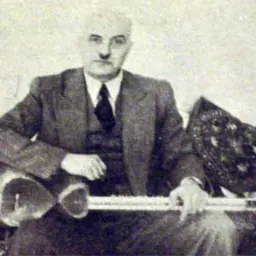
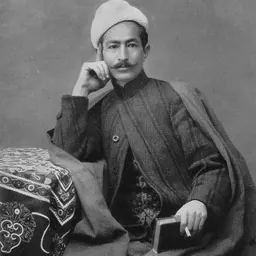

Related people
Same field, nearest in time


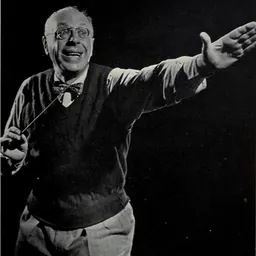

Contemporaries
People whose lives overlapped Ruhollah Khaleqi's
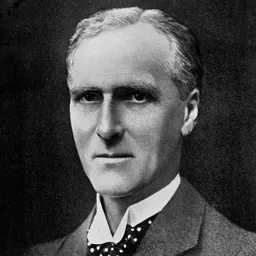

Frequently asked questions
Who was Ruhollah Khaleqi?
Iranian musician (1906–1965)
When was Ruhollah Khaleqi born?
Ruhollah Khaleqi was born in 1906 in Mahan.
When did Ruhollah Khaleqi die?
Ruhollah Khaleqi died on 12 November 1965 in Salzburg.
What was Ruhollah Khaleqi's occupation?
Ruhollah Khaleqi was a conductor, composer, music educator, music journalist and musician.
What nationality was Ruhollah Khaleqi?
Ruhollah Khaleqi was Iranian.
Sources & further reading
Cite this page
APA: Biography.guide. (2026). Ruhollah Khaleqi. https://biography.guide/ruhollah-khaleqi/
MLA: "Ruhollah Khaleqi." Biography.guide, https://biography.guide/ruhollah-khaleqi/.
Chicago: "Ruhollah Khaleqi." Biography.guide. https://biography.guide/ruhollah-khaleqi/.
Data last updated: 2026-09-20 · Spot an error? Report a correction.
Page generated 2026-09-27 05:25 UTC