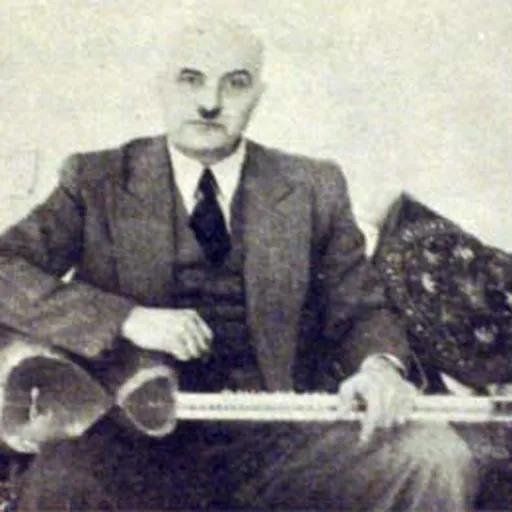
About Ali-Naqi Vaziri
Lived 1887 – 1979 (aged 91–92). Ali-Naqi Vaziri was an Iranian teacher, composer, musicologist and tar (lute).
Ali-Naqi Vaziri (; 1 October 1886 in Tehran – 9 September 1979), also transcribed as Ali Naghi Vaziri, was a composer, thinker, and celebrated player of the tar. He is considered a revolutionary icon in the history of 20th-century Persian music.
Ali-Naqi Vaziri was born on 1 October 1886, in Tehran, Qajar Iran.
Vaziri for years was the director of the Tehran Conservatory of Music and a professor at the University of Tehran.
Innovations Vaziri was one the first Persian musicians in the 20th century to go to Europe to study music, and after his return to Tehran in 1924.
He was for a long time the only traditional instrumentalist familiar with and promoted the theory of Western classical music.
He wrote the first transcription of Iranian music using European staff notation in his lute instruction book Dastur-e Tar, published in Iran (1913) and Germany (1923). It contained material from the Iranian oral classical canon (known as the radif), as well as arrangements inspired by composers like Beethoven, Rossini, and Schubert.
Vaziri was the first to introduce and promote equal moderation in classical Persian music; in this way, each octave was evenly divided into 24 notes. This method made it possible to use Western system to harmonise traditional Persian melodies. His experiments with musical scale was work in the direction of blending Western polyphony into Persian music.
His creation of the 24 step scale was created "with the intention of accommodating the application of Western harmony to musical compositions within Persian modes." Vaziri's theory for classical Persian music was heavily rejected since the 1960s.
Vaziri trained students, some of whom became famous in Persian music, including: Abolhassan Saba, Ruhollah Khaleghi, Javad Maroufi, Heshmat Sanjari.
He invited some artists of his time (such as Ali Dashti, Ali-Akbar Dehkhoda, Gholamreza Rashid-Yasemi, Badiozzaman Forouzanfar and Hassan Taqizadeh) together to establish an "Academy of Fine Arts" with the aim of collecting a culture of musical words and which may have become the basis for the formation of the Academy of Persian Language and Literature.
Don’t just read it —
keep it.
Full-length biographies made to live with: read them, listen on the way to work, watch them tonight.
- E-book
- Audio
- Video
Instant download · yours to keep · every purchase keeps this site free
Important facts
People in Ali-Naqi Vaziri's life
Named in this biography and alive at the same time




Related people
Same field, nearest in time

Contemporaries
People whose lives overlapped Ali-Naqi Vaziri's


Frequently asked questions
Who was Ali-Naqi Vaziri?
Iranian musician (1887–1979)
When was Ali-Naqi Vaziri born?
Ali-Naqi Vaziri was born in 1887 in Tehran.
When did Ali-Naqi Vaziri die?
Ali-Naqi Vaziri died on 9 September 1979 in Tehran.
What was Ali-Naqi Vaziri's occupation?
Ali-Naqi Vaziri was a teacher, composer, musicologist and tar (lute).
What nationality was Ali-Naqi Vaziri?
Ali-Naqi Vaziri was Iranian.
Sources & further reading
Cite this page
APA: Biography.guide. (2026). Ali-Naqi Vaziri. https://biography.guide/ali-naqi-vaziri/
MLA: "Ali-Naqi Vaziri." Biography.guide, https://biography.guide/ali-naqi-vaziri/.
Chicago: "Ali-Naqi Vaziri." Biography.guide. https://biography.guide/ali-naqi-vaziri/.
Data last updated: 2026-09-20 · Spot an error? Report a correction.
Portrait: Wikimedia Commons · author & licence
Page generated 2026-09-27 04:57 UTC