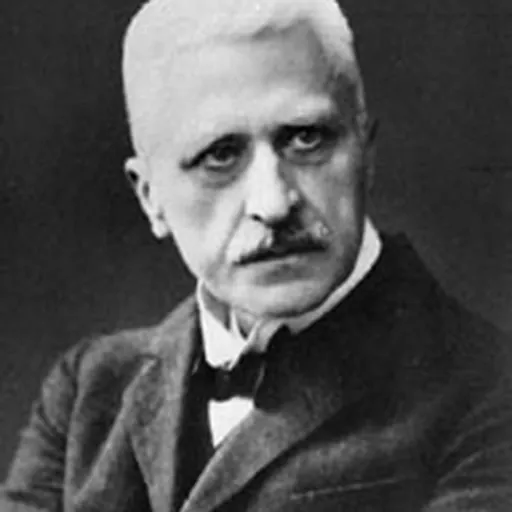
Rudolf Otto
German theologian, philosopher, and comparative religionist
About Rudolf Otto
Lived 1869 – 1937 (aged 67). Rudolf Otto was a politician, philosopher, non-fiction writer, university teacher, religious studies scholar and member of parliament.
Rudolf Otto (25 September 1869 – 7 March 1937) was a German Lutheran theologian, philosopher, and comparative religionist. He is regarded as one of the most influential scholars of religion in the early twentieth century and is best known for his concept of the numinous, a profound emotional experience he argued was at the heart of the world's religions. While his work started in the domain of liberal Christian theology, its main thrust was always apologetical, seeking to defend religion against naturalist critiques, making him a more conservative figure. Otto eventually came to conceive of his work as part of a science of religion, which was divided into the philosophy of religion, the history of religion, and the psychology of religion. He attended the Gymnasium Andreanum in Hildesheim and studied at the universities of Erlangen and Göttingen, where he wrote his dissertation on Martin Luther's understanding of the Holy Spirit (Die Anschauung von heiligen Geiste bei Luther: Eine historisch-dogmatische Untersuchung), and his habilitation on Kant (Naturalistische und religiöse Weltansicht). By 1906, he held a position as extraordinary professor, and in 1910 he received an honorary doctorate from the University of Giessen.
Otto's fascination with non-Christian religions was awakened during an extended trip from 1911 to 1912 through North Africa, Palestine, British India, China, Japan, and the United States. He cited a 1911 visit to a Moroccan synagogue as a key inspiration for the theme of the Holy he would later develop.
The Idea of the Holy
Otto's most famous work, The Idea of the Holy was one of the most successful German theological books of the 20th century, has never gone out of print, and is available in about 20 languages. The central argument of the book concerns the term numinous, which Otto coined. He explains the numinous as a "non-rational, non-sensory experience or feeling whose primary and immediate object is outside the self". This mental state "presents itself as ganz Andere, wholly other, a condition absolutely sui generis and incomparable whereby the human being finds himself utterly abashed." According to Mark Wynn in the Stanford Encyclopedia of Philosophy, The Idea of the Holy falls within a paradigm in the philosophy of emotion in which emotions are seen as including an element of perception with intrinsic epistemic value that is neither mediated by thoughts nor simply a response to physiological factors. Otto therefore understands religious experience as having mind-independent phenomenological content rather than being an internal response to belief in a divine reality. Otto applied this model specifically to religious experiences, which he felt were qualitatively different from other emotions. Otto felt people should first do serious rational study of God, before turning to the non-rational element of God as he did in this book.
Later works In Mysticism East and West, published in German in 1926 and English in 1932, Otto compares and contrasts the views of the medieval German Christian mystic Meister Eckhart with those of the influential Hindu philosopher Adi Shankara, the key figure of the Advaita Vedanta school. thus falling within the tradition of apophatic theology. Otto was also one of the very few modern theologians to whom C. S. Lewis indicates a debt, particularly to the idea of the numinous in The Problem of Pain. In that book Lewis offers his own description of the numinous:
German-American theologian Paul Tillich acknowledged Otto's influence on him,
Non-Christian theology and spirituality Otto's ideas have also exerted an influence on non-Christian theology and spirituality. They have been discussed by Orthodox Jewish theologians including Joseph Soloveitchik and Eliezer Berkovits. The Iranian-American Sufi religious studies scholar and public intellectual Reza Aslan understands religion as "an institutionalized system of symbols and metaphors [...] with which a community of faith can share with each other their numinous encounter with the Divine Presence." Further afield, Otto's work received words of appreciation from Indian independence leader Mohandas Gandhi.
Religious studies In The Idea of the Holy and other works, Otto set out a paradigm for the study of religion that focused on the need to realize the religious as a non-reducible, original category in its own right. The eminent Romanian-American historian of religion and philosopher Mircea Eliade used the concepts from The Idea of the Holy as the starting point for his own 1954 book, The Sacred and the Profane. The paradigm represented by Otto and Eliade was then heavily criticized for viewing religion as a sui generis category, The American Episcopal priest John A. Sanford applied the ideas of both Otto and Jung in his writings on religious psychotherapy.
Philosophy The philosopher and sociologist Max Horkheimer, a member of the Frankfurt School, has taken the concept of "wholly other" in his 1970 book Die Sehnsucht nach dem ganz Anderen ("longing for the entirely Other"). Walter Terence Stace wrote in his book Time and Eternity that "After Kant, I owe more to Rudolph Otto's The Idea of the Holy than to any other book." Other philosophers influenced by Otto included Martin Heidegger, Leo Strauss, Hans-Georg Gadamer (who was critical when younger but respectful in his old age), Max Scheler, Edmund Husserl, Joachim Wach, and Hans Jonas.
Other The war veteran and writer Ernst Jünger and the historian and scientist Joseph Needham also cited Otto's influence.
Ecumenical activities Otto was heavily involved in ecumenical activities between Christian denominations and between Christianity and other religions. He experimented with adding a time similar to a Quaker moment of silence to the Lutheran liturgy as an opportunity for worshipers to experience the numinous.
Works A full bibliography of Otto's works is given in Robert F. Davidson, Rudolf Otto's Interpretation of Religion (Princeton, 1947), pp. 207–9
In German Naturalistische und religiöse Weltansicht (1904) Die Kant-Friesische Religions-Philosophie (1909) Das Heilige – Über das Irrationale in der Idee des Göttlichen und sein Verhältnis zum Rationalen (Breslau, 1917) West-östliche Mystik (1926) Die Gnadenreligion Indiens und das Christentum (1930) Reich Gottes und Menschensohn (1934)
English translations Naturalism and Religion, trans J. Arthur Thomson & Margaret Thomson (London: Williams and Norgate, 1907) [originally published 1904] The Life and Ministry of Jesus, According to the Critical Method (Chicago: Open Court, 1908). The Idea of the Holy, trans JW Harvey (New York: OUP, 1923; 2nd edn, 1950; reprint, New York, 1970), [originally published 1917] Christianity and the Indian Religion of Grace (Madras, 1928) India's Religion of Grace and Christianity Compared and Contrasted, trans FH Foster (New York; London, 1930) 'The Sensus Numinis as the Historical Basis of Religion', Hibbert Journal 29, (1930), 1–8 The Philosophy of Religion Based on Kant and Fries, trans EB Dicker (London, 1931) [originally published 1909] Religious essays: A supplement to 'The Idea of the Holy''', trans B Lunn, (London, 1931) Mysticism East and West: A Comparative Analysis of the Nature of Mysticism, trans BL Bracey and RC Payne (New York, 1932) [originally published 1926] 'In the sphere of the holy', Hibbert Journal 31 (1932–3), 413–6The original Gita: The song of the Supreme Exalted One (London, 1939)The Kingdom of God and the Son of Man: A Study in the History of Religion, trans FV Filson and BL Wolff (Boston, 1943)Autobiographical and Social Essays (Berlin: Walter de Gruyter, 1996),
Don’t just read it —
keep it.
Full-length biographies made to live with: read them, listen on the way to work, watch them tonight.
- E-book
- Audio
- Video
Instant download · yours to keep · every purchase keeps this site free
Important facts
People in Rudolf Otto's life
Named in this biography and alive at the same time


Related people
Same field, nearest in time





Contemporaries
People whose lives overlapped Rudolf Otto's





Frequently asked questions
Who was Rudolf Otto?
German theologian, philosopher, and comparative religionist (1869–1937)
When was Rudolf Otto born?
Rudolf Otto was born on 25 September 1869 in Peine.
When did Rudolf Otto die?
Rudolf Otto died on 7 March 1937 in Marburg.
What was Rudolf Otto's occupation?
Rudolf Otto was a politician, philosopher, non-fiction writer, university teacher, religious studies scholar and member of parliament.
What nationality was Rudolf Otto?
Rudolf Otto's recorded nationality: German Reich.
Sources & further reading
Cite this page
APA: Biography.guide. (2026). Rudolf Otto. https://biography.guide/rudolf-otto/
MLA: "Rudolf Otto." Biography.guide, https://biography.guide/rudolf-otto/.
Chicago: "Rudolf Otto." Biography.guide. https://biography.guide/rudolf-otto/.
Data last updated: 2026-09-24 · Spot an error? Report a correction.
Portrait: Wikimedia Commons · author & licence
Page generated 2026-09-27 05:08 UTC