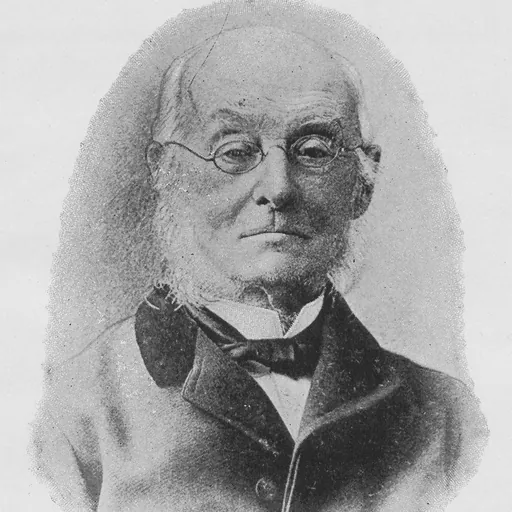
Rudolf Amandus Philippi
German-Chilean naturalist and palaeontologist
About Rudolf Amandus Philippi
Lived 1808 – 1904 (aged 95). Rudolf Amandus Philippi was a Chilean paleontologist, zoologist, ornithologist, botanist, naturalist and university teacher.
Rodolfo Amando (or Rudolph Amandus) Philippi (14 September 1808 – 23 July 1904) was a German–Chilean paleontologist and zoologist. Philippi contributed primarily to malacology and paleontology, but also published a major work on Diptera of Chile. His great-grandson, Rodulfo Amando Philippi Bañados (1905-1969), was also a zoologist.
Early life Philippi was born in Charlottenburg, Berlin to Johann Wilhelm Eberhard Philippi, a Prussian government auditor, and his third wife Maria Anna Krumwiede (m. 1806). The father had five children from two earlier marriages and Philippi was the eldest from the third marriage. In 1818, Philippi, his younger brother Bernhard Eunom (1811–1852) and their mother went to Yverdon-les-Bains, Switzerland, where they were educated at the Pestalozzian Institute founded by Johann Heinrich Pestalozzi (1746–1827). The teaching included the use of natural objects for teaching and Philippi was involved in collecting plants and butterflies at a young age. The move was caused by an affair of their father with the housekeeper and led to the separation of the parents. The three returned to Berlin in 1822 where Philippi went to the Königliche Gymnasium zum Grauen Kloster (founded in 1574) and in 1826 he moved to the Friedrich-Wilhelms-Universität Berlin and graduated in 1830. His studies included medicine, surgery, comparative anatomy, botany and zoology. His dissertation was on the orthoptera of Berlin (Orthoptera Berolinensia). Respiratory illness forced him to leave Berlin in 1830 to warmer parts of Italy where he travelled around with the geologists Friedrich Hoffmann and Arnold Escher von der Lind who were studying Etna and Vesuvius. Philippi began to look at fossils here. He also collected molluscs and interacted with the Italian Benedictine priest and malacologist Emiliano Guttadauro (1759–1836) who encouraged him to study molluscs. He returned briefly to Berlin to complete his medical studies and qualified as a physician in 1833. He then worked as a teacher at Kassel from 1835. In 1836 he married a cousin, Caroline Krumwiede, who came from a well-to-do family and hoped that the means would let him study molluscs.
Early career His first major work on molluscs based on his collections from Sicily was published in 1836. For this work, he received a medal from Kaiser Friedrich Wilhelm III thanks to a recommendation from Alexander von Humboldt. Along with 14 others, he founded the Vereins für Naturkunde (Natural History Society) of Kassel the same year. In 1837 he was diagnosed with pneumonia and told that he had to move to a drier climate. He then moved to Sicily living there for several years, recovering his health. He began to collect molluscs in earnest, making use of a collector trained by Italian malacologist Arcangelo Scacchi (1810–1893). In 1840 he returned to Kassel, with a stop in Neuchâtel where he met Louis Agassiz. At Kassel, he interacted with the local malacologists who included Karl Menke, who had begun the first journal in German, Zeitschrift für Malakozoologie in 1844. This led to an increased productivity, and he wrote several books including Abbildungen (illustrated monographs), leading to a medal from the new King, Kaiser Friedrich Wilhelm IV. His brother Bernhard Eunom Philippi in the meantime became a successful merchant and sailed to Chile several times, making collections for museums. Bernhard moved to Chile in 1841 and encouraged Germans to emigrate to Punta Arenas, an area that he helped seize control of, and had been made a governor of the Magellan Province. It was shortly after completing a monograph on the Chilean frogs in 1904 that he was diagnosed with pneumonia, leading to his death. A state holiday was announced the next day and his body was kept for public viewing and was visited by 10000 people. The 284-horse-drawn cortege was lined along its route by 30,000 people including schoolchildren and the entire Chilean parliament and cabinet were in attendance. He was buried in the Santiago Catholic Church where Philippi, as being Lutheran, was buried in a corner called the Dissidents’ Courtyard. and more than 425 new species of Diptera. As of 2006, 1,670 of species he described are considered valid, of which 1,017 plants, 650 animals and three fungae. Over 10% of Chiles angiosperms, amphibians, dermaptera and phasmapods were first described by Philippi. He also described Cephaloptera tarapacana, a new species of Myliobatiform ray, later accepted as Mobula tarapacana.
A species of snake, Tropidodipsas philippii, is named in his honor. In 1897, botanist Carlos Luigi Spegazzini published Philippiella, a monotypic genus of flowering plants from Argentina and Chile, belonging to the family Thymelaeaceae named after him. Museo de la Exploración Rudolph Amandus Philippi in Valdivia is named after him.
Philippi's youngest son, Federico Philippi (1838–1910), was also a zoologist and botanist.
Selected works
Taxon described by him See :Category:Taxa named by Rodolfo Amando Philippi
Don’t just read it —
keep it.
Full-length biographies made to live with: read them, listen on the way to work, watch them tonight.
- E-book
- Audio
- Video
Instant download · yours to keep · every purchase keeps this site free
Important facts
more
Rodolfo Amando, Rudolph Amandus Philippi, A.A. Philippi, Rudolf Amandus Philippi Krumwiede, Rudolfo Amando Philippi, Rodolfo Amando Philippi KrumwiedePeople in Rudolf Amandus Philippi's life
Named in this biography and alive at the same time




Related people
Same field, nearest in time




Contemporaries
People whose lives overlapped Rudolf Amandus Philippi's





Frequently asked questions
Who was Rudolf Amandus Philippi?
German-Chilean naturalist and palaeontologist (1808-1904)
When was Rudolf Amandus Philippi born?
Rudolf Amandus Philippi was born on 14 September 1808 in Charlottenburg, Berlin.
When did Rudolf Amandus Philippi die?
Rudolf Amandus Philippi died on 23 July 1904 in Santiago.
What was Rudolf Amandus Philippi's occupation?
Rudolf Amandus Philippi was a paleontologist, zoologist, ornithologist, botanist, naturalist and university teacher.
What nationality was Rudolf Amandus Philippi?
Rudolf Amandus Philippi was Chilean.
Sources & further reading
· Wikipedia: Rudolf Amandus Philippi
· DBpedia: Rodolfo Amando Philippi
Cite this page
APA: Biography.guide. (2026). Rudolf Amandus Philippi. https://biography.guide/rudolf-amandus-philippi/
MLA: "Rudolf Amandus Philippi." Biography.guide, https://biography.guide/rudolf-amandus-philippi/.
Chicago: "Rudolf Amandus Philippi." Biography.guide. https://biography.guide/rudolf-amandus-philippi/.
Data last updated: 2026-09-22 · Spot an error? Report a correction.
Portrait: Wikimedia Commons · author & licence
Page generated 2026-09-27 05:01 UTC