
About Roy Park
Lived 1892 – 1947 (aged 54). Roy Park was an Australian cricketer and australian rules football player.
Roy Lindsay Park (30 July 1892 – 23 January 1947) was an Australian sportsman and doctor. The son of a Methodist minister, he played cricket for Australia and also Australian rules football in the Victorian Football League (VFL). He was educated at Wesley College, Melbourne. Park also served in the Australian Imperial Force in World War I.
Football career Park started his senior VFL career at University, making his debut in 1912. He had an immediate impact as the club's leading goal kicker with 22. Park's 53 goals in the 1913 VFL season was bettered only by Fitzroy's Jimmy Freake with 56. Little interest was manifested in the meeting of Richmond and University at Richmond [Cricket Ground on 13 August 1913], the local men displaying more knowledge and better tactics than the students, and winning handsomely.The real concern in the game centred in the doings of Roy Park, the students' goal sneak, a great favourite on all grounds.Notwithstanding that his side has not won a game, Park's success has been phenomenal, his judgment standing out among his comrades' like an oasis in a desert.After the match the opposition supporters, who were carried away by the boy's marvellous accuracy [in kicking five goals], rushed the ground and carried him in shoulder high – a unique tribute in these degenerate days. – The Australasian, 6 September 1913.
Park had medical studying commitments at Melbourne University in 1914, leaving him free for few games, but still managed to kick 36 goals for the season that was University's last in the VFL competition.
In 1915 Park played with VFL club Melbourne, where he kicked 35 goals in 13 games, but was suspended for four matches for striking Gerry Balme of St Kilda, despite three witnesses coming forward to say that Park had not hit the player at all. Park refused to play football again after his suspension, ending his VFL career with 146 goals in 57 matches. However, following the end of the war, Park returned to football, playing with Footscray—he was conducting his medical practice in Footscray at the time—who were then a member of the Victorian Football Association (VFA). In the 1920 VFA second semi-final replay, Park won the match for Footscray against North Melbourne with a dramatic kick that dribbled through for a goal with less than ten seconds left on the clock.
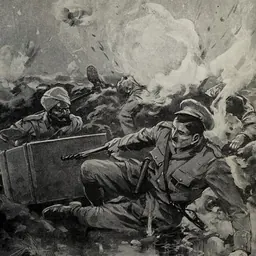
World War I A registered medical practitioner, Upon enrolling, Park was given the rank of captain and left Australia on 4 August 1917 aboard HMAT Themistocles. He served with the 5th Field Ambulance Unit and was mentioned in dispatches in the London Gazette on 11 July 1919 and in the Commonwealth of Australia Gazette on 30 October 1919. Park returned safely to Australia on 2 June 1919 after the conclusion of World War I.
Cricket career Park was a cricket prodigy at Wesley College. His schoolmate Robert Menzies, future Prime Minister of Australia, recalled reading Shakespeare behind the school practice nets, "so that he could partake of the bard whilst watching Park bat." Park played for South Melbourne Cricket Club in the Victorian Cricket Association (VCA), and starred as a right-handed opening batsman, including a 315-run opening partnership with future Australian Test captain Bill Woodfull, for many years a club record. He became the youngest man to lead the batting averages for Melbourne Cricket Club. He was chosen as part of Warwick Armstrong's 1914/15 Australian team for a stillborn tour of South Africa:
At Melbourne, Park had been one of the youngsters sent to the "special net" for Armstrong's attention. Armstrong had been impressed, Park awestruck, later crediting Armstrong with "most of my cricket brains". They were an odd sight in partnership, like a planet and its satellite, but their simpatico was deep. During the match against South Australia, for example, Park joined his captain with an hour left of the second day and shared a thunderous stand. Over lunch on the third day, with Park 226 and himself 101, Armstrong recalled his own eight-year-old record score for Victoria: "Parky, you haven't far to go to beat my 250. I promise to do my best to stop there while you make them." Park did not make it, but always remembered the gesture.
At first-class level, he made 2514 runs at an average of just under 40, scoring nine centuries, with a highest score of 228. Following his retirement from cricket, Park held numerous administrative positions, including the South Melbourne delegate to the VCA and Victorian selector. In 1953 a memorial plaque honouring Park was unveiled in South Melbourne by the Mayor of South Melbourne.
Park's son-in-law, Ian Johnson, who married his daughter, Lal, was a captain of the Australian cricket team in the 1950s and a member of The 1948 Invincibles.
Don’t just read it —
keep it.
Full-length biographies made to live with: read them, listen on the way to work, watch them tonight.
- E-book
- Audio
- Video
Instant download · yours to keep · every purchase keeps this site free
Important facts
People in Roy Park's life
Named in this biography and alive at the same time



Related people
Same field, nearest in time



Contemporaries
People whose lives overlapped Roy Park's

Frequently asked questions
Who was Roy Park?
Australian sportsman (1892-1947)
When was Roy Park born?
Roy Park was born on 30 July 1892 in Charlton.
When did Roy Park die?
Roy Park died on 23 January 1947 in Middle Park.
What was Roy Park's occupation?
Roy Park was a cricketer and australian rules football player.
What nationality was Roy Park?
Roy Park was Australian.
Sources & further reading
· DBpedia: Roy Park (sportsman)
Cite this page
APA: Biography.guide. (2026). Roy Park. https://biography.guide/roy-park/
MLA: "Roy Park." Biography.guide, https://biography.guide/roy-park/.
Chicago: "Roy Park." Biography.guide. https://biography.guide/roy-park/.
Data last updated: 2026-09-24 · Spot an error? Report a correction.
Page generated 2026-09-27 05:02 UTC