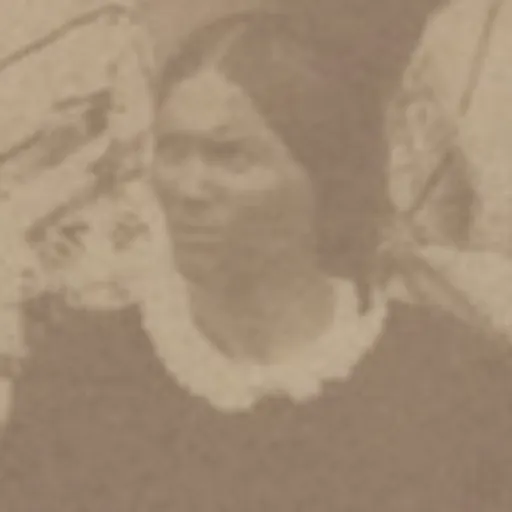
About Rosina Widmann
Lived 1826 – 1908 (aged 82). Rosina Widmann was a German missionary, deaconess and educator.
Rosina Widmann, née Binder, (13 November 1826 – 14 November 1908) was a German educator and Basel missionary-wife who opened a girls’ school at Akropong in pre-colonial Ghana. She was the first exemplar of a European missionary-wife who worked in Ghana for a long period. Some scholars have suggested that her grandparents may have been among the first settlers of Korntal. Upon the recommendation of the Rev. Jakob Heinrich Staudt, the local Lutheran minister and a former lecturer at the Basel Mission Seminary, Binder had been chosen by the Basel Committee of Friends as a potential suitor for J. G. Widmann. Rosina Widmann had sought permission from the then, Okuapemhene, Nana Kwadade I for young girls in his chiefdom to be educated. Per the Basel Mission's newspaper in Akropong, the Station Chronicle, four female pupils enrolled at the new school almost immediately after the request. The number of girls who came to Rosina Widmann's school increased to 70 over time. When the Basel Mission started distributing for the school children, enrollment climbed to 80 or 90 by the end of the 1840s. Attrition was high as many students left within six to twelve months. The school population dwindled further once the mission stopped proving cloth for the enrolled pupils. In the end, only the pupils living in the missionary household remained in the school.
Later years and death Rosina Widmann stayed in Ghana, working for the Basel Mission for three decades and permanently returned to Korntal at the age of 50 in the spring of 1877, a few months after the passing of her husband. The Rev. J. G. Widmann died on 27 November 1876 and his remains were buried in Akropong. At Johann Widmann's funeral service, the chief of the town, the Krontihene attended the ceremony with his entourage of drummers though they remained outside the chapel, in silence, throughout the burial service. The chief's delegation accompanied the funeral procession to the mission cemetery.
Rosina Widmann died on 14 November 1908 in Korntal at the age of eighty-two. Rosina's Widmann's near singular effort in the vocational education of girls at Akropong, without any instructional support from Basel, disproved an earlier assertion made by the Inspector of the Basel Mission, the Rev. Josenhans that “women were a burden for missionary work.”
Don’t just read it —
keep it.
Full-length biographies made to live with: read them, listen on the way to work, watch them tonight.
- E-book
- Audio
- Video
Instant download · yours to keep · every purchase keeps this site free
Important facts
Related people
Same field, nearest in time


Contemporaries
People whose lives overlapped Rosina Widmann's






Frequently asked questions
Who was Rosina Widmann?
German educator and missionary
When was Rosina Widmann born?
Rosina Widmann was born on 13 November 1826 in Korntal-Münchingen.
When did Rosina Widmann die?
Rosina Widmann died on 14 November 1908 in Korntal-Münchingen.
What was Rosina Widmann's occupation?
Rosina Widmann was a missionary, deaconess and educator.
What nationality was Rosina Widmann?
Rosina Widmann was German.
Sources & further reading
Cite this page
APA: Biography.guide. (2026). Rosina Widmann. https://biography.guide/rosina-widmann/
MLA: "Rosina Widmann." Biography.guide, https://biography.guide/rosina-widmann/.
Chicago: "Rosina Widmann." Biography.guide. https://biography.guide/rosina-widmann/.
Data last updated: 2026-09-22 · Spot an error? Report a correction.
Portrait: Wikimedia Commons · author & licence
Page generated 2026-09-27 05:02 UTC